
Norwood, MA
Porch Floor, Steps & Railings in Norwood, MA
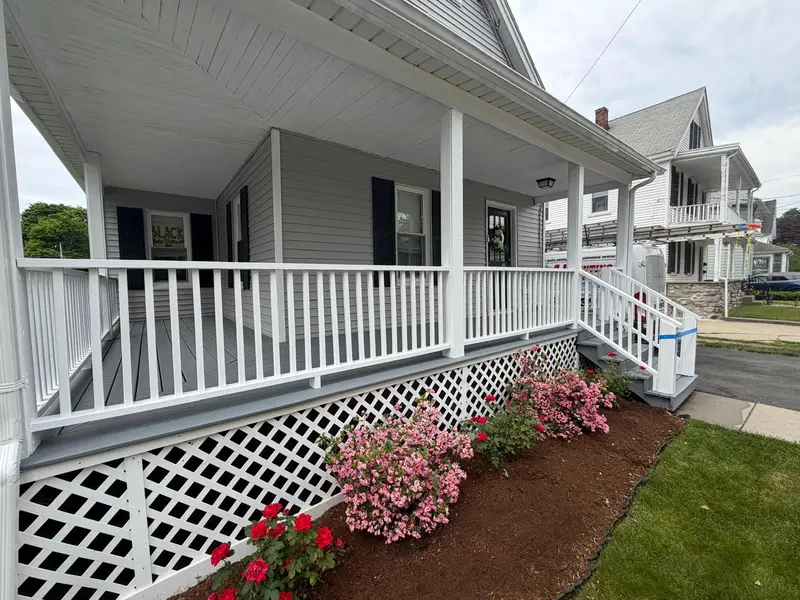
A Norwood home's front and back porches: floor boards and steps painted gray, with railings, balusters and lattice skirting in white.
See the photos →Siding, trim, doors and porches scraped, primed and painted, with the prep matched to what is on the walls and to the age of the house.
Single-family detached houses make up 66.7% of the town's housing units, and the 2021 master plan describes most of them as built in tract subdivisions. The town's preservation plan singles out post-war streets of ranch and Cape Cod houses as a resource type. Low, wide houses like these are easy to reach from a short ladder on most sides, but their long eaves, gable ends and garage faces add up to more trim than the footprint suggests.
The siding on any given house might be original wood clapboard or shingle, or it might be vinyl or aluminum added over the wood decades later. Each takes a different approach, so the first step on an estimate is figuring out which one is there and what condition the layer under it is in.
Census figures put 67.8% of local housing units in the pre-1980 decades, which brackets the 1978 cutoff for the federal lead rule. On those houses, paid scraping or sanding of more than 20 square feet of exterior paint has to be done lead-safe: sheeting spread on the ground, chips collected each day, no open-flame burning, power sanding only with a HEPA-vacuum attachment, and a cleanup check at the end.
Peeling on a wood-sided house of that era is often a sign of many coats building up until they lose grip, or of moisture getting behind the paint. The common exterior paint failures guide shows how to tell those apart, and the lead-safe painting page explains the rules in plain terms.
Only the core of Center Village is inside a local historic district. Town Meeting created it on May 8, 1975, and a Historic District Commission administers the bylaw. The district also overlaps the town's only National Register district, listed in 1980 for its Greek Revival, Italianate and other architecture.
The bylaw and the commission's design guidelines set which exterior changes need its review, and the commission's March 2026 agenda lists those guidelines for review and possible update. If your house is in the district, call the commission before choosing colors or replacing trim. The 2013 preservation plan notes that many historic houses on the residential streets around the village core, such as High and Bridge Streets, are not protected by the district bylaw; boundaries do not follow street names, so confirm by address. The Chelmsford Center page has more on that area.
The master plan describes many streams surrounded by wetlands, plus an urban forest of small woods and yard and street trees between subdivisions. Siding under heavy shade or near wet ground dries slowly after rain, which feeds mildew and shortens paint life on those faces.
Those walls get a mildewcide wash and a full rinse before scraping. Trimming branches back from the walls lets them dry faster after storms, and gutters that overflow onto trim are worth fixing before painting.
The older villages have more ornament. The preservation plan describes Greek Revival and Italianate houses at South Chelmsford's Kate's Corner and near the Eagle Mill in West Chelmsford. Corner boards, cornice returns, bracketed eaves and window hoods take hand scraping and brush work, and rotted pieces should be replaced before primer goes on.
Exterior paint needs surfaces dry and temperatures above the minimum on the can for the hours after application, including overnight. Late spring through early fall gives the widest window; painting in November is possible with the right products and a careful forecast. For how long a good job should hold up, see how long exterior paint lasts in Massachusetts.
| Single-family detached homes | 66.7% of housing units (9,302) (U.S. Census ACS 2020–2024 5-year, table B25024) |
| Built before 1980 | 67.8% of housing units (9,457) (U.S. Census ACS 2020–2024 5-year, table B25034) |
| Chelmsford Center local historic district | Created by Town Meeting, May 8, 1975; administered by the Historic District Commission (Chelmsford Historical Society, Parkhurst column (1986)) |
| National Register district | Chelmsford Center Historic District, listed 1980; Greek Revival, Italianate and other styles (National Park Service NPGallery, NRHP record 80000646) |
These jobs were in other towns, not in Chelmsford. Each card names the town where the work was done.
A Norwood home's front and back porches: floor boards and steps painted gray, with railings, balusters and lattice skirting in white.
See the photos →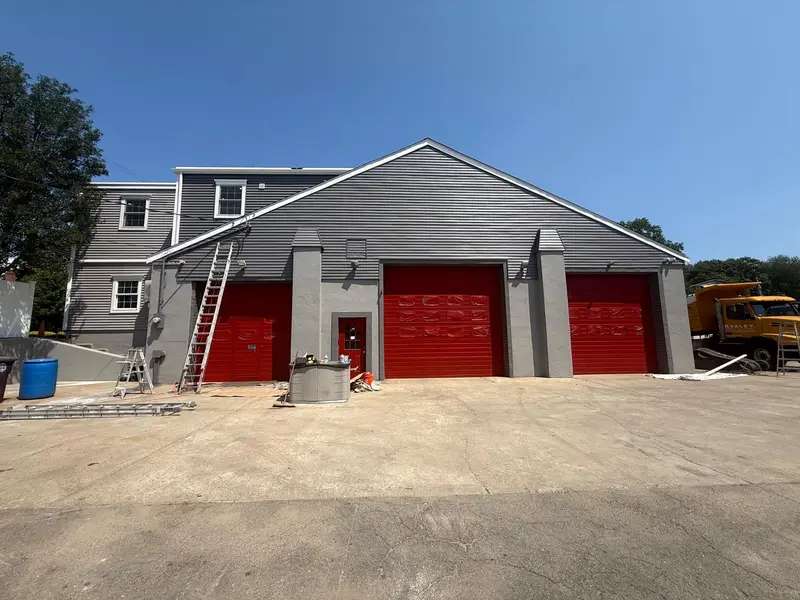
A garage building in Weymouth with white overhead doors and masonry pilasters whose paint was peeling. The doors and service doors were painted red and the pilasters refinished in gray.
See the photos →The local district covers only the core of Center Village. Ask the Historic District Commission or the town's planning office to confirm for your address, and ask at the same time what exterior changes need its review.
Yes. Aluminum gets washed to remove the chalk, any bare spots are primed with a metal primer, and an exterior acrylic goes on top. Dents and loose panels should be dealt with first since paint will not hide them.
It can be, with a paint labeled vinyl-safe. Going much darker than the original color can make vinyl absorb enough heat to warp, so paint makers publish limits on how dark you can go.
Shade and slow drying. That wall stays damp longest after rain and dew, so moisture works behind the paint. Cleaning off mildew, scraping to sound paint, priming bare wood and letting more sun in will help.
Often, yes. The limit is overnight temperatures and dew, not the date. Work shifts to midday hours and sunny walls, and the products used need to be rated for the low end of the forecast.
House size and height, siding type, how much loose paint must come off, lead-safe setup and carpentry repairs set the price. The Massachusetts exterior painting cost guide shows market data; AJ Painting gives its own figure in writing after a free on-site look.
Call AJ Painting at (508) 258-4325, Mon–Sat 7AM–6PM, to book a free visit and get a written estimate. Licensed and insured.
5.0 on Google · 35 verified reviews · Licensed & insured · Written quote in 48h