
Norwood, MA
Porch Floor, Steps & Railings in Norwood, MA
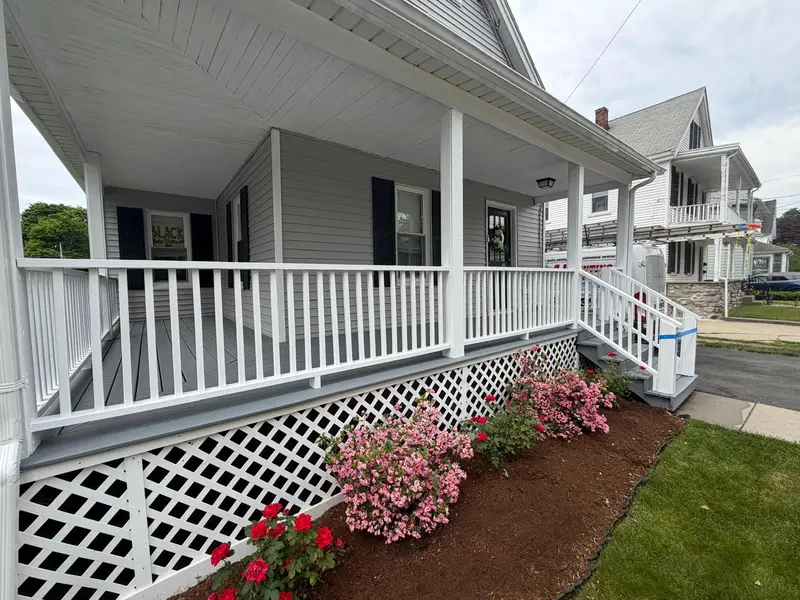
A Norwood home's front and back porches: floor boards and steps painted gray, with railings, balusters and lattice skirting in white.
See the photos →Deck cleaning, repair checks and stain or paint for decks, stairs and railings behind Ashland homes, with the finish chosen for how much shade and moisture each yard gets.
A deck floor is the hardest-working wood surface on a house. It holds snow for weeks, collects pine needles and leaf mold, and bakes in the summer sun. Expecting a deck stain to last as long as house paint leads to disappointment; the realistic aim is a finish that wears evenly and can be refreshed without stripping.
Single-family detached homes make up about 56% of the town's housing. The town's plan describes rapid suburbanization with large-scale subdivision development in the late twentieth century, and the population nearly doubled between 1980 and 2020. A deck original to a house from that period has been through decades of freeze-thaw cycles, so its framing deserves a look along with its finish.
Close to half of the town's land is open space, including Warren Woods, the Town Forest and the state parks, and some house lots back up to that tree cover. A deck under a canopy stays damp, grows black mildew and green algae, and softens at the board ends. On these decks the cleaning step matters as much as the stain: an oxygenated or sodium-percarbonate cleaner, a scrub, a thorough rinse, and a brightener to restore the wood's pH. The stain itself should include a mildewcide, and an annual wash in spring keeps growth from rooting into the finish.
Decks on lots near ponds and wetlands in the Sudbury River watershed face similar moisture. Good drainage under the deck and clear gaps between boards help any finish last longer.
Newer subdivision lots cleared for construction may have little shade, and there the enemy is UV. Clear sealers and very light toners gray out within a season. A semi-transparent stain with more pigment, or a solid stain on older boards that have already checked and split, gives far better protection on a south- or west-facing deck.
Mixing finish types is the most common cause of peeling deck stain. Before recommending a product, the existing coating is tested with water and a scrape so the new finish is compatible with what is already in the wood.
Each deck is walked for soft boards, raised fasteners, wobbly railings and rot at the ledger or post bases. Stain is cosmetic and protective, not structural, and those repairs belong to a carpenter before coating. Railings and balusters are finished first, then the floor in full-length runs to avoid lap marks. Attached townhouses make up about 15% of the housing here; if yours belongs to an association, confirm whether it sets an approved stain color before work begins. Our article on deck stain and New England winters has more on seasonal care, and the exterior painting page covers the house itself.
| Single-family detached homes | About 55.6% of housing units (U.S. Census ACS 2020–2024 5-year, table B25024) |
| Open space | Nearly half of town land (about 25% of total area protected) (Envision Ashland Comprehensive Plan 2025–2035) |
| Population growth | Nearly doubled 1980–2020, to 18,832 residents (Envision Ashland Comprehensive Plan 2025–2035) |
| Homes built 1980–1999 | About 32.5% of housing units (U.S. Census ACS 2020–2024 5-year, table B25034) |
These jobs were in other towns, not in Ashland. Each card names the town where the work was done.
A Norwood home's front and back porches: floor boards and steps painted gray, with railings, balusters and lattice skirting in white.
See the photos →Shade and leaf litter keep the boards wet. A proper cleaning with an oxygen-based cleaner and brightener, a stain that contains a mildewcide, regular sweeping, and a light wash each spring all slow regrowth. Trimming limbs to let in some sun helps more than any product.
Floors in full sun often need a maintenance coat every two to three years; railings and shaded vertical parts last longer. Solid stains last longer than semi-transparent ones but can peel when they fail, while penetrating stains fade gradually and are easier to recoat.
Wait until the wood has dried enough to absorb water. Sprinkle some on the boards: if it beads, give it more time. Depending on the lumber and the season this can be a few weeks to several months. Staining too early traps moisture and the finish fails.
Late spring and early fall are ideal, with dry days, mild temperatures and no rain in the forecast for at least a day. Avoid staining in direct midday summer sun, which dries the stain before it soaks in, and leave enough season for the boards to dry after cleaning.
Board condition, railing count, stairs and whether old finish must be stripped matter more than square footage alone. AJ Painting does not publish prices; see the Massachusetts ranges on our deck staining cost page, then get a free written estimate after an on-site look.
It can, with a porch-and-floor or deck-specific coating, but paint forms a film that peels when water gets under it, and on a horizontal deck that happens sooner than on siding. Solid stain is a middle ground that hides the wood while staying thinner and easier to maintain.
AJ Painting is licensed, insured and based in Ashland. Call (508) 258-4325 for a free on-site look and a written estimate for cleaning and staining.
5.0 on Google · 35 verified reviews · Licensed & insured · Written quote in 48h