
Norwood, MA
Porch Floor, Steps & Railings in Norwood, MA
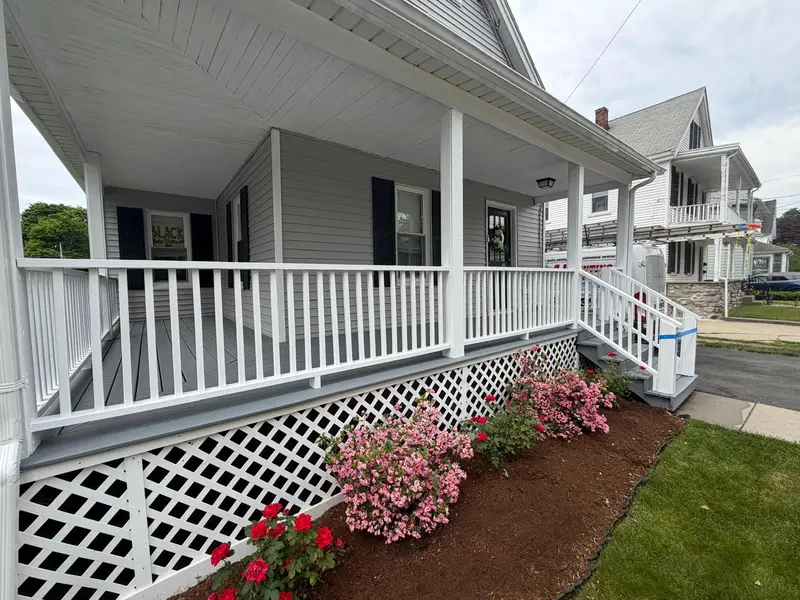
A Norwood home's front and back porches: floor boards and steps painted gray, with railings, balusters and lattice skirting in white.
See the photos →Worcester's airport weather station, about 1,000 feet up, logs long winters and near-freezing November nights. We plan siding, trim and porch work around that calendar and around the city's historic rules.
The weather station at Worcester Regional Airport records about 72.9 inches of snow and just over 48 inches of total precipitation in a normal year, with roughly 130 nights at or below freezing. With that much water and that many freeze-thaw cycles, moisture is the main thing working against exterior paint. Failures start where water sits: the bottoms of clapboards, window sills, porch rails, and the end grain of corner boards.
A durable exterior job in this climate is mostly about detail work at those spots. Scraping to sound paint, priming bare wood the same day, caulking the right joints (and leaving the laps open so siding can breathe), and replacing rotted sill noses before they spread are what make the topcoat last.
The city's three-deckers went up between about 1880 and 1930, the early ones as wood frames on brick foundations with clapboard siding, later ones often adding decorative shingle bands. The federal survey of those buildings found that most of them were later wrapped in aluminum or vinyl, which often covered window casings and stripped trim along the way.
That leaves three very different exterior types on the same street, each needing its own approach:
Worcester has four Local Historic Districts: Crown Hill, Elm Park Neighborhood, Montvale and Massachusetts Avenue. In Crown Hill, Montvale and Mass Ave, the Worcester Historical Commission reviews paint color, so a new scheme needs its sign-off before work starts. The Elm Park ordinance is different: it specifically leaves paint color out of review. Work that will not change design, color or outward appearance is handled with a Certificate of Non-Applicability instead of full review, so a same-color repaint is a simpler path; confirm with the commission before you start.
Removing original siding, porches or windows is a bigger matter. On buildings listed on the National or State Register, or on the commission's eligible list, that kind of work can fall under the city's one-year demolition delay. If your project includes replacing rotted clapboard, check the property in MACRIS first. The commission's guidance favors repairing wood clapboard or, if it must go, using fiber cement rather than vinyl. Homeowners in Elm Park can read more on that page.
Normal overnight lows at the airport are about 47°F in May, 53°F in September, 42°F in October and 33°F in November. Most acrylic paints need surface and air temperatures above roughly 35 to 50°F (depending on the product) during application and for the hours after, and dew on cold mornings delays starts. Practically, late spring through September is the dependable window, early October is possible on south and west walls, and November is a gamble.
Because of that, it pays to get an estimate and a start date settled in late winter. Our post on the best time of year to paint covers the season in more detail.
With the city counting 61,311 housing units built before 1978, original exterior wood on an older house should be treated as if lead is somewhere in its paint history until testing says otherwise. Federal rules call for lead-safe practices once more than 20 square feet of exterior paint is disturbed on a pre-1978 home: ground tarps, no open-flame burning, no uncontrolled power sanding, and daily cleanup. On densely built three-decker blocks such as those on Grafton Hill, the next yard is only a few steps away, so containment matters. Older three-decker areas like Vernon Hill and Main South have their own neighborhood pages. See our lead-safe painting page.
| Average annual snowfall (Worcester Regional Airport) | 72.9 inches (NOAA NCEI U.S. Climate Normals 1991–2020) |
| Normal October / November overnight low | 42.2°F / 32.5°F (NOAA NCEI Monthly Normals 1991–2020) |
| Local Historic Districts | 4 (color reviewed in 3 of them) (Worcester Historical Commission ordinance) |
| Three-decker construction era | c. 1880–1930; early examples wood frame with clapboard (NPS National Register nomination, Worcester Three-Deckers MRA) |
| Lead-safe threshold, exterior | More than 20 sq ft disturbed (pre-1978 homes) (U.S. EPA RRP Program) |
These jobs were in other towns, not in Worcester. Each card names the town where the work was done.
A Norwood home's front and back porches: floor boards and steps painted gray, with railings, balusters and lattice skirting in white.
See the photos →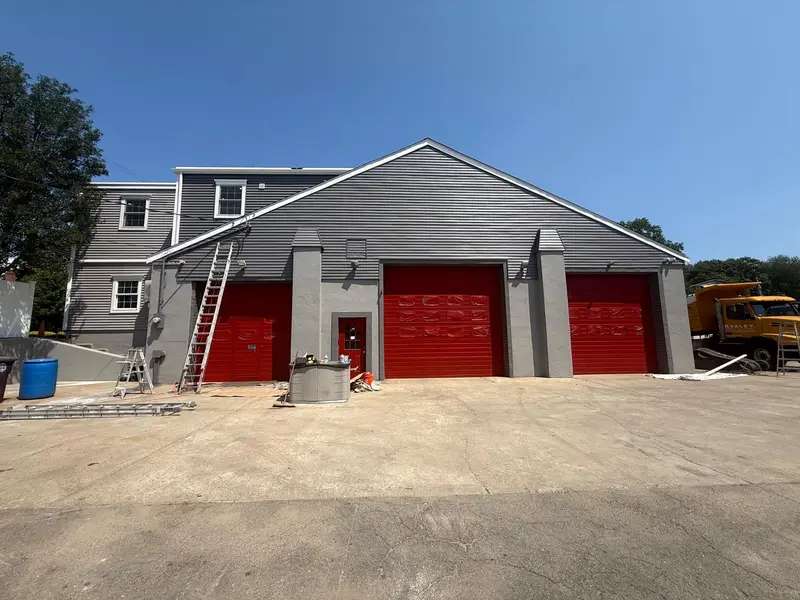
A garage building in Weymouth with white overhead doors and masonry pilasters whose paint was peeling. The doors and service doors were painted red and the pilasters refinished in gray.
See the photos →Only if it is in the Crown Hill, Montvale or Massachusetts Avenue Local Historic District, where the Worcester Historical Commission reviews color. The Elm Park Neighborhood district excludes paint color from review. Outside those four districts, the Historical Commission does not review paint color, though a condo association or deed restriction might.
Painting usually works well if the panels are straight and secure. The chalky oxidation has to be washed off completely, and any bare metal primed. A quality acrylic made for metal then bonds well and can make dented-but-sound siding look much better for far less than replacement.
Late winter or early spring, for work between May and September. Overnight lows drop into the low 40s in October and near freezing in November, which shortens the day's working window and slows curing.
Horizontal porch parts hold water and snow, and many have been painted over failing layers repeatedly. Lasting results usually take scraping back to sound paint, replacing soft wood, priming end grain and keeping a gap where posts meet the floor so water can drain.
On a listed or eligible historic building, removing original siding can trigger the city's one-year demolition delay, and the Historical Commission recommends repairing clapboard or using fiber cement instead. For any house, replacing just the rotted boards in wood and painting them keeps the original look.
Scraping time, lead-safe setup, height, and carpentry repairs move the number more than wall area. Our exterior painting cost guide shows Massachusetts market ranges and what pushes a job up or down.
We'll walk the house, note repairs and historic-district steps, and give you a written estimate. Call (508) 258-4325.
5.0 on Google · 35 verified reviews · Licensed & insured · Written quote in 48h