
Norwood, MA
Porch Floor, Steps & Railings in Norwood, MA
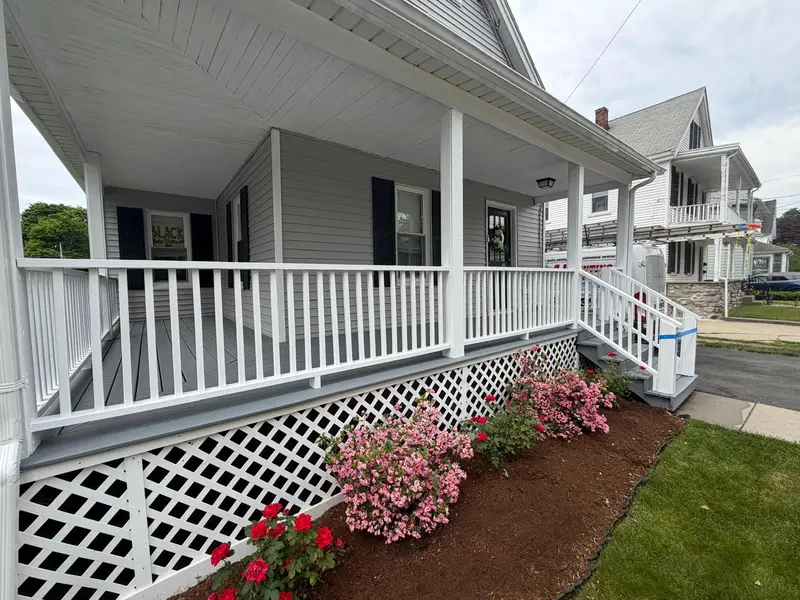
A Norwood home's front and back porches: floor boards and steps painted gray, with railings, balusters and lattice skirting in white.
See the photos →Deck boards, rails, stairs and porch floors cleaned, repaired where soft, and finished with a stain or coating suited to the wood and the old finish.
According to the 2021 master plan, single-family homes take up 56% of the town's land, and most were built in tract subdivisions. A deck on one of those lots gets far harder treatment than the house walls beside it. Snow sits on it, rain collects in checks, and summer sun hits the flat face all day.
A deck's age and lumber have no fixed link to the house it is attached to, so an estimate starts on the boards themselves: what wood they are, what is on them now, and which ones are still sound.
The master plan describes an urban forest of small woods, yard trees and street trees filling the spaces between subdivisions, along with many streams edged by wetlands. A deck under that canopy dries slowly after rain, collects leaves and pine needles in the gaps between boards, and grows mildew and algae in the shade.
Leaves left on boards stain them with tannins, and packed debris in the gaps holds water against the joists. Before staining, the deck is cleaned with a wood cleaner, the gaps are cleared, and a brightener restores the wood's surface. On shaded decks a finish with mildewcide helps, though cleaning once a year still does more than any product.
Rails and balusters wear much more slowly than walking surfaces, so one option is solid stain on the rails and semi-transparent on the floor, which lets each part be recoated on its own schedule. The paint vs. stain comparison goes further, and deck stain through a New England winter explains why floors fail first.
Single-family attached homes make up 8.0% of local housing units. Where townhouses share a row of decks, the master deed may treat each deck as a limited common area, with colors and upkeep set by the association. Check the rules before choosing a stain; the condo painting page covers association paperwork.
About 15.0% of units date from 1939 or earlier, and the preservation plan records 19th-century houses around the Chelmsford Center common and in North Chelmsford. Where an older house has an open porch with painted floors, steps and columns, those surfaces stay painted with a porch and floor enamel rather than switching to stain. On a house built before 1978, scraping more than 20 square feet of exterior paint falls under the EPA's lead-safe rule; see the lead-safe painting page.
Probe the bottom stair tread, the stringers and the boards at the house wall with a screwdriver. Soft wood gets replaced before staining, because a coating does not stop rot. Stain wants dry wood, a few dry days ahead, and application in shade or early in the day so it soaks in instead of drying on top. If the house is also being painted, the deck goes last; the exterior painting page covers the house side.
| Land used for single-family homes | 56% of the town's land; most homes in tract subdivisions (Town of Chelmsford Master Plan (2021), Residential Land Uses) |
| Tree cover and wetlands | An urban forest of small woods and yard and street trees between subdivisions; many streams bordered by wetlands (Town of Chelmsford Master Plan (2021), Natural Resources) |
| Single-family attached units | 8.0% of housing units (1,114) (U.S. Census ACS 2020–2024 5-year, table B25024) |
| Built 1939 or earlier | 15.0% of housing units (2,096) (U.S. Census ACS 2020–2024 5-year, table B25034) |
These jobs were in other towns, not in Chelmsford. Each card names the town where the work was done.
A Norwood home's front and back porches: floor boards and steps painted gray, with railings, balusters and lattice skirting in white.
See the photos →Mostly. An oxalic-acid brightener lifts tannin stains from leaves and acorns. Deep stains may stay faint, and a slightly darker or more opaque stain hides what remains.
Once it has dried enough that sprinkled water soaks in instead of beading. That can take weeks to months depending on the lumber and the weather. Staining too early traps moisture and the stain fails.
No product suits wet ground by itself, but a penetrating stain with mildewcide holds up better than a thick film on a deck that stays damp. Clear gaps and good airflow under the deck help the boards dry.
Only after stripping to bare wood, which is slow and, on older painted porches, may involve lead. For most painted decks, recoating with a solid stain or deck paint is more practical.
Read the written rule. Many associations that let owners stain still list approved colors so the row matches. Get the approval in writing before work starts.
Square footage, the number of rails and stairs, how much old coating must come off, and board repairs. The Massachusetts deck staining cost guide has market data, and AJ Painting puts its price in a written estimate after a free on-site look.
Call AJ Painting at (508) 258-4325, Mon–Sat 7AM–6PM, for a free visit and a written estimate. Licensed and insured.
5.0 on Google · 35 verified reviews · Licensed & insured · Written quote in 48h