
Newton, MA
Kitchen Cabinet Painting in Newton, MA
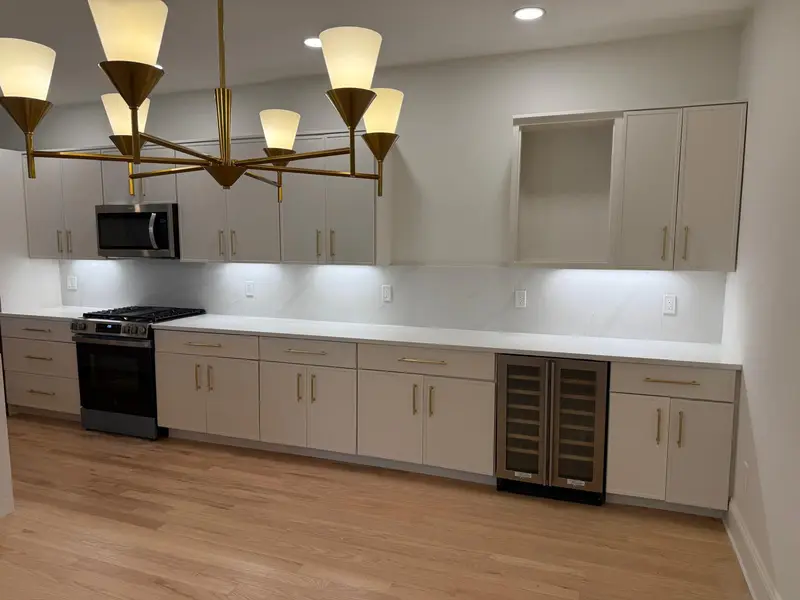
A Newton kitchen with a long run of cabinets and a peninsula. The doors came off, the boxes were painted in place, and the finished kitchen has white cabinets with brass pulls.
See the photos →Kitchen and bath cabinets, pantries and built-ins in Newton homes, cleaned, sanded, primed and sprayed with a hard enamel so they wear like a factory finish.
Kitchens here sit in houses of very different ages. The housing stock runs heavily to homes from 1939 or earlier, with a second large group from the 1950s and a smaller wave of houses built since 2000. A kitchen in a house that old has very likely been redone at least once, and cabinets from a remodel twenty or thirty years ago are often sound enough to paint rather than tear out.
Before suggesting anything, we open doors, look at the edges and the inside of the boxes, and check what finish is on them. Solid wood, veneer over plywood, MDF and thermofoil each take paint differently, and one of them does not take it well at all.
Glass-front cupboards between a kitchen and dining room, linen closets with drawers, and pantry shelving survive in many older homes even after the main kitchen has been redone. They are worth keeping, and they are usually painted wood with a long history of coats.
In housing from before 1978, sanding those layers is lead work. Massachusetts requires lead-safe renovation practices for paid work that disturbs more than six square feet of painted surface in a room, and a full pantry or a run of built-ins passes that easily. We contain the area, sand with HEPA extraction or use wet methods, and clean to a verified standard. Our lead-safe painting page explains the process in more detail.
With the median owner-occupied home here valued around $1.26 million, people sometimes assume the answer is always a new kitchen. Often it is not. If the boxes are plywood, square and dry, and the layout works, painting gives a new look for a fraction of the disruption, and the countertops and plumbing stay put.
Replacement makes sense when boxes are particleboard swollen from leaks, when doors are thermofoil that is lifting, or when you want to change the layout anyway. Our article on cabinet painting vs. replacement goes through the trade-offs, including how long a painted finish lasts in a busy kitchen.
Doors and drawer fronts come off and are labeled so every piece goes back where it was. We degrease everything, because cooking residue is the main reason cabinet paint fails, then scuff-sand and prime with a primer chosen for the existing finish. Doors are sprayed in a controlled area; the boxes are sprayed or brushed and rolled in place with the kitchen masked off.
The topcoat is a hard-curing enamel made for cabinets rather than ordinary wall paint. It feels dry within hours but needs days to cure fully, so we reinstall carefully and ask you to go easy on the doors for the first week or two. Our cabinet painting process post has the step-by-step.
With seven in ten homes here lived in by their owners, a cabinet job often means working around a household that still needs to cook. We plan the sequence so the sink and at least part of the counter stay usable, and we keep the spraying and drying of doors out of the kitchen. If you are repainting the walls at the same time, the interior painting page for Newton covers that side of the work.
| Housing built 1939 or earlier | 48.8% of units (U.S. Census ACS 2020–2024 5-year, table B25034) |
| Housing built 1950–1959 | 12.0% of units, the second-largest decade (U.S. Census ACS 2020–2024 5-year, table B25034) |
| Housing built 2000 or later | About 11.8% of units (U.S. Census ACS 2020–2024 5-year, table B25034) |
| Median value, owner-occupied homes | $1,264,900 (U.S. Census ACS 2020–2024 5-year, table B25077) |
A Newton kitchen with a long run of cabinets and a peninsula. The doors came off, the boxes were painted in place, and the finished kitchen has white cabinets with brass pulls.
See the photos →Oak has deep, open pores, and paint alone will telegraph them. If you want a smooth, modern look, we apply a grain filler before priming. If a little texture is fine, we skip that step and save time. We can show you a sample door both ways.
Yes. Built-ins like that are usually painted wood with many old coats. In a pre-1978 house we treat sanding them as lead work, contain the room, and take care around the glass, hinges and latches. Hardware can be cleaned and reused.
The boxes are usually done in a few working days, with doors finished off site or in a separate area. Cure time is the longer part: the paint keeps hardening for a couple of weeks, so you can use the kitchen but should treat the doors gently at first.
Not reliably. If the foil is intact we can sometimes prime it with a specialty bonding primer, but once it starts peeling at the edges, paint will fail with it. New doors on the existing boxes are often the better fix.
Painting usually costs well under new cabinetry because the boxes, counters and plumbing stay in place, but the gap depends on door count and condition. Our cabinet painting cost guide summarizes Massachusetts market ranges, and we follow up with a written estimate for your kitchen.
No. Newton's historic district commissions review exterior changes. Cabinets, pantries and other interior work are outside their scope.
We check the cabinet material and current finish, then write up a clear plan and estimate. Free on-site visit; call (508) 258-4325, Monday to Saturday.
5.0 on Google · 35 verified reviews · Licensed & insured · Written quote in 48h