
Newton, MA
Kitchen Cabinet Painting in Newton, MA
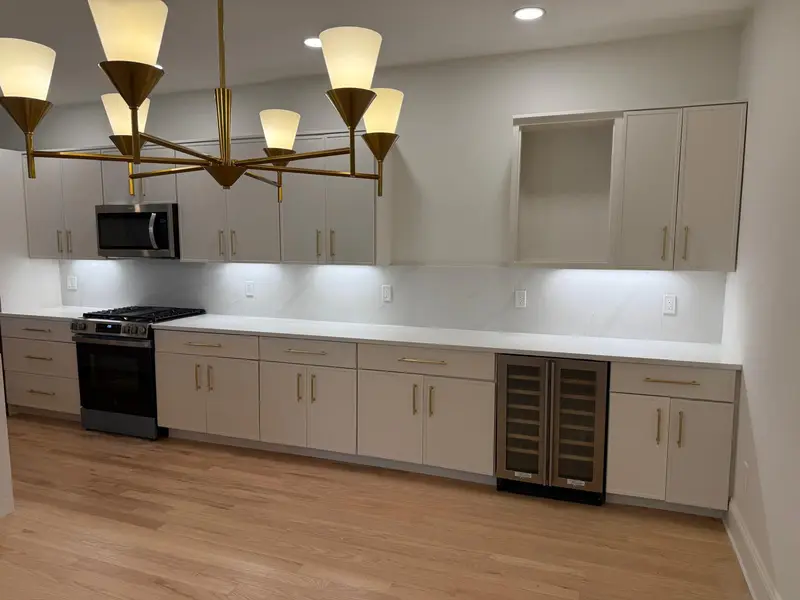
A Newton kitchen with a long run of cabinets and a peninsula. The doors came off, the boxes were painted in place, and the finished kitchen has white cabinets with brass pulls.
See the photos →Walls, ceilings, trim and doors in Newton houses, about half of which were built by 1939, prepared with the plaster and lead-paint realities of an older home in mind.
The median house in this city was built around 1942, and nearly half of all homes date to 1939 or earlier. That changes what an interior paint job involves. Rooms of that age were typically finished in plaster over lath rather than drywall, and under the current color there can be many decades of earlier coats, some of them oil and some likely lead-based.
A fresh coat on those rooms looks good for about as long as the surface underneath holds together. Most of the effort on an interior job here goes into finding hairline cracks, loose plaster keys and failing old layers before anyone opens a can of finish paint.
Old plaster is hard, dense and quiet, and worth keeping. It also moves with the seasons. Ceiling cracks that run along the lath lines, bulges near a stair, and spiderweb cracking around door headers are common in prewar rooms. Paint alone will not hold those together.
We tap and press suspect areas to see whether plaster has let go of the lath. Sound cracks get opened, taped with mesh and filled with setting compound; loose sections are reattached with plaster washers before patching. Ceilings with many old coats sometimes show alligatoring or peeling where a later latex went over oil without a bonding primer, and those areas need scraping and priming rather than another topcoat.
If your house also has a newer addition finished in drywall, the two surfaces take paint differently. We prime patches and new board separately so the sheen matches from the old room into the new one.
About 80% of the city's housing was built before 1980, and lead paint was not banned for residential use until 1978. In a house that old, we treat sanding, scraping and paint removal on original surfaces as lead work until a test says otherwise.
Massachusetts sets a clear line: paid work in pre-1978 housing that disturbs more than six square feet of painted surface in a room must be done under lead-safe renovation rules, with a certified supervisor on site. In practice, that means plastic sheeting sealed to the floor and doorways, misting instead of dry sanding, HEPA vacuums, and a cleaning check before the room goes back into use. Our lead-safe painting page walks through the steps and what to expect if you have young children at home.
Newton's housing came in waves. The largest is the prewar stock, and the second largest is the 1950s, when about one in eight of today's homes was built. Each era has its own woodwork. Prewar houses often have wide, layered casings, picture rail and paneled doors with heavy buildup in the corners. Fifties houses tend toward flatter, simpler trim, often painted from the start, and sometimes slab doors.
Heavy buildup is the main issue on older trim. When detail has been softened by layers, careful scraping and feathering of failed areas brings back some crispness, but full stripping of original trim in a pre-1978 house is a bigger, lead-regulated job we would discuss with you separately. For most rooms, a good bonding primer and a durable enamel are the right answer.
Seven in ten homes here are lived in by their owners, and many interior jobs happen with the family still at home. We work room by room so bedrooms and the kitchen are back in use at the end of the day whenever the scope allows.
Two-family houses make up roughly 15% of the city's housing units. If you own one and live upstairs while a tenant is downstairs, interior work in either unit means notice, access times and keeping shared stairs clear and clean.
Planning the outside too? The exterior painting page for Newton covers siding, trim and historic-district questions.
| Median year housing built | 1942 (U.S. Census ACS 2020–2024 5-year, table B25035) |
| Housing built 1939 or earlier | 48.8% of units (U.S. Census ACS 2020–2024 5-year, table B25034) |
| Housing built before 1980 | About 80% of units (U.S. Census ACS 2020–2024 5-year, table B25034) |
| Lead-safe threshold, interior | More than 6 sq ft of painted surface disturbed per room (Mass.gov, Lead-safe renovation for homeowners) |
| Owner-occupied homes | 70.0% of occupied units (U.S. Census ACS 2020–2024 5-year, table B25003) |
A Newton kitchen with a long run of cabinets and a peninsula. The doors came off, the boxes were painted in place, and the finished kitchen has white cabinets with brass pulls.
See the photos →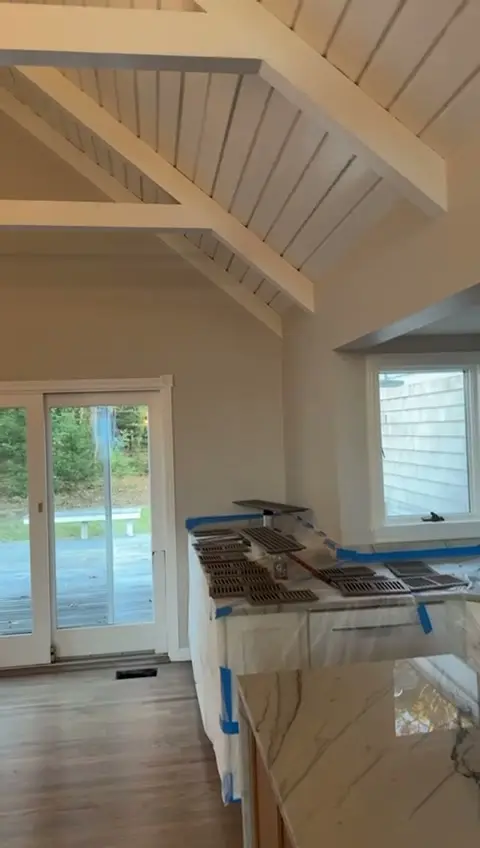
A home in Mashpee on Cape Cod with light gray walls, white trim and doors, and a vaulted plank ceiling with exposed beams finished in white.
See the video →Painting over them only hides the cracks for a season or two. Cracks that follow the lath usually mean the plaster is moving or has lost some grip. We check whether it is still attached, reattach loose areas, tape and fill with setting compound, then prime. That is what keeps the cracks from reappearing through the new paint.
It is reasonable to assume the original trim, windows and older wall coats contain lead. A test can confirm it, but either way, any paid prep that disturbs more than six square feet in a room must follow Massachusetts lead-safe rules. If the job is just a repaint over sound, intact surfaces with minimal sanding, the disturbance is much smaller. We explain which applies after seeing the rooms.
No. Newton's local historic district commissions review exterior changes visible from a public way. Interior painting, including color changes, falls outside their review.
Yes. We schedule around the other household, keep shared halls and stairs protected and clear, and if the building predates 1978 we contain dust so it does not travel into the other unit. Tell us who lives where and we will plan the access.
Plaster repair and lead-safe prep can add more than the paint itself, so room count alone is a poor guide. Our interior painting cost guide shows Massachusetts market ranges and what pushes a job up or down. After walking through your rooms we give you a written estimate with the repair work itemized.
That is your call, and it is hard to undo. Stained woodwork in prewar rooms is often original and can be cleaned and refreshed instead. If it is already painted, keeping it painted is usually the practical route. We can show you both options on a test area.
We walk the rooms, check the plaster and older layers, and put the repair and painting scope in a written estimate. Call (508) 258-4325, Monday to Saturday, 7AM to 6PM.
5.0 on Google · 35 verified reviews · Licensed & insured · Written quote in 48h