
Newton, MA
Kitchen Cabinet Painting in Newton, MA
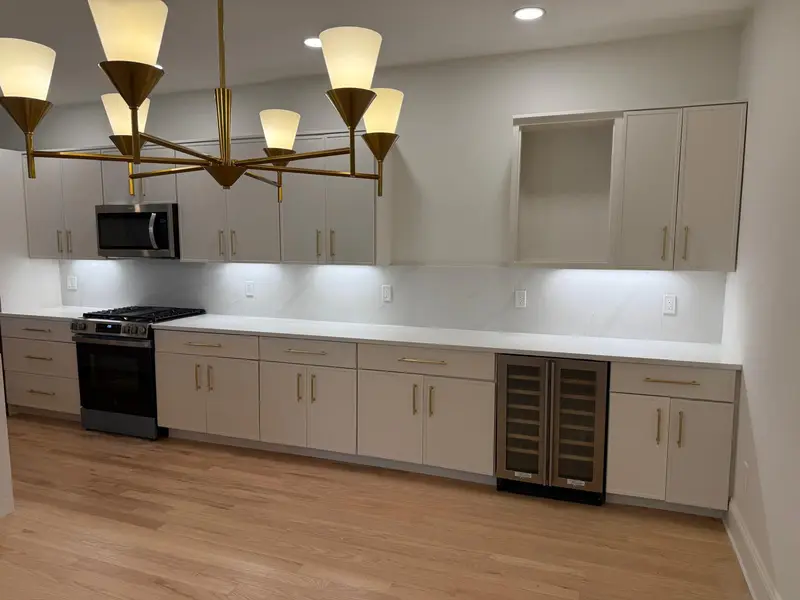
A Newton kitchen with a long run of cabinets and a peninsula. The doors came off, the boxes were painted in place, and the finished kitchen has white cabinets with brass pulls.
See the photos →Stain and paint for decks, porch floors, stairs and railings on Newton properties, with the finish chosen for how much shade, leaf litter and foot traffic each one gets.
Outdoor floors in this city fall into two groups. One is the backyard deck, typically pressure-treated pine or cedar and often added long after the house itself. The other is the original painted porch: tongue-and-groove floor boards, turned posts and balustrades on houses from before the Second World War, which make up close to half of the local housing. They need different products, and mixing up the two is a quick way to get a finish that fails early.
Over half of homes here are single-family detached houses, and another 15% or so are two-family houses. So alongside private yards with their own decks, some properties have a back porch or set of stairs shared by two households, where one finish has to stand up to both.
The city counted about 20,000 street trees in 2017, close to 80% of them Norway maples. Norway maples cast dense shade and drop seeds, sap and a heavy layer of leaves each fall. A deck under that canopy dries slowly after rain, grows green algae and black mildew, and collects debris between the boards where rot starts.
For a shaded deck, we lean toward a penetrating stain with a mildewcide and a darker, more pigmented tone that hides staining from leaves. We also recommend clearing the gaps between boards each fall and washing the surface each spring. A deck that dries faster lasts longer, whatever finish is on it.
Penetrating semi-transparent stains soak into the wood and wear away gradually, so a maintenance coat goes on without stripping. Solid stains and paints cover more and hide mismatched boards, but they form a film that can peel and later needs scraping. On a horizontal surface under snow, that difference matters.
Our paint vs. stain comparison goes through the choice in detail, and the post on deck stain in New England winters explains why decks wear out faster than siding.
A front porch on a prewar Queen Anne or Colonial Revival is part of the house, not an add-on, and its floor and railings are almost always painted. Those surfaces get a porch-and-floor enamel, not a deck stain. Porch ceilings, column bases and the lowest step take the most water and need checking for soft wood before they are painted.
Old porch paint frequently contains lead. Scraping more than 20 square feet of painted exterior surface on a pre-1978 house for pay falls under the state's lead-safe renovation rules, which a full porch floor and railing easily exceeds. We follow those rules as described on our lead-safe painting page.
If the porch is on a house inside a local historic district, repainting it does not need a certificate under the city's design guidelines. Replacing balusters, posts or floor boards with different materials is reviewed, so stick to in-kind repairs and ask the commission staff if you are unsure.
We begin with a walk-over for loose boards, raised fasteners, soft spots and wobbly rails, and we flag anything that needs a carpenter before coating it. Cleaning follows, with stripping where an old film finish is failing and a brightener on stripped wood. Once the wood is dry, we sand fuzzed grain, coat rails, balusters and stair stringers first, and finish the floor boards board-length by board-length so lap marks do not show.
If your project also includes the body of the house, the exterior painting page for Newton covers siding, trim and historic-district questions. Village pages such as Oak Hill and Newton Lower Falls have more about their own housing.
| Street trees (2017) | About 20,000, close to 80% Norway maple (Massachusetts Municipal Association (May 2017)) |
| Single-family detached homes | 54.8% of housing units (U.S. Census ACS 2020–2024 5-year, table B25024) |
| Two-family houses | 15.5% of housing units (U.S. Census ACS 2020–2024 5-year, table B25024) |
| Lead-safe threshold, exterior | More than 20 sq ft of painted surface disturbed (Mass.gov, Lead-safe renovation for homeowners) |
A Newton kitchen with a long run of cabinets and a peninsula. The doors came off, the boxes were painted in place, and the finished kitchen has white cabinets with brass pulls.
See the photos →
A Norwood home's front and back porches: floor boards and steps painted gray, with railings, balusters and lattice skirting in white.
See the photos →Stain helps, but the slipperiness is algae and mildew growing on wood that stays damp. A thorough cleaning, a stain with mildewcide, and keeping leaves and seeds swept off in fall do more together than any single product. Thinning low branches so the boards can dry also makes a real difference.
Yes. We coordinate with both households, finish the upper level first so drips do not land on fresh work below, and keep at least one stair route usable while coatings dry. If the porches are original painted wood, we use lead-safe prep.
Usually not. A porch floor that has been painted for decades needs porch-and-floor enamel over a sound, primed surface. Stain cannot soak into wood that is already sealed with paint and will wear off quickly.
Under Newton's design guidelines, repainting needs no certificate, and changes not visible from a public way are handled with a simpler certificate of non-applicability. Restaining an existing backyard deck is maintenance. Rebuilding or changing a visible porch is a different matter and should go to the commission.
The biggest variables are deck size, the length of railings and balusters, and whether a peeling film finish has to be stripped. Our deck staining cost guide lays out Massachusetts market data. We give you a written estimate after seeing the deck.
Late spring through early fall, on dry days with mild temperatures. After the leaves drop, we often recommend a cleaning and waiting until spring, when the wood is dry and there is a full season ahead.
We inspect the boards, identify the current coating and recommend stain or paint in a written estimate. Call (508) 258-4325, Monday to Saturday.
5.0 on Google · 35 verified reviews · Licensed & insured · Written quote in 48h