
Norwood, MA
Porch Floor, Steps & Railings in Norwood, MA
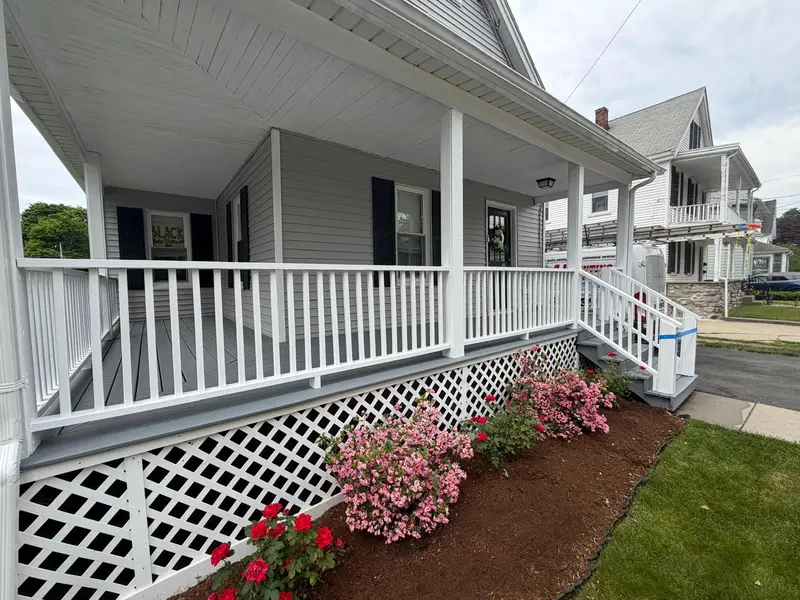
A Norwood home's front and back porches: floor boards and steps painted gray, with railings, balusters and lattice skirting in white.
See the photos →Siding, trim, doors and porches scraped, repaired and repainted, with the prep matched to the age of the house and any historic-district review checked before work starts.
Exterior paint in this town goes onto a wide range of buildings. The Massachusetts Historical Commission's 1980 survey describes Colonial-period houses that are mostly two stories with a central chimney and a center entrance, major Federal examples with hip roofs along Central Avenue, and a wave of estate building from the 1870s onward in Queen Anne, Colonial Revival and Craftsman styles. Between 1915 and 1940, large Colonial Revival houses made up the biggest share of new construction. The census adds the modern picture: the median home was built in 1964, and 1,130 units date from the 1950s and 1960s alone.
Each of those generations asks something different of a paint job. A two-century-old clapboard wall may carry many layers of oil paint over old-growth wood, while a 1960s house may have its original siding under one or two latex coats, and a house from the 2000s may have fiber-cement or factory-primed boards that mostly need cleaning, caulking and a topcoat.
Paint fails from the substrate out, so the work starts with a close look at every elevation: where water sheds off the roof, which sills and lower clapboards stay wet, where earlier coats are lifting in sheets rather than flaking at the surface. A sound exterior repaint usually runs through these steps:
About 65% of local housing units (2,580 of 3,969) were built in 1979 or earlier, a census bracket that straddles the 1978 federal ban on lead in house paint. On any home built before 1978, scraping more than 20 square feet of exterior paint brings EPA's Renovation, Repair and Painting Rule into play: ground covering, containment, no open-flame burning or power sanding without HEPA collection, and a documented cleanup. The lead-safe painting page walks through what that looks like on site.
The town has one local historic district, on Crescent Street, adopted by by-law in 1993. Its commission reviews proposed exterior modifications that can be seen from Crescent Street. The town's web page does not say whether a new paint color falls inside that review, so owners in the district should ask the commission before choosing colors; changes to trim profiles, doors or porch details fit the by-law's wording on exterior modifications more plainly.
The ten National Register districts in town, including Boston Post Road and Kendal Green, are a different matter. The town notes that National Register listing does not restrict what an owner does with the property unless federal assistance, such as rehabilitation tax credits, is used. Separately, the Demolition Delay By-law covers partial demolition of significant buildings constructed by 1945. A straight repaint is not described on that page, but if a project turns into removing a porch or a wing, file with the town before work begins.
Many exterior acrylics need surface and air temperatures above roughly 50°F through the drying period, and some formulations are rated lower. That leaves late spring through early fall as the dependable stretch, with shoulder-season days possible when nights stay mild. Whether a November exterior job can work depends on the product label and the forecast, not the calendar alone. If the deck is also due, staining it after the house is painted keeps drips off fresh boards; the deck staining page covers that side.
| Median year homes were built | 1964 (U.S. Census ACS 2020–2024 5-year, table B25035) |
| Housing built 1979 or earlier | 65% (2,580 of 3,969 units) (U.S. Census ACS 2020–2024 5-year, table B25034) |
| Local historic district | Crescent Street (by-law adopted 1993) (Town of Weston, Crescent Street Local Historic District) |
| National Register districts | 10, listing alone does not restrict owners (Town of Weston, Historical Commission) |
| Exterior lead-safe threshold | More than 20 sq ft disturbed, pre-1978 housing (U.S. EPA, Renovation, Repair and Painting Program) |
These jobs were in other towns, not in Weston. Each card names the town where the work was done.
A Norwood home's front and back porches: floor boards and steps painted gray, with railings, balusters and lattice skirting in white.
See the photos →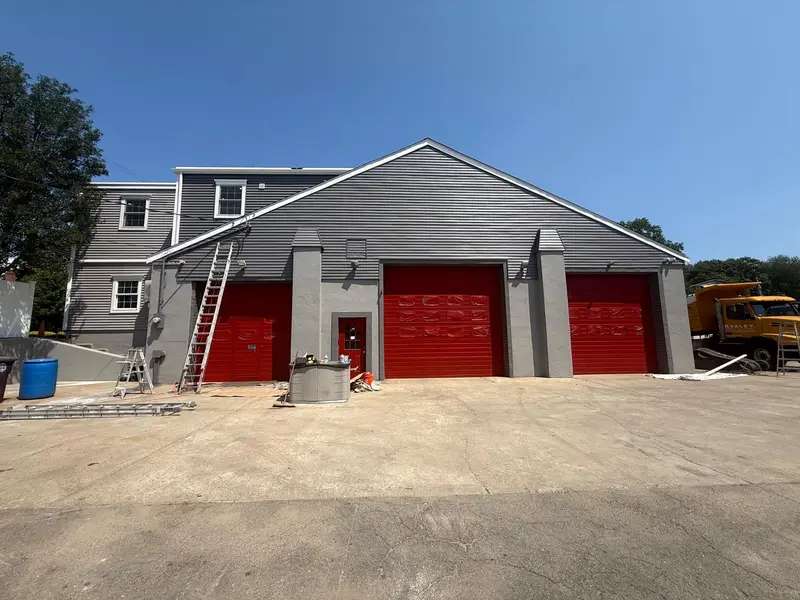
A garage building in Weymouth with white overhead doors and masonry pilasters whose paint was peeling. The doors and service doors were painted red and the pilasters refinished in gray.
See the photos →Ask the Crescent Street Local Historic District Commission first. Its review covers exterior changes visible from Crescent Street, and the town's page does not state whether color alone is included, so asking before ordering paint avoids having to redo the work.
According to the town, National Register listing does not restrict what owners do with a property unless they use federal assistance, such as rehabilitation tax credits. It is a separate designation from the Crescent Street local district, which does carry design review.
Repeated peeling on one wall often traces back to moisture moving through the siding or to coats built up over a failing layer. Look for gutter overflow, missing caulk and wet sheathing; if the old layers are lifting at the wood, scraping to a sound base matters more than the topcoat brand.
Any home built before 1978 should be tested where paint will be disturbed. Test kits recognized by EPA or an XRF inspection give an answer; if lead is present and more than 20 square feet will be scraped, lead-safe practices are required.
Wood siding in sound condition holds paint well once loose coats are removed and damaged boards are replaced. Residing makes more sense when rot is widespread, which an on-site look at sills, corners and the lowest courses will show.
House size and height, the number of trim details, the amount of scraping and carpentry, and whether lead-safe containment is needed all move the figure. The exterior painting cost guide explains Massachusetts market factors; AJ Painting gives a written estimate after a free visit.
AJ Painting is licensed and insured. Call (508) 258-4325, Mon–Sat 7AM–6PM, to set up a free on-site visit and a written estimate.
5.0 on Google · 35 verified reviews · Licensed & insured · Written quote in 48h