
Norwood, MA
Porch Floor, Steps & Railings in Norwood, MA
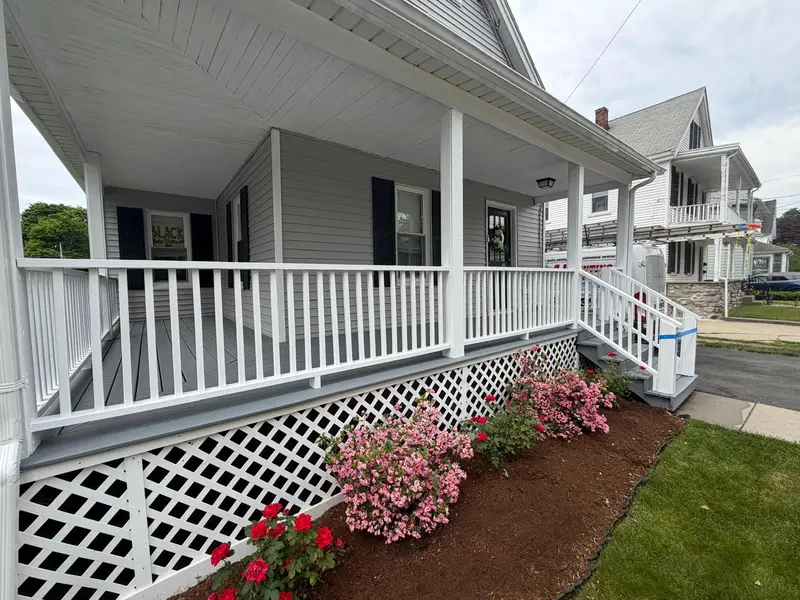
A Norwood home's front and back porches: floor boards and steps painted gray, with railings, balusters and lattice skirting in white.
See the photos →Deck boards, rails and stairs washed, brightened, repaired and coated with a stain or deck paint chosen for the wood and for how quickly that spot dries after rain.
Of the roughly 3,970 housing units in town, about 3,510 are detached single-family houses, and only a few hundred sit in multi-unit buildings. A deck on a detached house usually has no shared railing or condo association color rule to coordinate with, so the owner picks the product, and the questions that matter are about the wood itself and the conditions around it.
Those conditions vary from lot to lot. The Massachusetts Historical Commission describes the town as a rocky upland plateau draining mostly southeast toward the Charles River, with bogs and marshes in several places, especially the northwest. A deck set low near wet ground or beneath a heavy canopy dries slowly after every storm, while one facing open south sun gets its finish baked and faded instead. The same stain will age differently in those two spots.
The finish type sets the maintenance pattern for years. Penetrating finishes wear down gradually and are refreshed by cleaning and recoating; film-forming finishes protect longer from sun but have to be scraped when they start to peel. The deck paint vs. stain comparison covers the trade-off in detail.
Where boards stay wet, mildew and algae grow on the surface and soften the top fibers, and film coatings trap moisture until they blister. On a deck like that, a penetrating oil or semi-transparent stain with a mildewcide tends to fare better than a solid color. Pruning back branches, clearing debris from board gaps and making sure the ground underneath drains also help the coating more than any brand choice. How deck stain fares over a New England winter explains what freeze-thaw does to each product type.
Close to a quarter of local homes were built before 1940. Where one of them has a front porch with a painted tongue-and-groove floor, that floor may carry decades of paint layers, and on any house built before 1978 the bottom layers could contain lead. Scraping more than 20 square feet outdoors brings in EPA's lead-safe requirements; the lead-safe painting page explains what changes on site. Floor enamel goes back on after loose paint is removed and bare spots are primed.
Work starts with a deck cleaner and rinse, followed by a brightener that restores the wood's color and pH, then a light sanding of raised fibers. Loose nails are reset or replaced with screws, and soft boards at stair treads and post bases are swapped out. The wood must dry before stain goes on, and the forecast must stay dry through the cure time, which in practice limits the season to late spring through early fall. If the siding is also due, the exterior painting page explains why the house is painted before the deck.
| Single-family detached homes | 3,510 of 3,969 units (about 88%) (U.S. Census ACS 2020–2024 5-year, table B25024) |
| Terrain and drainage | Rocky upland; drains mainly to the Charles River; bogs especially in the northwest (MHC Reconnaissance Survey Town Report: Weston (1980)) |
| Homes built 1939 or earlier | 909 units (about 23%, ±205) (U.S. Census ACS 2020–2024 5-year, table B25034) |
| Outdoor lead-safe threshold | More than 20 sq ft disturbed, pre-1978 homes (U.S. EPA, Renovation, Repair and Painting Program) |
These jobs were in other towns, not in Weston. Each card names the town where the work was done.
A Norwood home's front and back porches: floor boards and steps painted gray, with railings, balusters and lattice skirting in white.
See the photos →A penetrating stain with mildewcide usually handles that better than a solid stain or paint, which can trap moisture and blister. Cleaning the deck each spring and opening up some light and airflow will extend any finish.
The lumber needs to dry enough to absorb stain. Sprinkle water on the boards: if it soaks in within a few minutes, the wood is ready; if it beads, wait longer. Kiln-dried-after-treatment lumber can often be finished sooner.
Dense hardwoods do not absorb much stain. They take thin penetrating oils formulated for hardwoods, applied lightly and wiped so nothing sits on the surface; heavier stains will stay tacky or peel.
Either strip and sand back to bare wood and switch to a penetrating stain, or scrape off all loose paint and recoat with a solid stain or deck paint. Stripping is more work up front but ends the peel-and-scrape cycle.
It can work on dry days when the wood and air are within the product's temperature range overnight as well as during the day. Once nights drop near freezing or leaves keep landing on wet boards, it is better to wait until spring.
Deck area, railings and balusters, stairs, the amount of stripping, and any board replacement drive it. The deck staining cost guide explains Massachusetts market factors, and AJ Painting writes an estimate after a free visit to see the deck.
Licensed and insured. Call AJ Painting at (508) 258-4325, Mon–Sat 7AM–6PM, to schedule a free on-site visit and a written deck estimate.
5.0 on Google · 35 verified reviews · Licensed & insured · Written quote in 48h