
Framingham, MA
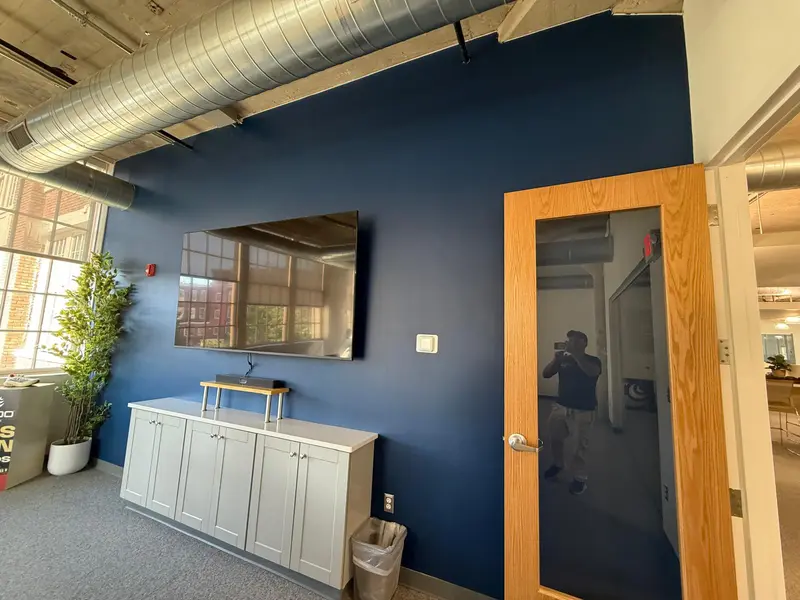
Navy Accent Walls in a Framingham Office
Deep navy accent walls in a loft-style office in Framingham, with exposed spiral ductwork, concrete columns and large factory windows.
See the photos →Siding, trim and doors on Framingham houses of every era, with the prep, timing and local historic-district rules handled before the first ladder goes up.
An exterior paint job is judged by how it looks in year six, not week one. In a city where most houses went up before 1980, that comes down to how much old paint is still bonded, what the siding is made of, and whether moisture is getting behind it. A quick look from the driveway rarely tells the full story, so we walk every side, check the sills and the bottom courses of clapboard, and write down what we find.
This page covers what tends to matter on Framingham houses specifically: the large postwar building wave, the older wood-sided homes near the town centers, the local historic district rules, and the season we have to work with.
The city's population more than doubled in the twenty years after 1946, and the subdivisions built north of Route 9, including Cherryfield and the Pinefield phases in Saxonville, were largely Capes and Ranches, according to the city's preservation plan. Census data shows 37% of all housing units date to the 1950s and 1960s.
Those houses are now 55 to 75 years old. Depending on the house, the walls may be original wood clapboard or shingles under many coats of paint, or vinyl or aluminum from a later re-siding. On wood, the usual failures are peeling on the weather side, cracked paint at window heads, and soft fascia boards where gutters overflowed. On vinyl or aluminum, the job is cleaning, the right primer for the substrate and a color that will not overheat and warp the panels, which rules out going much darker than the original on vinyl.
The city has six local historic districts, from the Centre Common district to districts named for individual buildings, such as the Sarah Clayes House and the H.H. Richardson Depot. The Historic District Commission's materials describe painting as ordinary maintenance that needs no certificate, and paint color is specifically exempt from its review.
Two things are still reviewed. Changes that alter the design or materials of an element visible from the street need a Certificate of Appropriateness, so replacing rotted trim with a different profile is a different conversation than repainting it. And masonry is treated carefully: the guidelines say unpainted brick or stone should stay unpainted, previously painted masonry should keep being painted, and sandblasting off old paint damages historic masonry.
The guidelines also favor keeping and repairing original wood siding, cornices, brackets and window sash over covering them. For older houses in Framingham Centre, that points to one sequence: repair and consolidate wood, then paint it, instead of replacing details that cannot be bought off a shelf.
Almost three in four housing units in the city were built before 1980, so on most exteriors we assume the bottom layers contain lead until a test says otherwise. Scraping and sanding old exterior paint is exactly when that layer becomes dust and chips in the garden beds.
We lay ground covers out from the foundation, contain the debris, avoid open-flame or high-heat removal, and clean up daily. The lead-safe painting page has the full picture.
Exterior coatings need surface and air temperatures above the label minimum, plus dry siding, for several hours after application. In practice that limits the season to roughly late spring through early fall here, with spring mornings and October evenings shortening the working day. Houses shaded by mature trees or close to the water around Farm Pond and Lake Cochituate take longer to dry out after rain, so we check moisture before priming rather than trusting the calendar.
| Local historic districts | Six, overseen by the Historic District Commission (City of Framingham, Historic District Commission) |
| Paint color in historic districts | Exempt from HDC review; painting masonry is reviewed (City of Framingham HDC FAQ) |
| Housing units built 1950–1969 | 37.3% of all units (U.S. Census ACS 2020–2024 5-year, table B25034) |
| Housing units built before 1980 | 72.6% (U.S. Census ACS 2020–2024 5-year, table B25034) |
| Postwar growth | Population rose from a little over 25,000 (1946) to just over 65,000 in twenty years (Town of Framingham Historic Preservation Plan (2016)) |
Deep navy accent walls in a loft-style office in Framingham, with exposed spiral ductwork, concrete columns and large factory windows.
See the photos →
A Norwood home's front and back porches: floor boards and steps painted gray, with railings, balusters and lattice skirting in white.
See the photos →No. Paint color is exempt from Historic District Commission review, and the commission treats repainting as ordinary maintenance. Its guidelines do suggest choosing colors that suit the house's period, but that is advice, not a requirement.
Probably not, if it has never been painted. The district guidelines say unpainted masonry should stay unpainted, and painting masonry is one of the things the commission does review. If the brick was painted before, it should generally keep being painted.
If the clapboards are mostly sound and the failure is in the paint, scraping, spot-repairing and repainting is usually far less disruptive than re-siding. We point out any boards that are too far gone during the estimate so you can weigh it honestly.
Earlier is better. The workable season runs roughly from late spring into early fall, and homes that need repairs or lead-safe scraping take more days on site, so they benefit from an early slot.
House size, number of stories, siding condition and how much scraping is needed drive the price. Our exterior cost guide uses Massachusetts market data to show typical ranges, and the Framingham cost page adds local context. Your written estimate will itemize the prep.
Only within limits. Dark colors absorb heat and can make vinyl warp, so we use vinyl-safe formulations and stay within the manufacturer's recommended range.
Free on-site visit and a written estimate that lists the prep, repairs and coats. Licensed and insured. Call (508) 258-4325.
5.0 on Google · 35 verified reviews · Licensed & insured · Written quote in 48h