
Framingham, MA
Navy Accent Walls in a Framingham Office
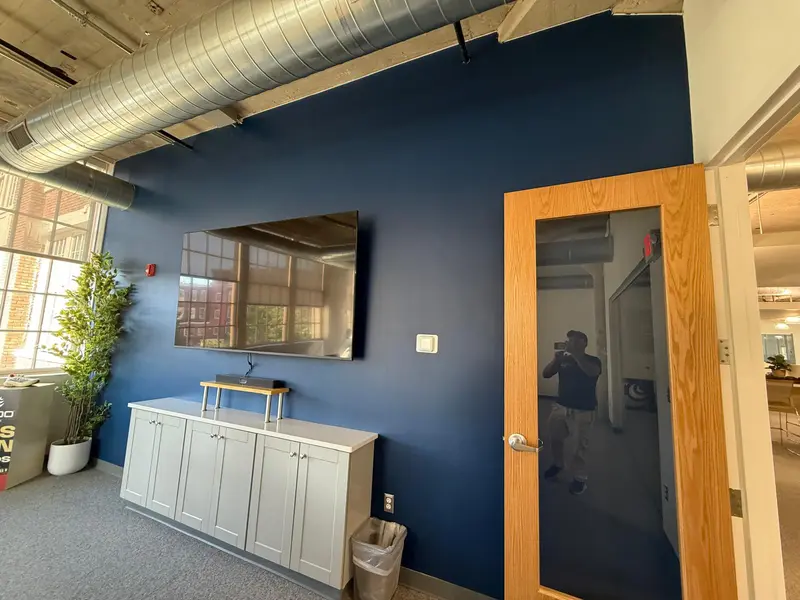
Deep navy accent walls in a loft-style office in Framingham, with exposed spiral ductwork, concrete columns and large factory windows.
See the photos →Cleaning, repair checks, and stain or paint for decks, porches and railings on Framingham homes, matched to the wood and to how much sun and moisture the yard gets.
Decks take more abuse than any other painted or stained surface on a house. Horizontal boards hold snow and standing water, get full afternoon sun, and are walked on all summer. A finish that holds up for years on vertical siding wears out far sooner on a deck floor, so the goal is a coating you can maintain, not one that looks perfect for a month and then peels.
Just over half of the city's housing units are single-family detached homes, and for those owners the deck or porch is theirs alone to maintain, with no association schedule to wait for. The work below is about getting those surfaces to hold a finish through a New England winter.
Identifying the wood and the current finish decides everything else. Solid stain over a deck that was previously treated with a penetrating oil will not stick; a clear sealer over a deck that was painted is pointless. We check what is on there before we recommend anything.
The city takes in the Sudbury River and its marshes, Farm Pond, Lake Cochituate and several old reservoirs, and some properties back onto that water or onto wooded land. Decks in shaded, damp spots grow mildew and algae quickly and need a stain with a mildewcide and a thorough cleaning every season. Decks in open, south-facing yards face the opposite problem: UV breaks down clear and lightly tinted finishes fast, so a more pigmented semi-transparent or solid stain lasts longer.
The postwar subdivisions north of Route 9 have had more than sixty years for yard trees to grow, so a deck that once sat in full sun may now spend part of the day in shade. That is worth considering when choosing a stain color and opacity. Homes built since 2010, about 8.5% of the housing stock, may have decks still on their first or second coat of stain.
We start by walking the deck for soft boards, popped nails or screws and loose railings. Paint and stain do not fix structural problems, and we will tell you if a board or post needs a carpenter before we coat it.
Then comes cleaning with a deck cleaner, and stripping where an old film-forming finish is peeling. A brightener follows on stripped wood to restore its pH and color. Once the boards are dry, we sand raised grain and fuzzy areas, coat the railings and vertical parts first, and finish the floor boards in long runs so lap marks do not show.
Houses from before the Second World War, such as the Colonial Revival, Dutch Colonial and bungalow blocks in South Framingham, may have covered front porches with tongue-and-groove floors, turned posts and painted railings. Those are painted surfaces, not stained ones, and the old paint layers may contain lead. Scraping them calls for the precautions described on our lead-safe painting page. For porch detail on the house itself, see our exterior painting page.
| Single-family detached homes | 52.1% of housing units (U.S. Census ACS 2020–2024 5-year, table B25024) |
| Water features | Sudbury River and marshes, Farm Pond, Lake Cochituate, three former Sudbury system reservoirs (Town of Framingham Historic Preservation Plan (2016)) |
| Housing built 2010 or later | 8.5% of units (U.S. Census ACS 2020–2024 5-year, table B25034) |
| Postwar subdivisions north of Route 9 | Largely Cape and Ranch houses (Cherryfield, Pinefield phases) (Town of Framingham Historic Preservation Plan (2016)) |
Deep navy accent walls in a loft-style office in Framingham, with exposed spiral ductwork, concrete columns and large factory windows.
See the photos →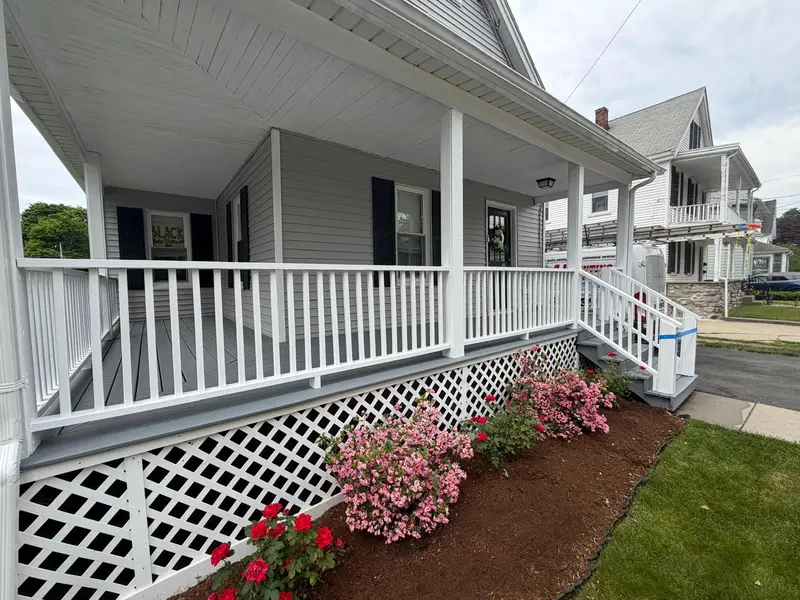
A Norwood home's front and back porches: floor boards and steps painted gray, with railings, balusters and lattice skirting in white.
See the photos →New treated lumber is often still wet from the treatment process. We usually wait until a few drops of water soak in rather than bead on the surface, which can take a few months. Staining too early traps moisture and the finish fails.
Penetrating stains wear away gradually and are easier to recoat; paint and solid stains hide more but can peel and need scraping later. Our paint vs. stain comparison lays out the trade-offs in detail.
A thorough cleaning to kill the growth, a stain with a mildewcide, and trimming back branches if possible so the boards can dry. Even with all that, a shaded deck usually needs a yearly wash to stay clean.
It depends on sun exposure and product. Horizontal surfaces in full sun may need a maintenance coat every two to three years, while railings and shaded areas last longer. Our post on deck stain and New England winters explains why.
Price depends on square footage, railing length, and whether old coatings need stripping. Our deck staining cost guide summarizes statewide market data. We write up a specific estimate after looking at your deck.
Most composite boards are not designed to be stained. We can clean them, and if the manufacturer approves a specific coating for faded boards, we follow that product's instructions.
We'll check the boards, identify the current finish and recommend the right product in a written estimate. Call (508) 258-4325, Monday to Saturday.
5.0 on Google · 35 verified reviews · Licensed & insured · Written quote in 48h