
Framingham, MA
Navy Accent Walls in a Framingham Office
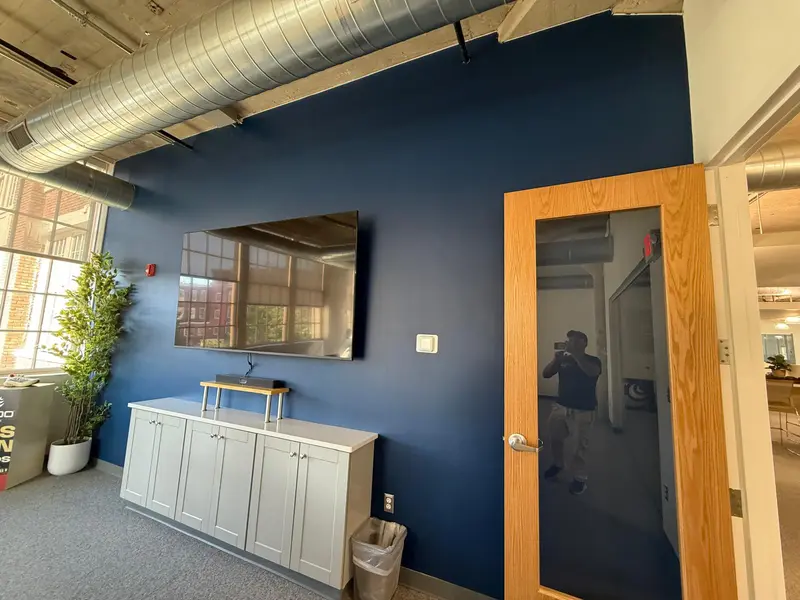
Deep navy accent walls in a loft-style office in Framingham, with exposed spiral ductwork, concrete columns and large factory windows.
See the photos →A durable factory-style finish on the kitchen and bath cabinets you already own, for Framingham homeowners deciding between refinishing and a full remodel.
Most kitchens in this city sit inside houses that are 50 years old or more; the census puts the median build year of local housing at 1966. A kitchen in a house that age has often been remodeled at least once, so the cabinets you are looking at might be 1980s or 1990s oak, builder-grade maple from a later renovation, or, in the oldest houses, painted built-ins that predate both.
Painting is a good fit when the boxes are plywood or solid wood, the layout still works, and the problem is color, wear or an orange finish that dates the room. It is a poor fit when the boxes are swollen particleboard under the sink or the layout itself is what you dislike.
Each of these takes a different prep path. Oak gets a grain filler if you want a smooth modern look; maple needs a strong bonding primer because it is hard and slick; old painted built-ins need careful testing first, because the oldest layers may contain lead.
Doors and drawer fronts come off and get labeled so they can be finished lying flat, away from the dust of a working kitchen, and returned to the right opening. The face frames and cabinet ends stay in place and are masked, cleaned with a degreaser, sanded and primed on site.
We use a primer chosen for the substrate and a hard-curing cabinet enamel rather than wall paint. Wall paint stays slightly soft and sticks to itself, which is why doors painted with it tend to stick and chip along the hinge side. Expect the kitchen to be usable but crowded for several days while frames are coated and doors cure.
If the hardware is changing, tell us before the estimate. New pulls that use a different hole spacing mean filling the old holes and drilling new ones before primer, not after.
Roughly 17% of housing units in the city were built in 1939 or earlier, a group the city's preservation plan traces from Greek Revival and Italianate houses through early-1900s Colonial Revival and bungalow forms. Homes like these may still have a butler's pantry, a china cabinet or painted kitchen cupboards that were built in place.
Built-ins like that are worth keeping, but they are also where we expect lead in the bottom coats. We test before sanding, and if lead is present, the sanding happens under lead-safe practices with containment and HEPA cleanup, as described on our lead-safe painting page. If you own one of the early-1900s houses in South Framingham and the cupboards are original, plan for that extra step.
Replacing cabinets brings new countertops, plumbing and electrical disconnection, and often flooring patches where the old footprint was. Painting keeps all of that in place. If the counters are staying and the boxes are sound, refinishing usually makes more financial sense. Our refinish vs. replace guide walks through the trade-offs in more detail.
| Median year homes were built | 1966 (U.S. Census ACS 2020–2024 5-year, table B25035) |
| Housing built 1939 or earlier | 16.9% of units (U.S. Census ACS 2020–2024 5-year, table B25034) |
| Housing built 2010 or later | 8.5% of units (U.S. Census ACS 2020–2024 5-year, table B25034) |
| Early-20th-century housing around Waverly Street | Colonial Revival, Dutch Colonial and bungalow forms (Town of Framingham Historic Preservation Plan (2016)) |
Deep navy accent walls in a loft-style office in Framingham, with exposed spiral ductwork, concrete columns and large factory windows.
See the photos →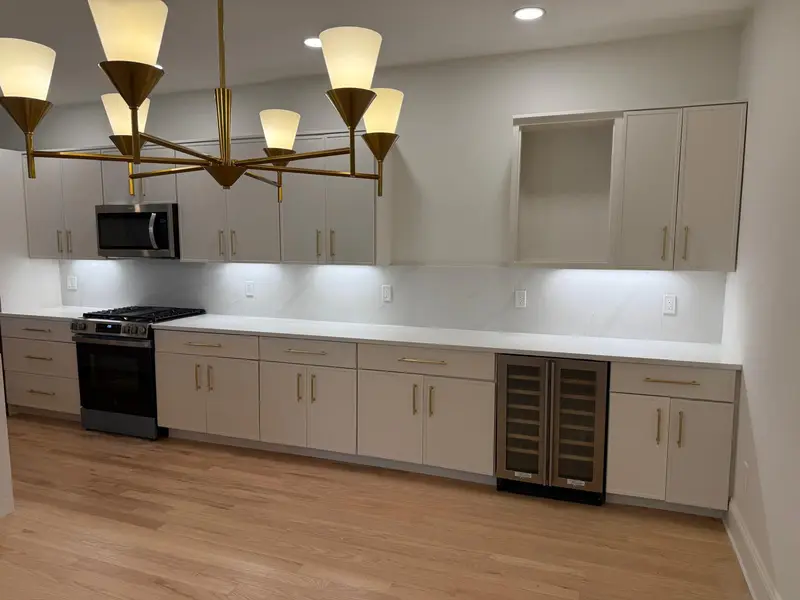
A Newton kitchen with a long run of cabinets and a peninsula. The doors came off, the boxes were painted in place, and the finished kitchen has white cabinets with brass pulls.
See the photos →Oak's open grain will show as a texture under paint unless it is filled first. Some people like that look; if you want a smooth, modern finish, we add a grain-filling step before priming. A sample door is the easiest way to compare the two looks before deciding.
Expect several days of limited use. Doors and drawer fronts are finished apart from the boxes and need cure time, while the frames are coated in place. You can generally still use the sink and appliances, with some care around fresh paint.
Usually yes. If the existing paint is well bonded, we clean, test for lead, scuff-sand under lead-safe practices if needed, prime and repaint. Stripping is only necessary where the old coats are failing or so thick they hide the detail.
We can, but most people skip it. Cabinet interiors take more time because of shelves and corners, and they see less wear. We will price it as a separate line so you can decide.
Refinishing usually costs a fraction of a full replacement because counters, plumbing and appliances stay where they are. For Massachusetts market ranges based on kitchen size, see our cabinet painting cost guide. Your written estimate will count doors, drawers and panels.
Andre looks at the boxes, doors and finish in person and tells you honestly whether refinishing makes sense. Call (508) 258-4325.
5.0 on Google · 35 verified reviews · Licensed & insured · Written quote in 48h