
Norwood, MA
Porch Floor, Steps & Railings in Norwood, MA
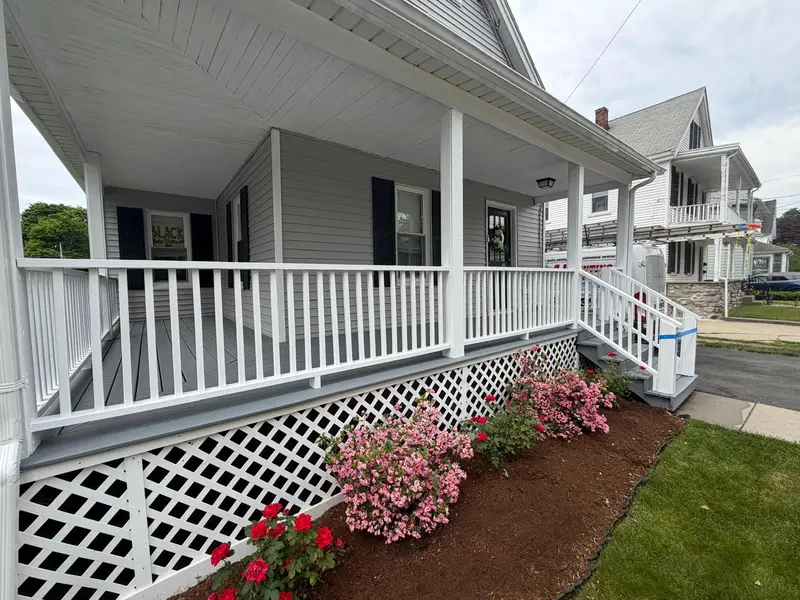
A Norwood home's front and back porches: floor boards and steps painted gray, with railings, balusters and lattice skirting in white.
See the photos →Siding, trim and porch work planned around the age of your house, how much shade it sits in, and the short New England painting season.
Douglas has a split housing stock, and the exterior job changes a lot depending on which side of the split your house falls on. Census estimates put 21.8% of the town's 3,497 housing units at 1939 or earlier, while 32.8% went up between 1980 and 1999 and another 25.8% in 2000 or later. The median year built is 1986. A house from the 1830s and a house from the 1990s need very different preparation before any color goes on.
The Old Douglas Center Historic District, listed on the National Register in 2001, surrounds the town common and is made up mostly of Federal and Greek Revival houses, along with buildings such as the 1834 First Congregational Church and the c. 1770s Dudley Tavern. On Main Street, the E. N. Jenckes Store is an 1833 Greek Revival wood-frame building with a two-story porch under its overhanging roof.
Houses of that age can carry many layers of paint on clapboard, corner boards, cornices and window casings. The work on them is mostly prep: scraping loose layers, sanding edges so new paint does not telegraph old ridges, replacing split or rotted pieces, priming bare wood, and caulking joints that let water behind the siding. Any house built before 1978 should be treated as possibly containing lead paint until tested, and exterior scraping on those houses follows lead-safe work practices. Our lead-safe painting page explains what that involves.
According to the National Park Service, National Register listing on its own places no restrictions on what a private owner does with the property unless federal money is involved. The 2024 Douglas General Bylaws contain no demolition-delay provision and mention the Historical Commission only in connection with scenic roads, and we could not find a local historic district in town records. That points to color and material choices being up to the owner, but local rules can change, so confirm with the town before a major exterior change if your house is inside the district.
The 2025 Douglas Hazard Mitigation Plan estimates that 78% of the town's land is forested, much of it in the western part that makes up Douglas State Forest. About 900 acres of town are ponds and streams, including Wallum Lake, Manchaug Pond, Whitin Reservoir and Badluck Pond. Those are town-wide figures, not a reading of any one lot, but a wall that faces dense trees or sits near water dries slowly after rain and dew.
Slow-drying siding is where mildew, algae streaks and peeling show up first. On those elevations it helps to wash with a mildewcide cleaner and let the wood dry before painting, choose a paint with mildew resistance, and trim branches back from the walls and roof edge. North-facing and tree-covered sides often deserve a closer look at the visit than the sunny front of the house.
Houses from the 1980s, 1990s and 2000s may have wood clapboard, cedar shingle, fiber-cement or vinyl siding, and each takes paint differently. Wood and fiber cement accept acrylic house paint well once they are clean and sound. Vinyl can be painted, but the color has to be within the range the manufacturer allows, because darker shades absorb heat and can warp the panels. On a vinyl-sided house, the trim, doors and garage doors may be the only surfaces that were ever painted.
Exterior paint needs surface and air temperatures above the minimum printed on the can, plus dry weather while it cures, which in Massachusetts confines outside painting to the warmer part of the year; the label and the forecast set the actual dates. Our article on when to repaint a house in New England covers the warning signs. For pricing context, the exterior painting cost guide walks through what drives the scope. We are based in Ashland, licensed and insured, and the on-site visit and written estimate are free. Call (508) 258-4325, Monday to Saturday, 7 AM to 6 PM.
| Housing units built 1939 or earlier | 21.8% (761 of 3,497 units) (U.S. Census ACS 2020–2024 5-year, table B25034) |
| Median year built | 1986 (U.S. Census ACS 2020–2024 5-year, table B25035) |
| Old Douglas Center Historic District | National Register, listed 2001; mostly Federal and Greek Revival houses around the common (Wikipedia, citing the NPS National Register Information System) |
| Forested land | An estimated 78% of the town (Town of Douglas Hazard Mitigation Plan 2025 Update) |
| National Register and private owners | No federal restriction on privately funded work (National Park Service, National Register FAQ) |
These jobs were in other towns, not in Douglas. Each card names the town where the work was done.
A Norwood home's front and back porches: floor boards and steps painted gray, with railings, balusters and lattice skirting in white.
See the photos →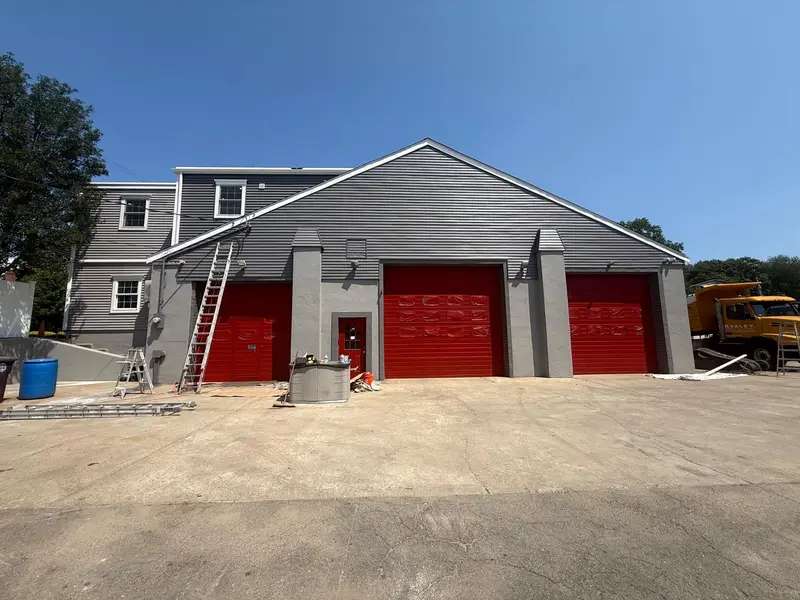
A garage building in Weymouth with white overhead doors and masonry pilasters whose paint was peeling. The doors and service doors were painted red and the pilasters refinished in gray.
See the photos →The district there is a National Register listing, and the National Park Service says that listing alone does not restrict privately funded work. Douglas's 2024 general bylaws have no demolition-delay provision, and we could not find a local historic district. Rules can change, so a quick check with the town before a big color change is still sensible.
You can't tell by looking. If the house was built before 1978, assume it may until a test says otherwise. A certified inspector or an EPA-recognized test kit can check specific surfaces, and any scraping on a pre-1978 house should follow lead-safe practices.
Shade and moisture are common causes, and a wall under trees can stay damp long after the rest of the house dries. Check for gutters overflowing onto siding, soil or mulch touching the bottom courses, and branches brushing the walls before repainting, or the new paint will fail in the same spot.
Yes, with a paint formulated for vinyl and a color no darker than the siding maker allows. Too dark a shade can make panels heat up and warp. Cleaning off chalk and mildew first matters more on vinyl than on wood.
Mostly the condition of the existing paint, the amount of carpentry repair, the height and number of stories, trim detail and whether lead-safe methods apply. The Massachusetts exterior cost guide explains those factors; your own number comes in the written estimate after the free visit.
It depends on the forecast and the product. Many exterior acrylics list a minimum temperature around 35 to 50°F, and dew on cold evenings can still spoil a fresh coat. See our post on painting an exterior in November.
Siding, trim and shaded walls all go into the written scope. Call (508) 258-4325.
5.0 on Google · 35 verified reviews · Licensed & insured · Written quote in 48h