
Norwood, MA
Porch Floor, Steps & Railings in Norwood, MA
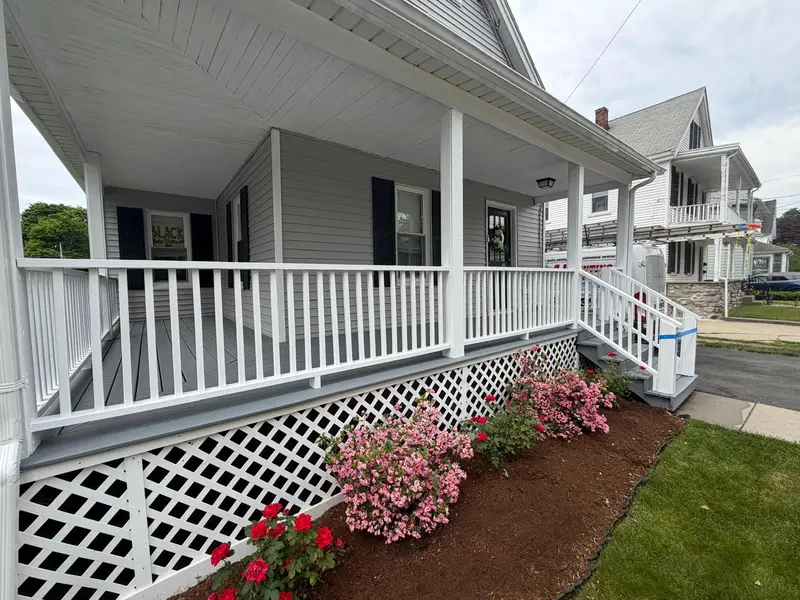
A Norwood home's front and back porches: floor boards and steps painted gray, with railings, balusters and lattice skirting in white.
See the photos →Siding, trim, doors and porches painted in the dry months, with scraping and priming done properly and a check on historic district review before work begins on homes in the district.
An exterior coating fails from the outside in. Sunlight breaks down the binder, water slips behind cracked caulk, and freeze-thaw cycles push the film off wherever moisture is trapped in the wood. A repaint that lasts deals with those three things during prep instead of counting on extra paint to cover them.
This is an inland town, so the salt spray that coastal houses fight is not part of the picture. The stresses here are the ordinary New England ones: UV on south- and west-facing walls, mildew on shaded sides, and splash-back along foundations where siding sits close to the soil.
The 1981 state survey lists shallow-pitched roofs, wide bracketed eaves, flush-board siding and round-arched windows with molded lintels as common features of the mid-century houses, and it singled out the town center for its Italianate collection. Brackets and lintels are full of end grain and joints where paint cracks early, so they get hand-scraped, spot-primed and re-caulked wherever a joint has opened. Flush boards have no clapboard shadow lines to hide lap marks or sanding scars, so they need careful sanding and a steady wet edge.
The same survey names turned porch posts and patterned gable shingles as markers of the Queen Anne and Colonial Revival style among the modest 1870s–1890s houses built along South, Crescent, Summer, Auburn and Plymouth Streets. Each course of a fancy-cut shingle has a bottom edge that needs paint worked into it by brush, and turned posts collect thick layers in every groove. In Stanley, around the National Register-listed Bridgewater Iron Works site, the survey found Federal houses on Main, Wall and High Streets as well.
The town's Historic District Committee decides whether exterior architectural features in the historic district are appropriate, and covered work needs a certificate of appropriateness. Exactly which painting projects are covered is spelled out in the committee's rules, so if your house is in the district, contact the committee before choosing colors or replacing trim. Its page links to Historic New England's Historic Colors of America as a recommended palette, a useful reference for period houses anywhere in town.
Census estimates put 44.6% of local homes before 1980. A house built before 1978 may hold lead paint in its lower layers even after several newer coats. Once paid work disturbs more than 20 square feet of exterior paint, lead-safe practices apply: plastic sheeting on the ground, misting to keep dust down, no open-flame burning, no power sanding without a HEPA shroud, and a daily cleanup that leaves no chips in garden beds. The lead-safe painting page has the details.
Exterior paints need surface and air temperatures above a product-specific minimum, often 35 to 50°F, along with dry wood and several rain-free hours after application. Around here that generally means late spring through early fall, with shoulder-season days workable once the dew has burned off. Starting each wall after the sun has moved off it reduces blistering and lap marks.
If the deck is due as well, it is stained after the body and trim are finished; see deck staining. The Titicut and Scotland neighborhood pages cover those parts of town.
| Coastal exposure | None: an inland town; largest water body is Lake Nippenicket (nearly 500 acres) (Town of Bridgewater Housing Production Plan (Old Colony Planning Council, 2017)) |
| Local exterior review | Historic District Committee issues certificates of appropriateness for covered exterior work in the historic district (Town of Bridgewater, Historic District Committee) |
| Italianate features at the town center | Bracketed eaves, flush-board siding, round-arched windows with molded lintels (MHC Reconnaissance Survey Town Report: Bridgewater (1981)) |
| Homes built before 1980 | 44.6% of units (4,203 of 9,429) (U.S. Census ACS 2020–2024 5-year, table B25034) |
| National Register listing | Bridgewater Iron Works historic district, Stanley (listed 2002) (Wikipedia, citing the National Register Information System) |
These jobs were in other towns, not in Bridgewater. Each card names the town where the work was done.
A Norwood home's front and back porches: floor boards and steps painted gray, with railings, balusters and lattice skirting in white.
See the photos →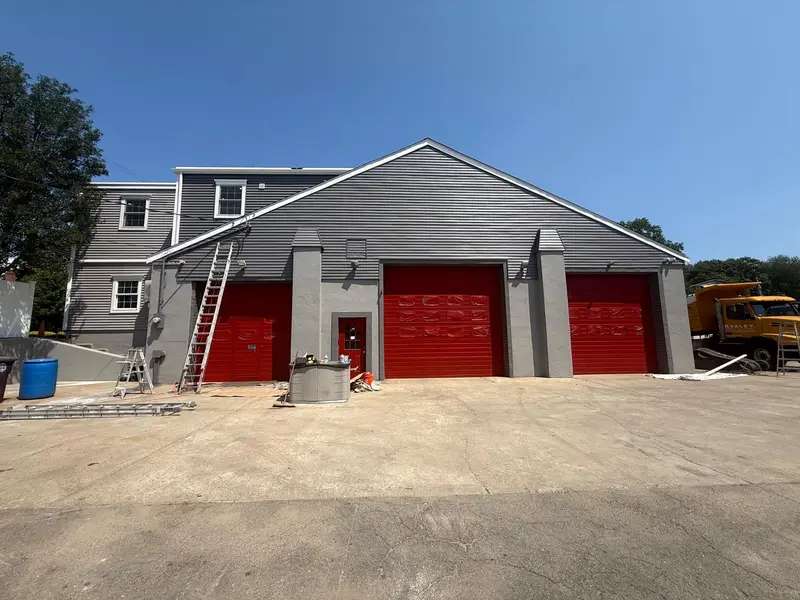
A garage building in Weymouth with white overhead doors and masonry pilasters whose paint was peeling. The doors and service doors were painted red and the pilasters refinished in gray.
See the photos →That depends on whether the house sits inside the local historic district and on what the committee's rules treat as a covered exterior feature. The committee issues certificates of appropriateness for covered work, so the safe step is to ask it directly before the job is scheduled. Houses outside the district are not part of that review.
There is no fixed number. Exposure matters more than the calendar: a south wall in full sun wears faster than a north wall under trees, and trim often shows wear before siding. A spring walk-around looking for chalking, cracked caulk and peeling at window sills lets you fix small spots before they force a full repaint.
AJ does not quote online; the written estimate comes after Andre sees the house in person. State-level market figures are collected in the exterior painting cost guide. On an older home, the amount of scraping, carpentry repair and any lead-safe setup can matter as much as the size of the house.
Yes, with a paint rated for vinyl and in a color no darker than the siding maker allows, since dark colors absorb heat and can warp the panels. Several paint brands publish vinyl-safe color collections. Chalk and mildew have to be washed off first.
Yes. Paint over soft wood fails quickly. Small soft spots can be dug out and filled with epoxy; a rotted sill, corner board or fascia section is better replaced with new stock primed on all sides before it goes up. Any repair needed shows up as a line in the written estimate.
If the paint predates 1978, keep children and pets away from the work zone and out of the yard below it until cleanup is done. Lead-safe practices catch chips on plastic sheeting that is folded and bagged at the end of each day. Ask for the lead test result before work starts so everyone knows which precautions apply.
Licensed and insured, with a free on-site visit and a written estimate. Call (508) 258-4325, Monday–Saturday 7AM–6PM.
5.0 on Google · 35 verified reviews · Licensed & insured · Written quote in 48h