
Norwood, MA
Porch Floor, Steps & Railings in Norwood, MA
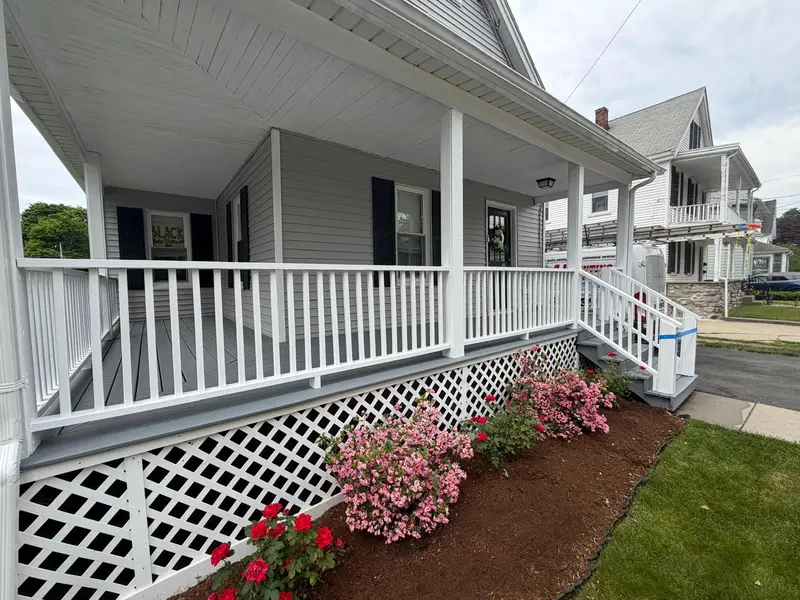
A Norwood home's front and back porches: floor boards and steps painted gray, with railings, balusters and lattice skirting in white.
See the photos →Decks, steps and railings washed, repaired where boards have gone soft, and coated with a stain or paint that suits the wood and how the deck gets used.
Detached single-family houses make up 63.5% of local housing in the latest Census estimates, and another 7.5% are attached single-family units such as townhouses. On a detached home the owner picks the stain and the schedule. On an attached unit, a deck may share a railing line or privacy wall with the neighbor, and an association may set the color, so read the rules first; association work is covered on the condo painting page.
Every deck finish trades protection against ease of renewal. Clear and toner finishes show the most wood and need recoating soonest. Semi-transparent stains add pigment for UV resistance and still wear evenly. Solid stains and deck paints hide the grain and block the most sun, but they form a film that can peel and must be scraped before the next coat.
Part of the Hockomock Swamp, a state Area of Critical Environmental Concern, lies in town. The Taunton River begins here where the Matfield and Town Rivers meet, and Lake Nippenicket covers nearly 500 acres. Not every yard is damp, but where a deck sits low over moist soil or under heavy tree cover, the boards dry slowly and mildew and algae get a foothold.
Those decks do better with a stain that contains a mildewcide, a yearly cleaning, and gaps between boards kept clear so leaves and water do not sit on the joists.
The paint vs. stain comparison goes into the trade-offs in more depth.
The job starts with a walk-around: probing posts at grade, the ledger where the deck meets the house, stair stringers and any board that flexes underfoot. Popped nails are replaced with screws and soft boards are swapped before cleaning. Next comes an oxygen-based cleaner for gray wood, or a stripper if an old film is coming off, then a gentle rinse and a brightener. High-pressure washing can raise grain and gouge soft wood, so it is used sparingly.
After a couple of dry days, stain is applied by brush or pad, worked into board ends and back-brushed into the grain. Railings and balusters are usually coated first so any drips land on boards that have not been finished yet.
Porch floors on older homes are traditionally painted rather than stained, and with 11.9% of local houses built in 1939 or earlier, a porch floor may carry many coats. The 1981 state survey identified porches with turned posts as a mark of the Queen Anne and Colonial Revival houses built in the 1870s through the 1890s along South, Crescent, Summer, Auburn and Plymouth Streets. On a house from before 1978, scraping more than 20 square feet of that porch paint brings lead-safe rules into play; the lead-safe painting page explains what that means on site.
Stain and porch enamel need dry wood, mild temperatures and a clear forecast through the cure, which in this region means late spring into early fall. If the house body is also due, the exterior painting page explains why siding goes first. For product life through freeze and thaw, see how deck stain survives a New England winter.
| Single-family detached homes | 63.5% of units (5,990 of 9,429) (U.S. Census ACS 2020–2024 5-year, table B25024) |
| Single-family attached homes | 7.5% of units (711) (U.S. Census ACS 2020–2024 5-year, table B25024) |
| Wetlands in town | Part of the Hockomock Swamp ACEC (designated 1990) (Town of Bridgewater Housing Production Plan (Old Colony Planning Council, 2017)) |
| Largest water body | Lake Nippenicket, nearly 500 acres (Town of Bridgewater Housing Production Plan (Old Colony Planning Council, 2017)) |
| Homes built 1939 or earlier | 11.9% of units (U.S. Census ACS 2020–2024 5-year, table B25034) |
These jobs were in other towns, not in Bridgewater. Each card names the town where the work was done.
A Norwood home's front and back porches: floor boards and steps painted gray, with railings, balusters and lattice skirting in white.
See the photos →Floors wear faster than railings. A semi-transparent stain on a sunny deck may want a maintenance coat every couple of years; a solid stain can look good longer but then needs more prep. The simplest test is water: if drops soak in quickly rather than beading, the boards are ready.
There is no online price list; AJ writes an estimate after looking at the deck. The deck staining cost guide summarizes Massachusetts market figures. Board replacement, stripping an old solid stain and the number of balusters can all change the total.
Only after the old film is fully removed with a stripper and sanding, because a semi-transparent stain needs bare wood to soak into. If stripping is not practical, the realistic choice is another solid coat over well-scraped boards.
Low decks get little airflow underneath, so the boards stay wet longer. Keep the gaps open, trim plants back from the edges, clean every year, and choose a stain with mildew resistance. Check the joists and ledger for soft spots too, since rot often starts out of sight.
Once the wood has shed the moisture from treatment. Sprinkle some water on it: when it soaks in instead of beading, it is ready. That can take a few weeks in summer and longer for a deck built in the fall. Staining too soon traps moisture and the finish will not penetrate.
Most composite boards are not designed for it, and a coating may void the warranty. Some manufacturers approve restoration coatings for faded boards, so check before anything is applied. Otherwise, regular cleaning is the maintenance.
Free on-site visit and written estimate. Call (508) 258-4325, Monday–Saturday 7AM–6PM.
5.0 on Google · 35 verified reviews · Licensed & insured · Written quote in 48h