

Norwood, MA
Porch Floor, Steps & Railings in Norwood, MA
A Norwood home's front and back porches: floor boards and steps painted gray, with railings, balusters and lattice skirting in white.
See the photos →Siding, trim, doors and porches on Braintree houses, with the scraping, priming and paperwork older exteriors need.
Single-family detached houses make up 65.1% of Braintree's housing units, and three-quarters of all units predate 1980. A house built before 1980 has had decades to collect coats of paint, and the condition of those layers decides how much of the budget goes to prep versus finish coats.
A state survey from 1979 called the town's architecture modest rural and suburban design, with Capes, side-hall Greek Revival cottages, Italianate and Queen Anne houses in the older sections, and later subdivisions spreading out through the twentieth century. Each of those shapes has its own weak spots outside.
On wood clapboard, peeling tends to start at the bottom edge of each board, on the sunny and rain-exposed walls, and wherever water sits: window sills, the tops of drip caps, porch rails and the lowest courses near the ground. Sound paint can be scuffed and primed; loose paint has to come off down to a firm edge, and bare wood needs primer the same day or soon after.
The survey recorded Italianate houses on Hollis Avenue and West Street and Queen Anne houses on Liberty, River and West Streets. Where those houses keep brackets, cornices or decorative porch trim, they take more ladder time and hand work than a plain ranch. That detail is worth counting when comparing estimates.
With 74.7% of local housing built before 1980, a large share of exteriors in town may carry lead in older paint layers. The EPA's RRP Rule covers paid work that disturbs paint on homes built before 1978, and outside that means plastic sheeting on the ground to catch chips, no open-flame burning, no power sanding or planing without HEPA-exhaust control, care to keep wash water and paint debris contained, and a cleanup that leaves soil and plantings free of chips. Our lead-safe painting page has the details.
Braintree has one local historic district, the Town Center district along Washington Street, with about 18–19 historic properties according to town sources. The Historical Commission reviews exterior changes visible from public streets there and issues a Certificate of Appropriateness or a Determination of Non-Applicability. A planning staff report quoting the ordinance lists the items exempt from review; paint color is not on that list, although the Commission can exempt colors after a public hearing.
If your house is in the district, contact the town's Historic Division before choosing a new color scheme. A same-color repaint may be simple, but the Commission is the one that decides. Outside the district, no town review applies to painting that we have found.
Most exterior paints list a minimum air and surface temperature on the label, and dew on cold mornings can ruin a coat that has not cured. Spring through early fall gives the widest window; late-season work is possible with the right product and some flexibility. Our post on whether you can paint an exterior in November goes through the limits.
For housing details by area, see East Braintree, South Braintree and Braintree Highlands. Interior work is covered on our Braintree interior painting page.
| Single-family detached homes | 65.1% of housing units (U.S. Census ACS 2020–2024 5-year, table B25024) |
| Housing built before 1980 | 74.7% of units (U.S. Census ACS 2020–2024 5-year, table B25034) |
| Local historic districts | One: Braintree Town Center Historic District (Town of Braintree, Historic Division) |
| Paint color in the district | Not among the categories exempt from Commission review (Braintree PCD staff report quoting Ch. 2.755 (July 2023)) |
These jobs were in other towns, not in Braintree. Each card names the town where the work was done.
A Norwood home's front and back porches: floor boards and steps painted gray, with railings, balusters and lattice skirting in white.
See the photos →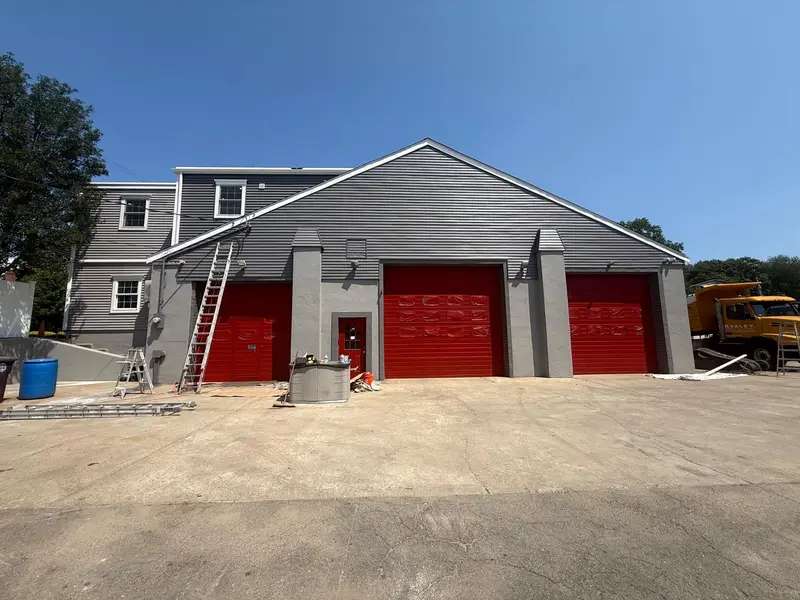
A garage building in Weymouth with white overhead doors and masonry pilasters whose paint was peeling. The doors and service doors were painted red and the pilasters refinished in gray.
See the photos →Only properties in the Town Center Historic District along Washington Street go through Historical Commission review for exterior changes seen from public ways. Paint color is not on the ordinance's exempt list, so check with the Historic Division first if you are in the district. Elsewhere in town we have not found a review requirement for painting.
You can't by looking. If the house was built before 1978, a paid painter has to either test the surfaces with an approved method or treat the paint as lead-based and follow lead-safe practices while scraping.
Walls that take more sun and driving rain wear faster, and moisture from inside the house, gutters or nearby shrubs can push paint off from behind. The cause needs fixing, or the new coat will peel in the same spot.
Yes, with paint rated for the material and a color that is not much darker than the original, since dark colors can make vinyl warp in the sun. Cleaning and a bonding primer where needed come first.
It depends on size, height, detail and how much prep the old paint needs. Our exterior painting cost guide gives Massachusetts market ranges, and the free on-site visit ends with a written estimate for your house.
That depends on prep, product and exposure. Our article on how long exterior paint lasts in Massachusetts covers the factors.
A licensed, insured painter will walk the house with you and leave a written estimate at no charge. Call (508) 258-4325, Monday–Saturday.
5.0 on Google · 35 verified reviews · Licensed & insured · Written quote in 48h