
Norwood, MA
Porch Floor, Steps & Railings in Norwood, MA
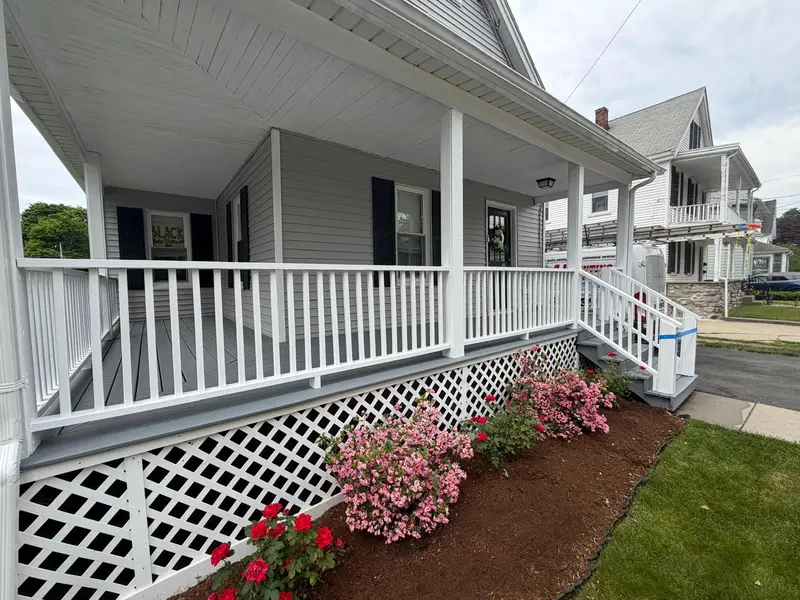
A Norwood home's front and back porches: floor boards and steps painted gray, with railings, balusters and lattice skirting in white.
See the photos →Siding, trim, windows and doors prepared and painted, from early clapboard farmhouses near the town center to houses built in the last twenty years.
An exterior paint job lasts only as long as the prep under it. Paint fails at the places where water gets in: the bottom edges of clapboards, window sills, the end grain of corner boards, and joints where caulk has split. The work that decides how long the finish holds happens before the first coat, in scraping, sanding, repairing wood and priming bare spots.
In this town the starting point varies a lot from one street to the next. Census data show about 22% of homes date from 1939 or earlier and about 42% from 2000 or later, so one house may carry a century or more of paint layers while another is on its first or second coat.
The Massachusetts Historical Commission's reconnaissance report traces the local house forms by period: the two-story, five-bay center-chimney house in the Colonial era; the double-chimney form, which the report calls prevalent in the Federal period, with few brick dwellings; then gable-end, side-passage houses with Greek Revival and Italianate details from 1830 to 1870. Where a house of these periods is wood-framed and clapboarded, as the 1870 Town Hall is, the exterior means clapboards, corner boards, cornices and window casings that have likely been repainted many times.
On houses like these the goal is to remove loose paint without damaging old wood. That means hand scraping and sanding, filling or replacing split clapboards, consolidating soft sills, and priming bare wood the same day it is exposed. Gable-front houses also put a large, tall wall facing the street, so staging and ladder setup is a bigger part of the job than on a ranch.
The 1870 Town Hall on Woodward Avenue is individually listed on the National Register of Historic Places. Its nomination describes a wood-clapboard, gable-front building and points to a cluster of historic buildings around Meeting House Common, including the 1826 First Parish Meetinghouse and the Bullard House, that could form a National Register district. That district is described as potential, not designated.
National Register listing on its own does not control the paint colors a private owner chooses. We found no record of a local historic district under Chapter 40C in town. Before any demolition or major alteration, it is still worth calling the town to ask what review applies; ordinary repainting is a different matter.
Just under 43% of local housing units were built before 1980, and lead paint was banned for homes in 1978. On those houses the lower layers of siding and trim paint may contain lead. EPA's Renovation, Repair and Painting rule applies when paid work disturbs more than 20 square feet of exterior painted surface on a pre-1978 home: ground sheeting, no power sanding without HEPA shrouds, no open-flame burning, and careful cleanup of chips from soil and planting beds. The lead-safe painting page covers the steps.
Exterior paint needs dry wood and air and surface temperatures above the minimum printed on the can, during application and for the curing hours after. In central Massachusetts, late spring through early fall gives the most reliable window, with cool nights and morning dew shortening the working day at either end. Our post on painting a house exterior in November explains the late-season limits, and how long exterior paint lasts here covers repaint intervals.
| Housing units built before 1980 | 42.7% (638 of 1,495) (U.S. Census ACS 2020–2024 5-year, table B25034) |
| Housing units built 2000 or later | 42.1% (630 of 1,495) (U.S. Census ACS 2020–2024 5-year, table B25034) |
| Federal-period house form (1775–1830) | Double-chimney prevalent; few brick dwellings (Massachusetts Historical Commission, Reconnaissance Survey Town Report: Berlin (1983)) |
| Berlin Town Hall (1870) | National Register listed; wood clapboard, slate roof (National Park Service, NRHP Registration Form: Berlin Town Hall) |
| Single-family detached share | 52.6% of housing units (U.S. Census ACS 2020–2024 5-year, table B25024) |
These jobs were in other towns, not in Berlin. Each card names the town where the work was done.
A Norwood home's front and back porches: floor boards and steps painted gray, with railings, balusters and lattice skirting in white.
See the photos →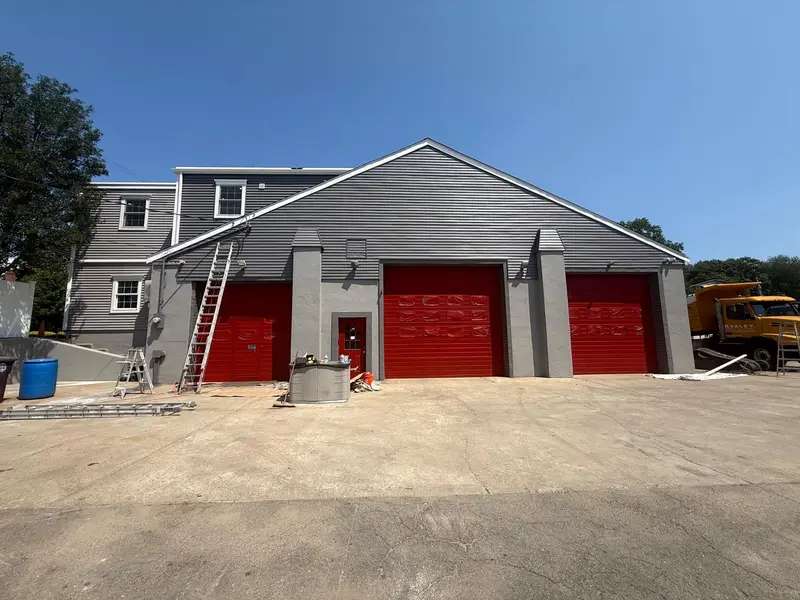
A garage building in Weymouth with white overhead doors and masonry pilasters whose paint was peeling. The doors and service doors were painted red and the pilasters refinished in gray.
See the photos →For ordinary repainting, we found no record of local historic district rules in town that would require it, and National Register listing does not by itself restrict a private owner's colors. If you live in an attached home with an association, check its rules on exterior colors before you choose.
Everything loose, peeling or cracked to the wood, plus feathering the edges so the new coat lies flat. Full stripping to bare wood is rarely needed and is slow and costly. On a pre-1978 house, the scraping follows EPA lead-safe rules once it passes 20 square feet.
Yes. Split boards can often be glued and fastened; soft or rotted sections of clapboard, trim or sill are cut out and replaced with matching profiles before priming. We point these out during the on-site visit and list them in the written estimate so nothing is a surprise.
Late spring through early fall gives the most reliable drying conditions. Booking a visit in the off-season lets you settle the scope and colors before the season starts. See the best time of year to paint in Massachusetts.
Mostly by wall area, height, the amount of scraping and wood repair, and how much trim detail there is. A tall gable-front farmhouse with failing paint and a young house needing a refresh can differ by a wide margin. Our exterior painting cost guide shows Massachusetts market ranges; AJ's price comes in a written estimate after we see the house.
Yes. Factory-primed fiber-cement and PVC or composite trim take paint well when cleaned and, for PVC, coated with a color the manufacturer approves for heat build-up. These jobs are mostly cleaning, caulking and two coats rather than heavy scraping.
AJ Painting is licensed and insured. Call (508) 258-4325, Monday to Saturday, 7AM to 6PM.
5.0 on Google · 35 verified reviews · Licensed & insured · Written quote in 48h