
Norwood, MA
Porch Floor, Steps & Railings in Norwood, MA
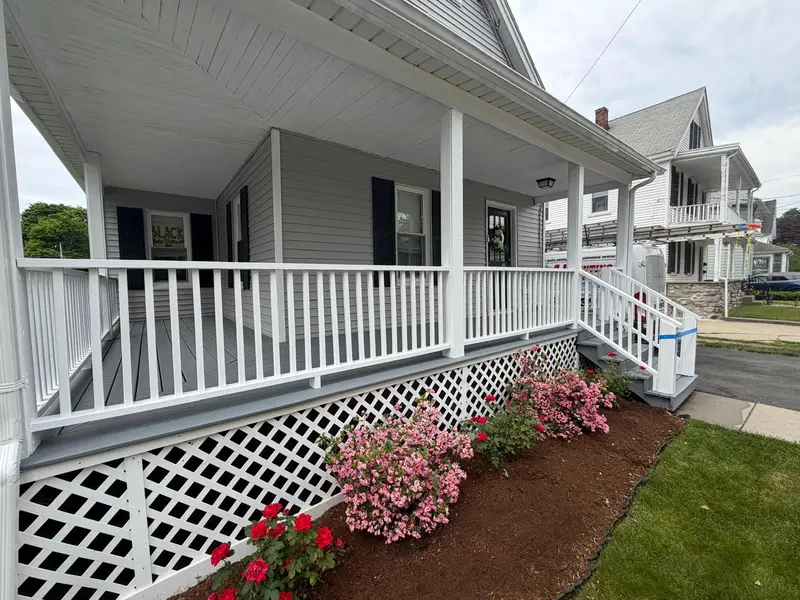
A Norwood home's front and back porches: floor boards and steps painted gray, with railings, balusters and lattice skirting in white.
See the photos →Deck boards, stairs, rails and porch floors washed, repaired and finished with a penetrating stain, solid stain or porch paint chosen for the wood and its exposure.
A deck wears differently from siding. The boards lie flat, so rain and snowmelt sit on them instead of running off, the top face gets direct sun, and foot traffic grinds away the finish on stairs and along the path to the door. A deck finish therefore wears out well before the paint on the walls beside it.
Local housing gives two very different starting points. About 42% of units were built in 2000 or later, and about 22% date from 1939 or earlier. A recent house may have an open deck of treated lumber, cedar or composite; an older one may instead have a covered porch with painted floorboards. The work for each is different, and so is the right coating.
On a deck built in the last twenty years, the framing is usually pressure-treated, and the decking may be treated pine, cedar or composite. New treated wood is often still wet from the treatment and should dry before its first stain; sprinkle water on a board, and if it soaks in rather than beading, it is ready. Cedar takes penetrating oil stains well but its tannins can bleed through a light solid color unless a stain-blocking primer goes on first.
Composite decking generally does not get stained. Cleaning is its main upkeep unless the manufacturer approves a coating, and painting it can void a warranty. Railings, posts and fascia around a composite deck are often wood and still need finishing.
The Massachusetts Historical Commission's survey of the town notes a local version of the three-bay, gable-end side-passage house in which one corner of the front facade is cut away to form a porch with a second side entry. A recessed porch like that, and the covered porches on other older homes, may carry paint on the floorboards, steps and railing, and once a surface has been painted, stain is no longer an option without stripping.
On a house built before 1980, which describes 42.7% of local housing units, those porch layers may include lead-based paint. Scraping porch floors and railings counts toward EPA's lead-safe threshold for exterior work, which is 20 square feet of disturbed paint. See our lead-safe painting page for what that involves.
The town sits in a low range of hills between the Nashua and Assabet river valleys, and its streams, the largest being North Brook, flow into the Assabet River, which crosses the town's southeast corner. Topography alone says little about a particular backyard, though. Boards close to the ground, under overhanging trees or on the north side of a house stay damp longer and grow mildew and moss; boards in open sun dry fast but lose stain color first. A low deck with poor airflow may need the stain matched to slower drying and more frequent cleaning.
Single-family attached homes make up about 20% of local housing units. Where decks and railings run between neighboring units, a color change on one side can stand out, and an association may control the color or product. Check those rules before choosing a stain, and coordinate with the neighbor if a shared railing or stair is part of the job.
For a broader look at how stain and paint differ on decks, see our paint vs. stain comparison and how deck stain holds up through a New England winter.
| Housing units built 2000 or later | 42.1% (630 of 1,495) (U.S. Census ACS 2020–2024 5-year, table B25034) |
| Single-family attached homes | 20.1% of housing units (300 of 1,495) (U.S. Census ACS 2020–2024 5-year, table B25024) |
| Local porch variant | Side-passage house with a cut-away corner porch and second side entry (Massachusetts Historical Commission, Reconnaissance Survey Town Report: Berlin (1983)) |
| Topography and water | Upland hills; North Brook; Assabet River crosses the southeast corner (Massachusetts Historical Commission, Reconnaissance Survey Town Report: Berlin (1983)) |
These jobs were in other towns, not in Berlin. Each card names the town where the work was done.
A Norwood home's front and back porches: floor boards and steps painted gray, with railings, balusters and lattice skirting in white.
See the photos →It depends on the product and the exposure. A semi-transparent stain on a sunny, high-traffic deck may need a maintenance coat every couple of years, while a solid stain lasts longer on vertical rails than on floor boards. The water-drop test is a good check: if water soaks in quickly, the finish is worn.
No. Weathered gray wood can be cleaned, brightened and lightly sanded back to sound fiber, then stained. Badly checked or cupped boards may need replacing first. The longer bare wood weathers, the more prep it takes.
If the floor has been painted before, it can only take paint or solid stain without stripping it to bare wood. Porch paint holds up well on covered floors. On a house built before 1978, any scraping of old porch paint is done with lead-safe methods.
Cleaning removes the mildew and moss, and a stain with a mildewcide slows its return, but stain cannot make a damp spot dry. Trimming back plants, clearing debris from board gaps and improving airflow under a low deck do more to keep it clean.
We do not quote set rates online. Size, the number of stairs and rail balusters, the current finish and any board replacement drive the price. Our deck staining cost guide has statewide market ranges, and a written estimate follows a free visit.
A dry stretch with mild temperatures and no rain forecast for a day or more after application, within the product's label limits. Late spring and early fall usually give the best conditions. Call (508) 258-4325, Monday through Saturday, to set up a visit.
AJ Painting is licensed and insured, based in Ashland. We look at the wood, the finish and the exposure before quoting.
5.0 on Google · 35 verified reviews · Licensed & insured · Written quote in 48h