
Norwood, MA
Porch Floor, Steps & Railings in Norwood, MA
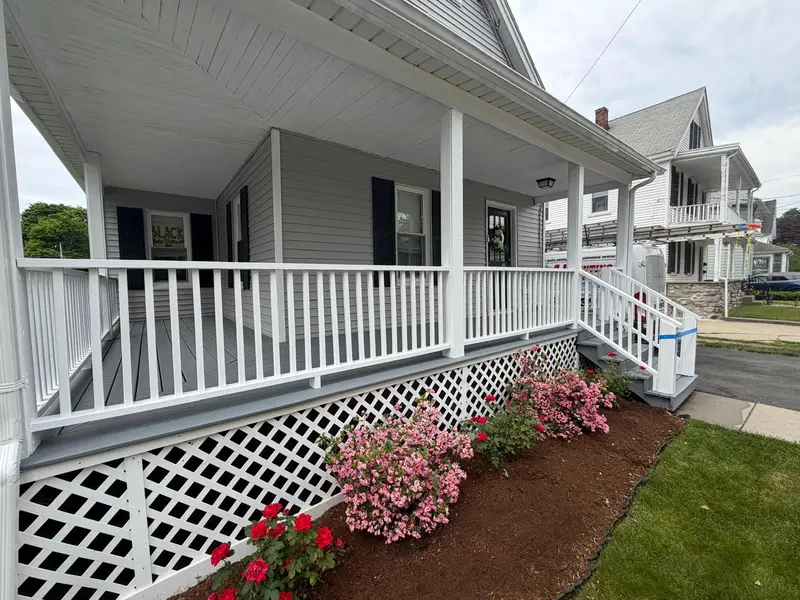
A Norwood home's front and back porches: floor boards and steps painted gray, with railings, balusters and lattice skirting in white.
See the photos →Walls, ceilings, trim and doors painted with prep chosen for the decade your rooms were built, from early-1900s multi-family houses to postwar homes and newer apartments.
The Census Bureau estimates 1960 as the median year local housing was built, but the spread around that midpoint is wide. Of the town's 13,815 housing units, 24.9% date to 1939 or earlier, 20.5% went up during the 1950s alone, and just 8.0% were built in 2010 or later. Depending on the address, a painter could be facing century-old plaster or drywall hung within the last fifteen years, and the plan for the room depends on which.
The sections below cover what changes with the age of a room: the wall surface, lead, ceilings, woodwork, and the practical side of painting a home that is lived in or rented out.
Houses from before the Second World War were generally finished with plaster over wood lath, and unless the walls have been replaced since, that is what sits under the paint. The Norwood Historical Society records that the area once called the Flats, today's South Norwood, filled with rows of triple-deckers built quickly between 1900 and 1920. A triple-decker is built as three stacked apartments, so a single building can mean three separate sets of rooms to plan. Our South Norwood page has more on that neighborhood.
Sound plaster holds paint very well. Trouble shows up as hairline cracks at corners and above doors, bulges, or patches that give when you press them. Fine cracks can be opened slightly, filled with a setting-type compound and spot-primed. A section that has let go of the lath needs to be reattached with plaster washers or adhesive first; a fresh coat over loose plaster only hides it until the next crack appears.
Old trim in these rooms may carry many coats of oil-based gloss. Water-based enamel will not bond to that surface without deglossing and a bonding primer, and skipping that step is a common reason new trim paint peels off in sheets.
Census tables group construction years by decade, so they cannot isolate 1978, but 71.5% of local housing units were built before 1980. Under the EPA's Renovation, Repair and Painting rule, anyone paid to disturb paint in a home built before 1978 must be certified and use trained workers, and Massachusetts is one of the states that runs its own version of the program.
Indoors, the hazard is dust. Sanding a window stool, scraping a door jamb or cutting out a cracked corner can release fine lead particles that settle on floors and sills, where children and pets pick them up. Lead-safe interior work generally involves:
The 1950s are the largest single decade in the local housing count, with 2,829 units, followed by 1,639 from the 1960s. Walls from that period may be plaster, plaster over gypsum lath, or early gypsum board, and each patches differently, so a quick look behind a switch plate is a cheap way to find out.
Ceilings deserve attention too. Some sprayed textures applied in past decades contained asbestos, so a textured ceiling of unknown age should be tested before anyone scrapes it or rolls a wet coat onto it. A smooth ceiling in an older house may not be perfectly flat, and a dead-flat ceiling paint hides waves and patches far better than eggshell.
If your trim is original stained wood, decide carefully before painting it. White enamel brightens a dark room, but once the grain is covered, getting back to bare wood means stripping every piece.
Renters occupy 46.0% of the town's occupied housing units, and 46.1% of all units sit in buildings with two or more units. For a landlord, the vacancy between tenants is the easiest window to patch nail holes, repaint and reset a unit. Eggshell or satin on walls in halls, kitchens and baths stands up to scrubbing better than flat.
In an occupied house, the work goes room by room so the household keeps a place to sleep and cook. Low-VOC paints cut the smell, and furniture moved to the middle of each room and covered keeps the job moving. Owners of units in an association should also read our condo painting page, since building rules can affect access and work hours.
| Median year housing was built | 1960 (±3) (U.S. Census ACS 2020–2024 5-year, table B25035) |
| Housing units built 1939 or earlier | 24.9% (3,445 of 13,815) (U.S. Census ACS 2020–2024 5-year, table B25034) |
| Housing units built before 1980 | 71.5% (9,871 units) (U.S. Census ACS 2020–2024 5-year, table B25034) |
| Housing units built in the 1950s | 20.5% (2,829 units) (U.S. Census ACS 2020–2024 5-year, table B25034) |
| Renter-occupied homes | 46.0% of occupied units (U.S. Census ACS 2020–2024 5-year, table B25003) |
A Norwood home's front and back porches: floor boards and steps painted gray, with railings, balusters and lattice skirting in white.
See the photos →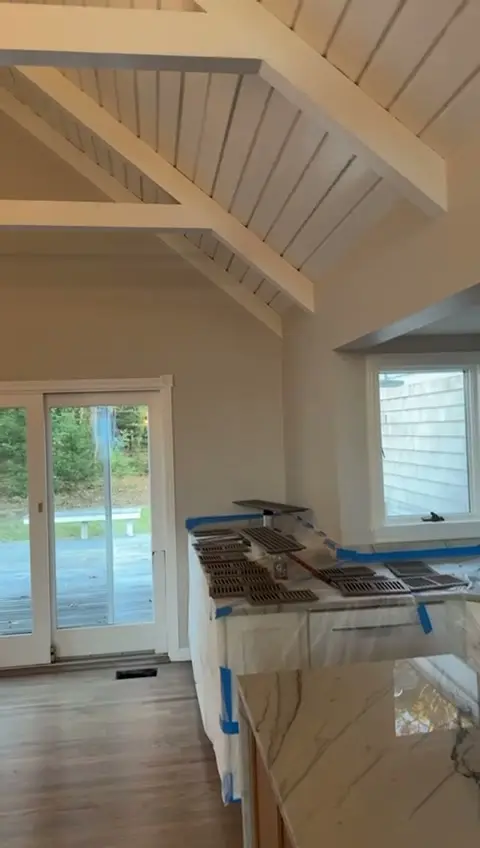
A home in Mashpee on Cape Cod with light gray walls, white trim and doors, and a vaulted plank ceiling with exposed beams finished in white.
See the video →Not necessarily. If the plaster is tight to the lath and only has hairline cracks, filling, sanding the patches and priming them is enough. A skim coat makes sense when the surface is badly pitted, covered in old wallpaper residue, or patched so many times that the repairs show through paint.
Yes. The federal rule covers any home built before 1978, and a 1950s house falls inside it; paid work there is treated as lead-safe work unless testing of the surfaces being disturbed shows no lead-based paint. Our lead-safe painting page explains what that work involves.
Yes. Working one or two rooms at a time keeps the rest of the house usable, and low-VOC products let a bedroom be slept in again soon after the last coat. Rooms with pre-1978 paint being sanded or scraped should stay closed off until cleanup is done.
Patch holes and dents, prime any stains, then repaint walls in a washable finish and refresh trim and doors where they are chipped. In a building from the early 1900s, the old trim paint is a lead concern, so chipped areas need lead-safe handling rather than a quick sanding.
Square footage, ceiling height, how much plaster or trim repair is needed and the number of colors move the total most. Our Massachusetts interior painting cost guide shows current market ranges, and a free visit produces a written estimate for your rooms.
It is your call, but treat it as permanent. Painted trim looks crisp and brightens dark rooms; reversing it later means stripping. Trim with a worn or damaged stain finish is a stronger candidate than woodwork still in good condition.
Book a free on-site visit and get a written estimate. Licensed and insured, Mon–Sat 7AM–6PM. Call (508) 258-4325.
5.0 on Google · 35 verified reviews · Licensed & insured · Written quote in 48h