
Norwood, MA
Porch Floor, Steps & Railings in Norwood, MA
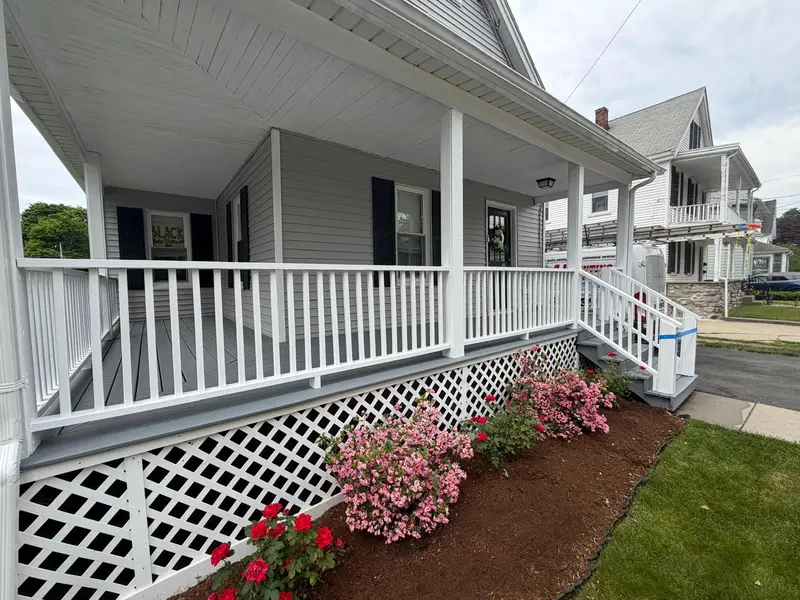
A Norwood home's front and back porches: floor boards and steps painted gray, with railings, balusters and lattice skirting in white.
See the photos →Cleaning, board repair and a stain or paint finish for decks, porch floors, railings and outdoor stairs, with the product matched to the wood and how the surface is used.
Census figures count 6,460 single-family detached houses in town, 46.8% of the housing stock, plus 976 single-family attached units such as townhouses. Owners occupy 54.0% of occupied homes. For those owners, the deck, porch and back steps are maintenance items on the same list as the roof and gutters.
A horizontal wood surface takes more punishment than any wall. Snow can sit on it for weeks, rain pools in cupped boards, summer sun bakes it, and chairs and shoes scrape it daily. The finish that lasts is the one matched to the wood and applied to boards that are clean and dry.
Another 19.3% of local housing units are in buildings with two to four units. In South Norwood, the Norwood Historical Society describes rows of triple-deckers built between 1900 and 1920, and where a building of that form has porches on more than one level, each one adds a floor, a railing and a ceiling to finish. Our South Norwood page has more about the area.
Some older porch floors are tongue-and-groove boards under porch and floor enamel rather than stain. Once a floor has been painted, stain cannot soak in, so the choices are to repaint with a floor enamel or strip to bare wood. Porch ceilings, railings and balusters on a house that old may carry decades of paint, and 71.5% of local housing units were built before 1980. On any home built before 1978, paid scraping of those parts calls for the lead-safe methods on our lead-safe painting page.
Each species cleans, absorbs and weathers differently, so identify what the deck is built from before buying anything:
Penetrating stains, transparent or semi-transparent, soak into the wood and wear away gradually, so a refresh is mostly cleaning and recoating. Solid stain and paint form a film that hides graying and mismatched boards, but on a walking surface that film can peel where water collects and wear through in traffic paths. Fixing it later means scraping.
A practical split is a penetrating stain on the deck boards with solid stain or paint on rails, posts and skirting, where nobody walks. Our post on how deck stain handles New England winters compares the options.
A deck in shade or close to the ground dries slowly and grows mildew and algae. Prep starts with a wood cleaner, a low-pressure rinse and, on graying wood, a brightener, followed by enough dry weather for the boards to give up their moisture. Loose nails get reset, split boards replaced and gaps cleared so water drains.
In mid-October, staining still works when the forecast offers several dry days above the product's minimum temperature and the boards are free of dew by late morning. Cold nights slow curing, and once that window closes, cleaning now and staining in spring is a reasonable plan.
| Single-family detached houses | 46.8% (6,460 of 13,815 units) (U.S. Census ACS 2020–2024 5-year, table B25024) |
| Owner-occupied homes | 54.0% of occupied units (U.S. Census ACS 2020–2024 5-year, table B25003) |
| Units in 2–4 unit buildings | 19.3% (2,660 units) (U.S. Census ACS 2020–2024 5-year, table B25024) |
| South Norwood triple-deckers | Built in rows, 1900–1920 (Norwood Historical Society, 'Points of Interest: South Norwood's Changing Street Scape') |
| Housing units built before 1980 | 71.5% (U.S. Census ACS 2020–2024 5-year, table B25034) |
A Norwood home's front and back porches: floor boards and steps painted gray, with railings, balusters and lattice skirting in white.
See the photos →Not without stripping it. Stain has to soak into bare wood, and old paint blocks it. The usual fix is to scrape the loose paint, prime bare areas and recoat with a porch and floor enamel. If the house predates 1978, that scraping has to be done lead-safe.
If the building is one property with one owner, that owner decides. If it is a condominium, the porch may be a common or limited common element, so check the master deed and get the association's approval first. Our condo painting page covers that process.
Sprinkle some water on a few boards. If it beads, the wood is still too wet or has an old water-repellent finish; if it soaks in within a few minutes, the deck is ready. Check boards in both sun and shade.
It depends on the forecast, not the date. You need dry boards, a run of dry days and temperatures above the stain's label minimum. When those stop lining up, wait for spring.
Deck size, the number of railings and stairs, board repairs and how much old coating must come off decide the price. Our Massachusetts deck staining cost guide has market ranges; a free visit gives a written estimate for your deck.
Newer pressure-treated wood usually just needs cleaning and a penetrating stain once it has dried out. An older deck may need board replacement, stripping of a failing film finish or a brightener before the new coat goes on.
Book a free on-site visit for a written estimate on cleaning, repairs and stain or paint. Licensed and insured. Call (508) 258-4325.
5.0 on Google · 35 verified reviews · Licensed & insured · Written quote in 48h