

Norwood, MA
Porch Floor, Steps & Railings in Norwood, MA
A Norwood home's front and back porches: floor boards and steps painted gray, with railings, balusters and lattice skirting in white.
See the photos →Siding, trim, shutters and doors scraped, primed and repainted, with the paperwork questions sorted out first if the house sits inside one of the town's local historic districts.
The Census puts the median year built for local housing at 1977, and 53.7% of units date from before 1980. A house that old has had decades to collect repaint layers, so the job turns less on color than on what is under the current coat: how well earlier layers are bonded, whether any of them contain lead, and whether the clapboards and trim beneath are still sound.
The largest block of housing went up in the 1950s and 1960s, which together account for 35.0% of units. The town's 2022 preservation plan describes 1940 to 1970 as the period when Sudbury changed from a largely agricultural place into a suburban one. Newer construction is a sizable share too: 24.1% of units were built in 2000 or later, and those siding systems call for a different conversation than a 1958 house with original wood clapboards.
Four named local historic districts are administered by the Historic Districts Commission: Town Center, Wayside Inn, King Philip and George Pitts Tavern. Their boundaries are measured as a set distance from the sides of named streets, generally 150, 300 or 500 feet depending on the district, rather than following lot lines. A house set back from Concord Road or Boston Post Road can therefore be partly inside a district, so checking the map comes before choosing colors.
Review covers only features visible from a public street, way or place, and the commission's guidelines judge visibility at any time of year, including winter when leaves are down. A side elevation hidden by foliage in July may still count.
District guidelines say siding should be wood and rule out vinyl and aluminum, and they ask that moldings and trim be wood as well. Existing shutters are to be kept and repaired where possible, and taking them off requires commission approval. For painting, that means rotted shutter stiles and trim pieces get repaired or replaced in wood before they are primed, rather than swapped for PVC or simply removed.
Outside the districts, the Demolition Delay Bylaw can reach structures built before 1940 or of indeterminate age, and the preservation plan notes that partial removal or alteration of historic building fabric can count. Painting alone is not demolition, but if the project also tears off original trim, porch parts or siding on an older house, ask the Historical Commission whether a review applies before work starts. The plan recommends revising the bylaw, so confirm the current text.
Federal lead-safe work practices apply to paid exterior work on pre-1978 housing once more than 20 square feet of painted surface is disturbed, and scraping one side of a house can pass that. That brings containment sheeting on the ground, controlled scraping and cleanup that collects paint chips instead of leaving them in the soil and planting beds. The lead-safe painting page explains each step.
The preservation plan observes that the town was far more open farmland from the 1700s into the mid-1900s and that woodland has grown back since suburbanization. Walls close to trees stay damp longer after rain and dew, and that is where mildew and peeling tend to show first. Washing those elevations and letting them dry fully before primer goes on matters more there than on a sunny gable. The guide to common exterior paint failures shows what each failure pattern points to.
Exterior coatings need surface and air temperatures within the label range and time to cure before dew falls, which narrows the calendar in fall. The article on painting an exterior in November walks through those limits, and how long exterior paint lasts covers repaint intervals.
| Median year structure built | 1977 (MOE +/- 4 years) (U.S. Census ACS 2020–2024 5-year, table B25035) |
| Housing units built before 1980 | 53.7% (3,486 of 6,497) (U.S. Census ACS 2020–2024 5-year, table B25034) |
| Repainting white in a local historic district | No Certificate of Appropriateness needed (Town of Sudbury Communitywide Historic Preservation Plan (2022), Chapter III) |
| Siding in the districts | Wood; vinyl and aluminum not allowed (Sudbury Historic Districts Commission General and Specific Guidelines) |
| Exterior lead-safe threshold | More than 20 sq ft of paint disturbed on pre-1978 housing (U.S. EPA, Renovation, Repair and Painting Program: Contractors) |
These jobs were in other towns, not in Sudbury. Each card names the town where the work was done.
A Norwood home's front and back porches: floor boards and steps painted gray, with railings, balusters and lattice skirting in white.
See the photos →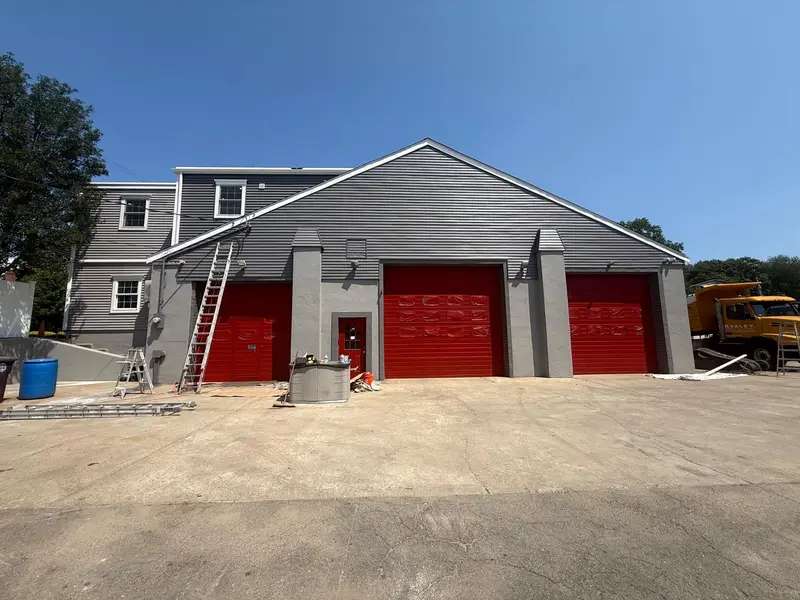
A garage building in Weymouth with white overhead doors and masonry pilasters whose paint was peeling. The doors and service doors were painted red and the pilasters refinished in gray.
See the photos →Routine maintenance is excluded from review, and repainting in white or a pre-approved color is exempt. Whether keeping an existing non-white color counts as maintenance is a question for the Historic Districts Commission; a short email with a photo and the color name settles it before you buy paint.
Once you apply, the commission has 14 days to decide whether review is needed. If it holds a hearing, it must decide within 45 days. Building that window into the schedule keeps a spring application from pushing the job into fall.
Taking them down temporarily to paint them is part of the work. Leaving them off for good inside a district requires commission approval, and the guidelines ask that wood shutters be repaired rather than replaced where possible.
Paint itself does not trigger the Demolition Delay Bylaw, which centers on pre-1940 structures. Federal lead-safe rules do apply to paid work on a pre-1978 house once more than 20 square feet of paint is disturbed outside.
Shaded walls hold moisture longer, which encourages mildew and lets water work behind the film. Those elevations usually need cleaning, scraping back to sound paint and full drying before priming, and sometimes a look at gutters and trim gaps.
The size of the house, the amount of scraping, carpentry repairs, lead-safe setup and the number of colors move the number most. The exterior painting cost guide and the Sudbury cost page summarize Massachusetts market data; AJ Painting gives a written estimate after a free on-site visit.
AJ Painting, based in Ashland, is licensed and insured. Call (508) 258-4325, Mon–Sat 7AM–6PM, to set up a free on-site look at your siding and trim and a written estimate.
5.0 on Google · 35 verified reviews · Licensed & insured · Written quote in 48h