
Norwood, MA
Porch Floor, Steps & Railings in Norwood, MA
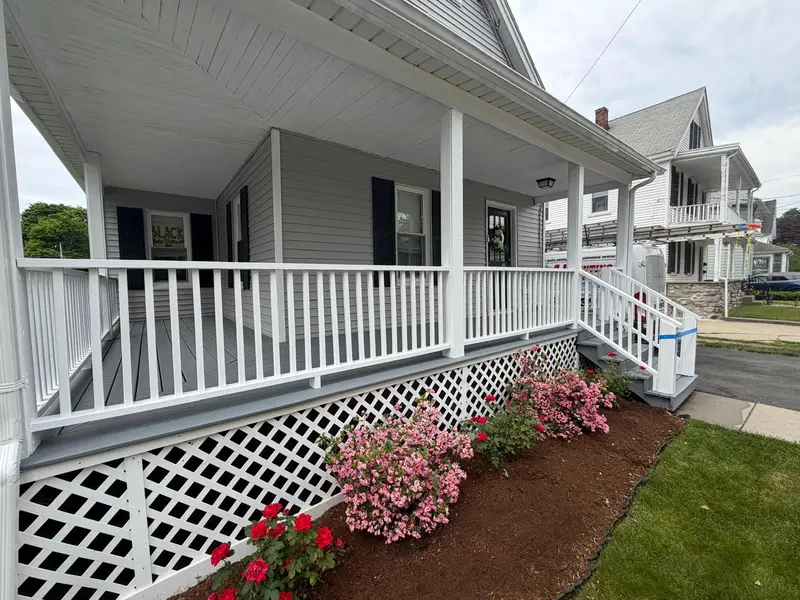
A Norwood home's front and back porches: floor boards and steps painted gray, with railings, balusters and lattice skirting in white.
See the photos →Deck boards, rails, stairs and porch floors cleaned, repaired and coated with a penetrating stain, solid stain or porch enamel suited to the wood and how much sun it gets.
The town's 2022 preservation plan describes a landscape that was open farmland with far fewer trees from the 1700s into the mid-1900s, and woodland that has returned since the suburbs filled in. For a deck, that tree cover cuts both ways. Shade keeps summer sun from baking the finish, but it also slows drying after rain, holds leaves and pollen against the boards and gives mildew a place to start. A deck under tall trees and a deck on an open south-facing lawn on the same street can need different products and different recoat schedules.
Single-family detached houses make up 83.8% of housing units. Another 8.1% are single-family attached homes; if yours is one of them, check whether a condominium or homeowners association sets rules on deck color or shared railings before choosing a stain.
In December 2003 manufacturers voluntarily stopped making CCA-treated wood for homeowner uses. EPA does not require tearing out older CCA decks, and it suggests that regularly applying a penetrating coating such as stain may reduce leaching. On an older deck, then, a maintained stain coat may do more than improve its looks.
On a shaded deck, a penetrating semi-transparent stain has an advantage: when it wears, it fades rather than peels, and the next coat goes on after cleaning without scraping. Solid stains and porch paints hide mismatched or repaired boards better and block more UV, but once moisture gets underneath, the film lifts and must be scraped before recoating. The deck paint and stain comparison and the article on how deck stain survives a New England winter go further into the trade-off.
Over half of local housing, 53.7%, predates 1980, and a front porch on a house that age may have painted floors and steps rather than stain. In housing built before 1978, paid exterior work that disturbs more than 20 square feet of paint falls under EPA lead-safe rules, and scraping a porch floor and its stairs can reach that. The lead-safe painting page explains the containment involved.
If the house is in one of the local historic districts, the commission reviews exterior features visible from a public way, with visibility judged even in winter when leaves are down. A front porch facing Old Sudbury Road is plainly in view; a back deck may not be. Repainting in white or a pre-approved color is exempt, and for anything else, ask the Historic Districts Commission whether your porch or deck color needs a Certificate of Appropriateness.
Shaded decks benefit most from a thorough cleaning: a deck cleaner to lift mildew and gray fibers, a full rinse, a brightener to neutralize the cleaner, light sanding where fibers are raised, and then enough dry days for the wood to dry out. Loose nails get reset or replaced with screws, and soft treads, rail caps and post bases are replaced before stain goes on.
Stain needs dry wood and dry weather to cure, which puts the work between late spring and early fall. If the house is being repainted the same season, finishing the deck after the exterior painting keeps drips and ladder marks off fresh stain.
| Single-family detached homes | 83.8% of units (5,446 of 6,497) (U.S. Census ACS 2020–2024 5-year, table B25024) |
| Single-family attached homes | 8.1% of units (526) (U.S. Census ACS 2020–2024 5-year, table B25024) |
| Woodland since suburbanization | Returned after an open farm landscape lasting into the mid-1900s (Town of Sudbury Communitywide Historic Preservation Plan (2022), Chapter III) |
| CCA lumber for homeowner use | Discontinued December 2003 (U.S. EPA, Chromated Arsenicals (CCA)) |
| Exterior lead-safe threshold | Over 20 sq ft of paint disturbed, pre-1978 housing (U.S. EPA, Renovation, Repair and Painting Program: Contractors) |
These jobs were in other towns, not in Sudbury. Each card names the town where the work was done.
A Norwood home's front and back porches: floor boards and steps painted gray, with railings, balusters and lattice skirting in white.
See the photos →Stain alone will not. Mildew grows on the dirt and pollen that sit on damp boards. Cleaning before staining, trimming back branches if you can, and rinsing off leaf debris through the season all help a fresh coat last.
It may be CCA-treated lumber, which manufacturers stopped producing for homeowner use in December 2003. EPA does not call for removing it; it advises goggles and a dust mask when sawing it, washing your hands after handling, and never burning scraps, and it notes that a penetrating stain applied regularly may reduce leaching.
Only once the old paint or solid stain is fully stripped or sanded off. A penetrating stain has nothing to soak into while a film still seals the wood.
White or a commission pre-approved color is exempt, and features not visible from a public way are outside review. For any other color on a visible porch, check with the Historic Districts Commission before buying paint.
Drip water on the boards in the sunniest spot. If it darkens the wood and soaks in within a few minutes rather than beading up, the finish has worn through.
Deck square footage, railing and stair length, whether an old film must be stripped, and board replacement drive most of the difference. The deck staining cost guide has Massachusetts market data, and AJ Painting provides a written estimate after a free on-site visit.
AJ Painting is licensed and insured. Call (508) 258-4325, Mon–Sat 7AM–6PM, to schedule a free look at your deck or porch and a written estimate.
5.0 on Google · 35 verified reviews · Licensed & insured · Written quote in 48h