

Norwood, MA
Porch Floor, Steps & Railings in Norwood, MA
A Norwood home's front and back porches: floor boards and steps painted gray, with railings, balusters and lattice skirting in white.
See the photos →Siding, trim, windows, doors and porches painted after the scraping, repairs and priming that the house's age and materials call for.
Outside, the age of a house shows up in its siding. Stoneham's 2024 Historic Preservation Plan describes the colonial survivors as timber frames covered in wood clapboards or shingles, and cites the Jonathan Green House at 63 Perkins Street, from about 1720, as clapboard-sheathed on a granite foundation. The 1989 National Register nomination for the Nobility Hill district lists shingle, clapboard and asphalt as wall materials in a district whose 33 contributing houses date from the 1860s to the 1920s.
The post-war era added a different kind of exterior. Between 1935 and 1965 the population went from 10,841 to more than 20,000, and the plan characterizes the new building as detached single-family houses in styles such as Capes and Ranches, often put up in batches along curving streets and cul-de-sacs. Census counts put 4,137 units, 40.6% of local housing, in the 1950 to 1979 decades.
Wood clapboards and shingles are scraped of loose paint, feathered at the edges, and spot-primed on bare wood before the finish coats. Split boards and soft sill ends are repaired or replaced first, because paint over rot fails within a season or two. Cedar shingles that were originally stained, not painted, are better served by a solid stain than by a film-forming paint.
Asphalt siding and later vinyl or fiber-cement replacements have their own rules: some can be painted with the right product and color range, while others are better left alone. A look at the material, and at the manufacturer's guidance, comes before any quote.
The town has four National Register historic districts, Central Square, Nobility Hill, the Middlesex Fells Reservoirs and the Middlesex Fells Reservation Parkways, and 154 resources on the Register. According to the 2024 plan, it has no local historic district and no demolition delay bylaw, and only two National Register buildings, the Warren Sweetser House and the Stoneham Fire Station, have significant protection through preservation restrictions.
In practice, that means there is no local district commission reviewing exterior changes as of the plan's writing; it recommends studying one. Even without a review board, the color history of an Italianate or Queen Anne house is worth considering, and the plan is a readable starting point for anyone curious about their own street.
With 70.3% of housing built before 1980, a scraped exterior can release lead dust and chips into soil and garden beds. The EPA's lead rule covers paid exterior work on pre-1978 housing that disturbs more than 20 square feet of paint. Scraping one side of an older house can pass that threshold, so on covered jobs ground sheeting, misting, careful cleanup and no power-sanding without HEPA collection are part of the job. More detail is on our lead-safe painting page.
Exterior paint needs dry surfaces and temperatures inside the label range during application and while it cures, which puts most of the work between spring and fall; our post on painting a house exterior in November covers the edges of that window. For specific areas, see our pages on Farm Hill and Bear Hill, and for a deck or porch floor, the deck staining page.
| National Register historic districts | 4 districts; 154 listed resources (Final Stoneham Historic Preservation Plan (2024)) |
| Local historic district / demolition delay bylaw | None, as of the 2024 plan (Final Stoneham Historic Preservation Plan (2024)) |
| Nobility Hill wall materials | Shingle, clapboard and asphalt (33 contributing houses, 1989) (Nobility Hill Historic District National Register nomination (1989)) |
| Housing units built 1950–1979 | 40.6% (4,137 of 10,196) (U.S. Census ACS 2020–2024 5-year, table B25034) |
| EPA lead rule exterior exemption | 20 sq ft or less of disturbed paint (U.S. EPA, Renovation, Repair and Painting Program) |
These jobs were in other towns, not in Stoneham. Each card names the town where the work was done.
A Norwood home's front and back porches: floor boards and steps painted gray, with railings, balusters and lattice skirting in white.
See the photos →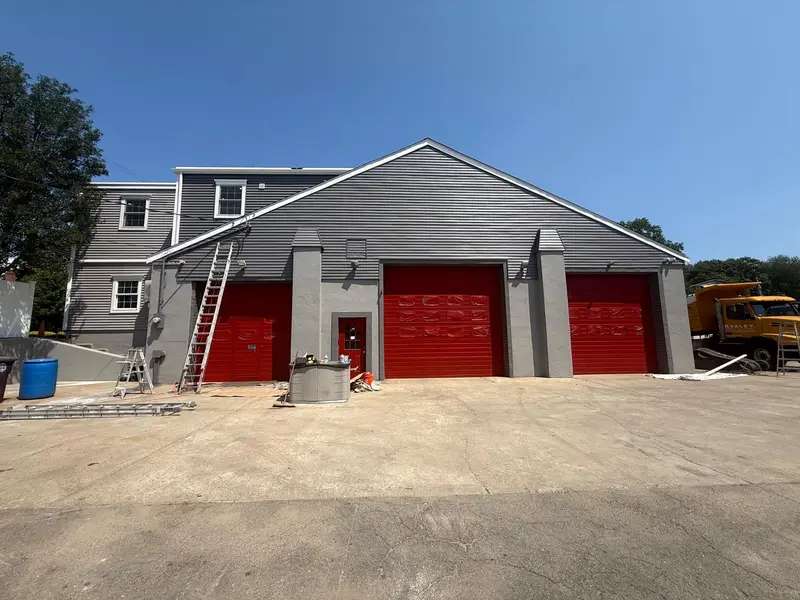
A garage building in Weymouth with white overhead doors and masonry pilasters whose paint was peeling. The doors and service doors were painted red and the pilasters refinished in gray.
See the photos →The town's 2024 preservation plan says there is no local historic district, the kind of district with a commission that reviews exterior changes. National Register listing on its own did not create that review. Because town bylaws can change after a plan is written, a call to the Historical Commission or building department before a major exterior change is a sensible check.
Some can. Vinyl takes paint formulated for it, in colors no darker than the manufacturer allows, since dark colors can make it warp in the sun. Old asphalt siding can hold paint if it is sound and clean. Brittle or crumbling material is a case for replacement, not paint.
All loose and peeling paint comes off, and edges are sanded so they don't show through the new coat. Paint that is still tightly bonded can stay. On a pre-1978 house the scraping is done with ground protection and lead-safe cleanup.
Start with the trim, fascia and window sills, on the sides that take the most sun and anywhere gutters overflow. Doors and the bottom courses of siding near the ground are other places to check.
Siding type and condition, height and access, the amount of scraping and carpentry, the number of windows and trim colors, and lead-safe setup on older homes. Our exterior painting cost guide summarizes market data for the state; the number for your house comes from an on-site estimate.
Sometimes, on days when surfaces are dry and the temperature stays within the paint's minimum through the drying period. The window narrows quickly once nights turn cold, so late-season jobs are planned around the forecast.
AJ Painting, based in Ashland and owned by Andre, is licensed and insured with a 5.0 Google rating from 35 reviews. Call (508) 258-4325 Mon–Sat, 7AM–6PM, for a free written estimate.
5.0 on Google · 35 verified reviews · Licensed & insured · Written quote in 48h