
Norwood, MA
Porch Floor, Steps & Railings in Norwood, MA
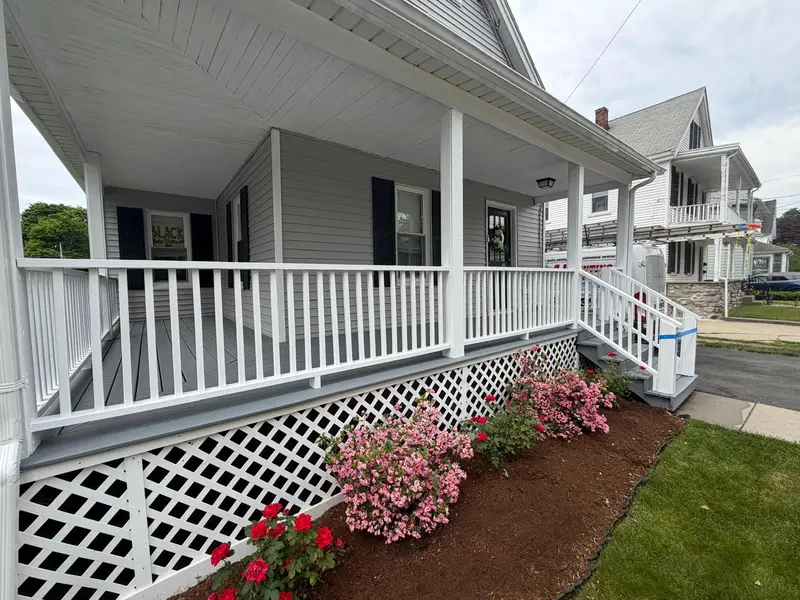
A Norwood home's front and back porches: floor boards and steps painted gray, with railings, balusters and lattice skirting in white.
See the photos →Decks, porches, stairs and railings washed, repaired and finished with a stain or paint chosen for the wood and for how much sun the yard gets.
A deck needs a yard, and in town 5,531 housing units, or 54.2%, are single-family detached homes, with another 412 single-family attached. Of 9,749 occupied homes, 71.0% are lived in by their owners.
Homes built from 1950 through 1979 make up 40.6% of the housing stock. The 2024 Historic Preservation Plan says the town nearly doubled in population between 1935 and 1965, as farmland was subdivided and wetlands were filled, and that new development tended toward detached houses on large lots, often built in batches in subdivisions with curvilinear streets and cul-de-sacs. A deck behind one of those houses may be much newer than the house itself, so the deck's own age and lumber are what to look at.
The same plan notes that the town's growth was shaped by its plateau, the Middlesex Fells and Spot Pond. A town-wide description says little about one backyard, though: whether your deck sits under trees, in open sun or on low ground that dries slowly matters more than any average.
Full sun breaks down stain through ultraviolet exposure, so south- and west-facing decks benefit from more pigment. Shade and damp produce mildew, algae and soft spots where boards stay wet, which calls for a deep cleaning, good drying time and a breathable product. Leaves packed between boards and planters sitting directly on the decking hold water, so they are cleared before work starts.
Pressure-treated pine has to dry out before it takes stain; if water beads on the surface, it is not ready. Cedar and redwood absorb stain well and are soft enough that heavy sanding can gouge them. Ipe and other dense hardwoods repel ordinary stain and need oils formulated for them. Composite and PVC boards are cleaned according to the maker's instructions; most are not meant to be stained.
Rot is checked before any finish goes on. A screwdriver that sinks into a board, joist top or stair stringer marks a repair, and loose railings are a safety issue to fix before cosmetics.
Clear and semi-transparent stains let the grain show and wear gradually, which makes the next coat straightforward. Solid stains and porch paints cover blemishes and mismatched replacement boards, but they sit on the surface and can peel underfoot. Splitting the job, with a penetrating stain on the floor and a solid color on rails and balusters, is one way to get both. Our comparison of deck paint and deck stain and our note on deck stain through a New England winter go further.
An older porch on one of the 2,504 local homes built in 1939 or earlier may have floors and railings with many layers of paint. On pre-1978 homes, scraping more than 20 square feet of exterior paint falls under the EPA's lead-safe rules, explained on our lead-safe painting page. Siding and trim around the porch are covered on the Stoneham exterior painting page, and our Farm Hill and Bear Hill pages look at those areas.
| Single-family detached homes | 54.2% of housing units (5,531 of 10,196) (U.S. Census ACS 2020–2024 5-year, table B25024) |
| Owner-occupied homes | 71.0% of occupied units (6,923 of 9,749) (U.S. Census ACS 2020–2024 5-year, table B25003) |
| Population growth during the post-war build-out | 10,841 (1935) to more than 20,000 (1965) (Final Stoneham Historic Preservation Plan (2024)) |
| Homes built in 1939 or earlier | 24.6% (2,504 of 10,196) (U.S. Census ACS 2020–2024 5-year, table B25034) |
These jobs were in other towns, not in Stoneham. Each card names the town where the work was done.
A Norwood home's front and back porches: floor boards and steps painted gray, with railings, balusters and lattice skirting in white.
See the photos →A penetrating stain with mildew inhibitors, applied after a thorough cleaning and full drying, handles damp conditions better than a film that can trap moisture and peel. Trimming branches and keeping the gaps between boards clear help the deck dry between rains.
Loose areas have to be scraped or stripped first, or the new coat will lift with them. If the old film is failing over most of the floor, stripping to bare wood and switching to a penetrating stain is the more durable fix; where it is still well bonded, a fresh coat of solid stain can go over it.
When water soaks into the boards instead of beading. That can take weeks or months depending on how wet the lumber was and how much sun the deck gets. Staining too early traps moisture and the finish fails sooner.
Generally no. Composite and PVC decking is cleaned with products the manufacturer approves. Some older composites can be coated with specialty products, but the maker's guidance comes first because coating can affect a warranty.
Square footage, stairs and railings, board replacement, whether old finish has to be stripped, and the product chosen. The deck staining cost guide gives statewide market figures; an on-site measurement produces the price for your deck.
Dry wood, no rain for the drying period on the label, and temperatures within the product's range. Washing adds a drying day or more before stain goes on, so schedules have room for weather delays between late spring and early fall.
AJ Painting of Ashland is licensed and insured, with 35 Google reviews averaging 5.0. Call (508) 258-4325, Mon–Sat 7AM–6PM, for a free visit and written estimate.
5.0 on Google · 35 verified reviews · Licensed & insured · Written quote in 48h