

Norwood, MA
Porch Floor, Steps & Railings in Norwood, MA
A Norwood home's front and back porches: floor boards and steps painted gray, with railings, balusters and lattice skirting in white.
See the photos →Siding, trim, doors and porches painted on Randolph houses, with prep matched to the age of the building and what has been replaced over the years.
Randolph's outside walls span more than two centuries. The Randolph Historical Commission's 2013 preservation plan says the oldest surviving houses are late-1700s, 1½-story side-gabled Capes, still found along streets such as Lafayette, Mill, Oak, Orchard, Union and North and South Main. Federal two-story houses followed, then Greek Revival and Italianate homes built during the boot-industry boom of 1840–1872, and Victorian and Queen Anne houses after that.
Those older houses are a minority now. The census counts 14.3% of units as built in 1939 or earlier and puts the median construction year at 1966, and the plan describes the postwar decades as a wave of modest ranches and Capes built on open land and old farms. The trim to prepare varies with the style: an Italianate house may have brackets under the eaves, a Queen Anne may have porch spindles and patterned shingles, and a ranch has long runs of fascia and soffit.
The consultants who wrote the preservation plan surveyed the town street by street and found that many historic buildings have been altered or had original materials replaced. For a painter, that means looking before assuming. A 19th-century house may now wear vinyl or aluminum on the walls with original wood only on the trim, while a postwar Cape might still have its first wood clapboards or shingles under several coats.
Wood that has been painted many times can fail as a thick, brittle film: long cracks, curling edges and bare gray wood where the coating has let go. That kind of failure needs scraping back to a sound edge, sanding, spot priming of bare wood and caulking of open joints before any finish coat. Painting over it only adds weight to a layer that is already lifting.
In the census, 69.6% of the town's housing units were built before 1980, and federal rules treat painted surfaces on pre-1978 homes as potential lead hazards. When paid work disturbs that paint, the EPA's RRP rule requires a certified firm and lead-safe methods. Outside, that means plastic sheeting on the ground extending out from the wall, closed windows nearby, no open-flame burning or uncontained power sanding, and a careful cleanup of chips at the end of each day.
Garden beds, play areas and a neighbor's driveway close to the property line all matter when setting up containment. Our lead-safe painting page covers the requirements.
Randolph had not adopted a local historic district as of the 2013 preservation plan. A study committee proposed one for part of North Main Street in 2003, the article was withdrawn after opposition, and the 2013 plan recommended trying again. The town's demolition-delay bylaw, as the plan describes it, deals with tearing buildings down, not with paint colors.
Rules can change after a plan is written, so the owner of an older house near the town center may want to check with the Historical Commission before a major exterior change. The plan's leading example of rehabilitation is the 1806 Jonathan Belcher House on North Main Street, then getting a full exterior restoration paid for partly with Community Preservation funds.
Randolph sits inland, on what the 1979 state survey calls rocky, glacially shaped uplands with ponds, bogs and swamps. A wall that stays shaded and damp, such as the north side of a house near wet ground or under trees, tends to grow mildew and needs a wash and a mildew treatment before paint.
Exterior paint needs dry surfaces and temperatures above the minimum printed on the can, both while it goes on and overnight while it cures. Our blog post on the best time of year to paint in Massachusetts goes through the seasons. For work inside, see our interior painting page for Randolph.
| Earliest surviving houses | Late-1700s 1½-story side-gabled Capes (Randolph Historical Commission, Randolph Preservation Plan 2013) |
| Median year built | 1966 (±3) (U.S. Census ACS 2020–2024 5-year, table B25035) |
| Housing units built before 1980 | 69.6% (9,099 of 13,080) (U.S. Census ACS 2020–2024 5-year, table B25034) |
| Local historic district | None adopted as of 2013; North Main Street proposal withdrawn (Randolph Preservation Plan 2013) |
| Jonathan Belcher House | Federal style, 1806; on the National Register since 1976 (National Register of Historic Places listings in Norfolk County) |
These jobs were in other towns, not in Randolph. Each card names the town where the work was done.
A Norwood home's front and back porches: floor boards and steps painted gray, with railings, balusters and lattice skirting in white.
See the photos →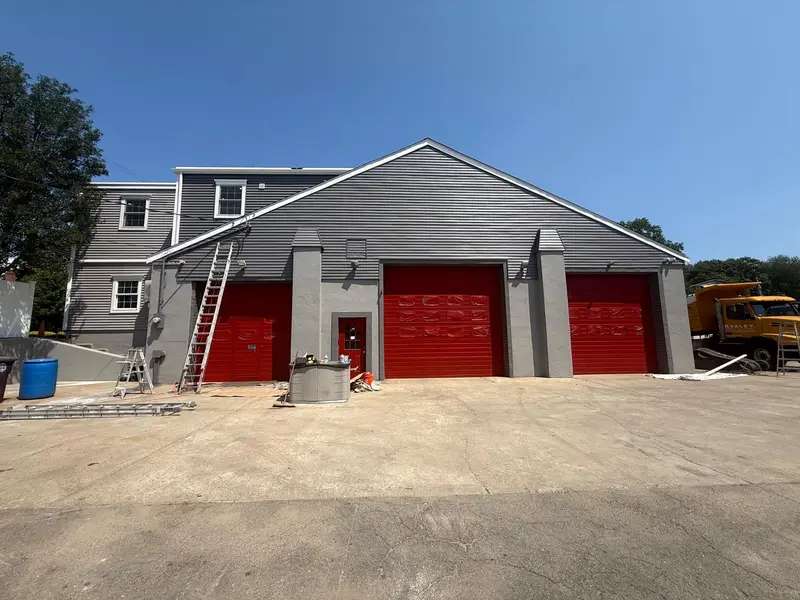
A garage building in Weymouth with white overhead doors and masonry pilasters whose paint was peeling. The doors and service doors were painted red and the pilasters refinished in gray.
See the photos →No local historic district had been adopted as of the town's 2013 preservation plan, and the demolition-delay bylaw it describes covers demolition rather than paint. If your house is old and near the town center, a quick call to the Historical Commission confirms nothing has changed since.
Yes. Trim, doors, shutters and window casings can be painted on their own. Vinyl itself can also be painted with a vinyl-safe color, but a much darker color than the original can make it warp in the sun, so color choice matters there.
Not always. Loose paint is scraped back to a firm edge and the transitions are sanded, and a full strip is generally reserved for walls where the coating has failed across most of the surface. Because older coats on a pre-1978 house may contain lead, that scraping follows EPA lead-safe practices.
Walls that get little sun and stay damp grow mildew and algae. They need washing and a mildew treatment before painting, and trimming back shrubs or branches touching the siding helps the wall dry out between rains.
The size of the house, the number of stories, the amount of scraping and repair, and how much trim there is all drive the total. Our exterior painting cost guide explains how each of those factors affects a Massachusetts job, and the free on-site visit gives you a written estimate for your own house.
It depends on prep, the product, sun exposure and how well the wood was sealed. Our post on how long exterior paint lasts in Massachusetts explains the factors that shorten or extend a paint job.
AJ Painting is licensed and insured and works Monday to Saturday, 7AM to 6PM. Call (508) 258-4325 for a free on-site visit.
5.0 on Google · 35 verified reviews · Licensed & insured · Written quote in 48h