
Norwood, MA
Porch Floor, Steps & Railings in Norwood, MA
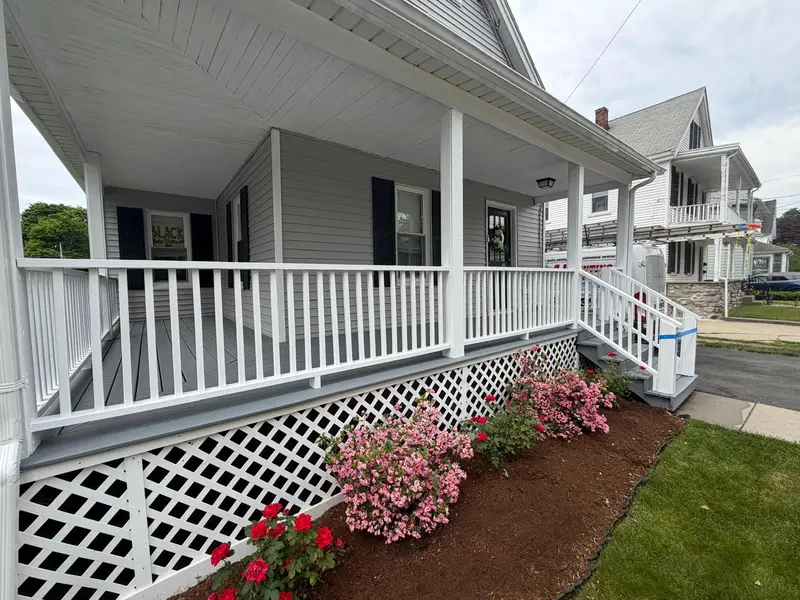
A Norwood home's front and back porches: floor boards and steps painted gray, with railings, balusters and lattice skirting in white.
See the photos →Siding, trim, doors and porches scraped, repaired, primed and painted, with prep sized to the house's age and how wet its lot stays.
A state survey from 1980 describes the town as rolling upland with sandy to gravelly soil, two large lakes, several smaller ponds, and large areas of bog and marsh, especially toward the east. Those wet stretches matter to an exterior job. A wall that faces a pond or a low, marshy yard stays damp longer after rain and dew, and paint on damp wood blisters and grows mildew sooner than paint on a sunny, well-drained side.
A walk around the house before the estimate shows where that happens, such as a north wall, a side shaded by trees, or the sill and lowest courses just above the foundation. Those spots need the most prep.
The Massachusetts Historical Commission lists side-hall cottages, in Greek Revival, Italianate and some Second Empire styles, among the most widespread house types of 1830 to 1870, and calls side-hall cottages of Victorian Gothic/Queen Anne or plain mid-Victorian design the most widespread type of 1870 to 1915. A small number of Second Empire cottages went up on Bacon Street around 1865 to 1875. On a wood-sided cottage, trim pieces such as corner boards, window casings, brackets and porch posts tend to lose paint first, at the joints.
Bringing them back means scraping loose paint, sanding feathered edges, replacing rotted pieces, priming bare wood, and caulking the seams that open each winter. On a house this old, that hand work can take longer than painting the siding itself.
About 53% of local housing units predate 1980, the nearest Census cutoff to the 1978 federal lead paint ban. Dry-scraping or power-sanding old exterior paint can scatter chips into garden beds and onto neighboring lots. Contractors who disturb paint on pre-1978 homes must be EPA RRP certified and use practices such as ground sheeting, misting while scraping, and careful cleanup. The details are on our lead-safe painting page.
The 1970s were the single largest building decade in the Census table, with about 16% of units, and another 38% were built from 1980 to 2009. On a newer house, the painted parts may be limited to trim, fascia, doors, shutters and any wood or fiber-cement siding. With fewer old coats underneath, the prep is often lighter than on a 19th-century cottage, though rot at fascia and sills still needs checking.
Vinyl and aluminum siding can be painted, but the color has to stay within the light-reflectance range the siding maker allows, or the panels can warp in summer sun. Manufactured homes are about 7% of the housing stock, and one with vinyl or metal siding calls for the same check.
The only local entry we found on the National Register is Angle Tree Stone, a boundary marker off High Street, not a house. We also found no local historic district under state law Chapter 40C, but confirm current rules with the town before changing an older facade.
Exterior paint needs dry surfaces and air and surface temperatures within the label range through the cure. In this part of Massachusetts that generally means late spring through early fall. Our article on the best time of year to paint goes into the details.
| Terrain and water | Rolling upland, sandy to gravelly soil, two large lakes and large bog/marsh areas, especially in the east (1980 survey) (Massachusetts Historical Commission, Reconnaissance Survey Town Report: Plainville (1980)) |
| Most widespread house type, 1870–1915 | Side-hall cottages (Victorian Gothic/Queen Anne or plain mid-Victorian design) (Massachusetts Historical Commission, Reconnaissance Survey Town Report: Plainville (1980)) |
| Housing units built in the 1970s | 16.4% (734 of 4,470, ±207), the largest single decade (U.S. Census ACS 2020–2024 5-year, table B25034, Plainville town (computed from table counts)) |
| Housing units built before 1980 | 52.9% (2,363 of 4,470) (U.S. Census ACS 2020–2024 5-year, table B25034, Plainville town (computed from table counts)) |
| National Register listing | Angle Tree Stone, boundary marker, listed 1976 (National Register of Historic Places listings in Norfolk County, Massachusetts) |
These jobs were in other towns, not in Plainville. Each card names the town where the work was done.
A Norwood home's front and back porches: floor boards and steps painted gray, with railings, balusters and lattice skirting in white.
See the photos →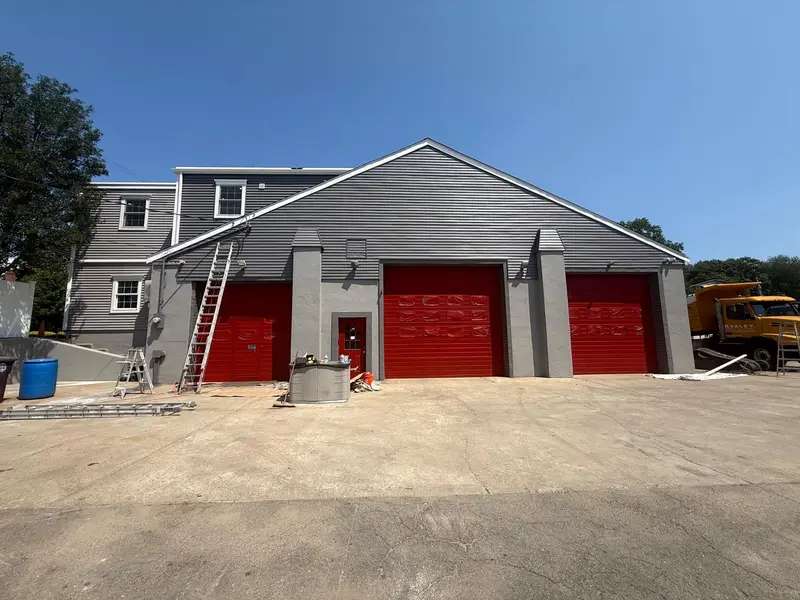
A garage building in Weymouth with white overhead doors and masonry pilasters whose paint was peeling. The doors and service doors were painted red and the pilasters refinished in gray.
See the photos →It may be moisture rather than the paint. Wood that stays wet pushes paint off from behind, so the fix starts with finding the source: gutters, splashback from the ground, plants against the wall, or missing caulk. Once that is handled and the wood is dry, primer and paint hold better.
We found no local historic district under Chapter 40C, the state law under which towns create local historic districts with design review. Rules can change, so a quick call to the town building department is worth it, and a condominium or townhouse association may set its own color rules.
Yes, with a paint made for vinyl and a color no darker than the siding maker allows. Darker colors absorb more heat and can make panels warp. The siding has to be washed and fully dry first.
It varies with prep, product, and exposure. A sunny south wall and a damp north wall on the same house can wear at different rates. Our article on how long exterior paint lasts in Massachusetts breaks down the factors.
The size and height of the house, how much scraping and carpentry the trim needs, lead-safe requirements on a pre-1978 home, and the number of colors. See the exterior painting cost guide for Massachusetts market data.
Each product lists a minimum application temperature, and the surface has to stay above it while the paint cures. Once cold nights arrive, getting the estimate done and scheduling the work for spring is the safer plan. Inside projects such as interior painting can keep going through winter.
AJ Painting Services, based in Ashland, is licensed and insured and offers a free on-site visit. Call (508) 258-4325, Mon–Sat 7AM–6PM.
5.0 on Google · 35 verified reviews · Licensed & insured · Written quote in 48h