
Norwood, MA
Porch Floor, Steps & Railings in Norwood, MA
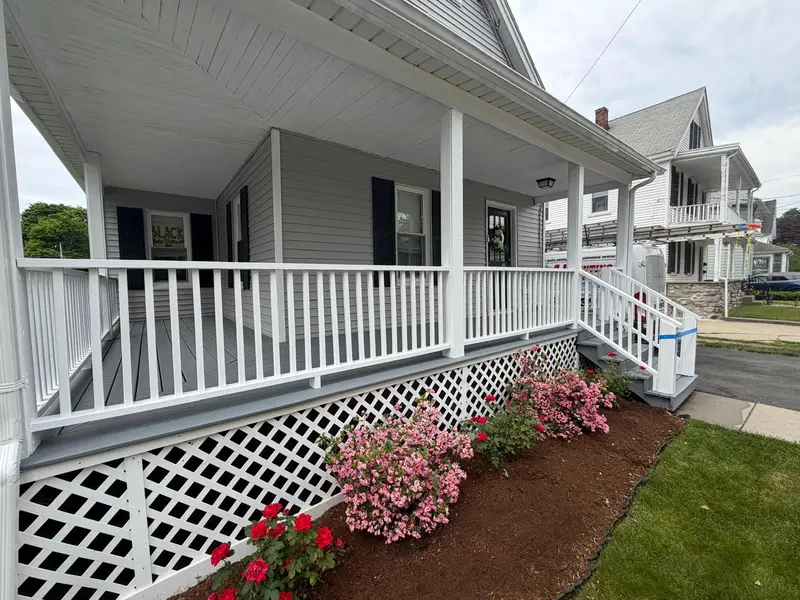
A Norwood home's front and back porches: floor boards and steps painted gray, with railings, balusters and lattice skirting in white.
See the photos →Deck floors, stairs, railings and porch steps washed, repaired and finished with a stain or paint suited to the wood and to how long the boards stay wet.
The Massachusetts Historical Commission's 1980 town survey describes rolling upland with sandy to gravelly soil, two large lakes and several smaller ponds, and large areas of bog and marsh, mostly in the eastern part of town. So two yards in the same town can treat a deck very differently. A deck on high, well-drained ground in full sun dries within hours of a storm, while one beside a pond or over low, wet ground can stay damp for much of the day.
Those two decks wear in opposite ways. The sunny one fades and checks as UV breaks down the stain and the wood surface. The damp one tends toward mildew, algae, and soft spots where water sits between boards. The cleaner, the product and the recoat schedule should be chosen for the site.
Stain only lasts if it can penetrate clean, dry wood. The usual sequence is a deck cleaner suited to the problem (a mildewcide wash for green, gray or black growth; a stripper for failing old coatings), a gentle rinse, and a brightener to restore the wood's pH. High-pressure washing at close range can raise and furrow the grain, so it is used with care.
After washing, the deck needs dry weather before staining. A simple test is to sprinkle water on a board: if it soaks in within a few minutes, the wood is ready; if it beads, it needs more time or the old finish is still sealing it.
Transparent and semi-transparent stains wear by fading, which makes the next coat simpler. Solid stains and porch paints cover more but can peel on horizontal surfaces, which is why they are often kept to railings, skirting and vertical trim.
Just over half of local housing units, about 53%, were built before 1980, and 13% date from 1939 or earlier. On houses that old, painted porch floors, steps and railings may have lead in the lower layers. Scraping or sanding them is regulated under the EPA RRP rule for paid work, with ground covers, wet methods and HEPA cleanup. Our lead-safe painting page explains the process.
Townhouses and other single-family attached units are about 7% of local housing, and manufactured homes about 7%. A townhouse deck may fall under association rules on color or on who handles maintenance, so check the governing documents. Wood steps and small decks built onto manufactured homes need the same cleaning and staining routine when they are pressure-treated lumber.
Stain needs a few dry days, with temperatures within the label range day and night. Late spring through early fall is the practical window; our post on deck stain and New England winters explains what cold does to a fresh coat.
| Terrain, lakes and wetlands | Sandy to gravelly upland, two large lakes, large bog/marsh areas especially in the east (1980 survey) (Massachusetts Historical Commission, Reconnaissance Survey Town Report: Plainville (1980)) |
| Single-family detached houses | 53.8% of housing units (2,407 of 4,470, ±395) (U.S. Census ACS 2020–2024 5-year, table B25024, Plainville town (computed from table counts)) |
| Single-family attached units | 7.1% of housing units (316 of 4,470, ±126) (U.S. Census ACS 2020–2024 5-year, table B25024, Plainville town (computed from table counts)) |
| Mobile homes | 7.4% of housing units (333 of 4,470, ±139) (U.S. Census ACS 2020–2024 5-year, table B25024, Plainville town (computed from table counts)) |
| Housing units built before 1980 | 52.9% (2,363 of 4,470) (U.S. Census ACS 2020–2024 5-year, table B25034, Plainville town (computed from table counts)) |
These jobs were in other towns, not in Plainville. Each card names the town where the work was done.
A Norwood home's front and back porches: floor boards and steps painted gray, with railings, balusters and lattice skirting in white.
See the photos →Kill and remove the growth with a mildewcide deck cleaner, rinse thoroughly, and give the boards time to dry, which can take longer on a shaded lakeside deck. Trimming back plants and clearing debris from the board gaps improves airflow and slows regrowth.
Once the lumber has dried enough to absorb water, which can take weeks to months depending on sun and the lumber. Use the water drop test; if it beads, wait. Kiln-dried-after-treatment lumber can be stained sooner.
A covered porch floor that stays out of standing water holds porch-and-floor enamel well. An open deck exposed to rain and snow usually does better with a penetrating stain, because film coatings peel where water sits.
Not reliably. New stain cannot bond to wood that is still covered by loose coating, so the failing finish has to be stripped or sanded off first. Spot-coating over peeling areas tends to bring the peeling back.
By deck area, stairs and railing length, the condition of the old finish, any board replacement, and the product chosen. The deck staining cost guide lays out those factors using Massachusetts market data.
Yes, and the timing can be coordinated so that siding and trim are finished before the deck is stained, which keeps drips off the fresh deck. See the exterior painting page for that side of the job.
AJ Painting Services, based in Ashland, is licensed and insured. Call (508) 258-4325, Mon–Sat 7AM–6PM, for a free on-site visit and written estimate.
5.0 on Google · 35 verified reviews · Licensed & insured · Written quote in 48h