
Norwood, MA
Porch Floor, Steps & Railings in Norwood, MA
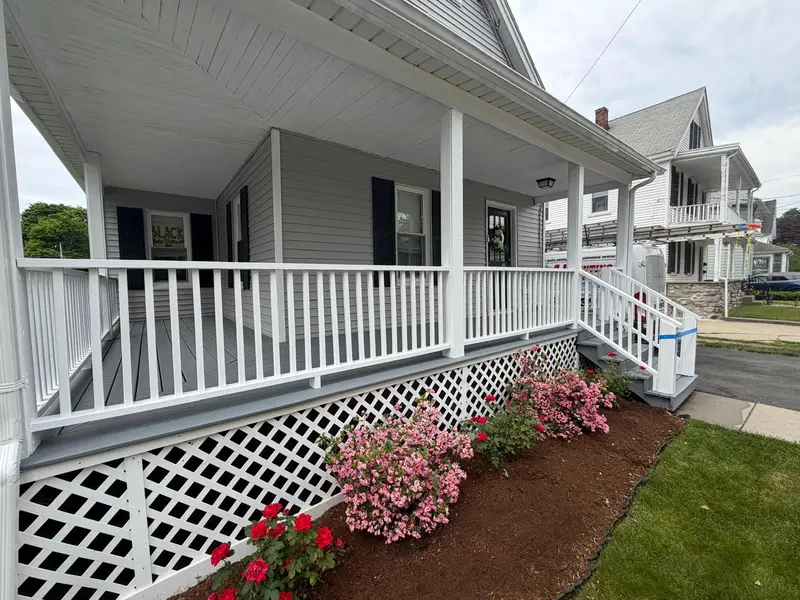
A Norwood home's front and back porches: floor boards and steps painted gray, with railings, balusters and lattice skirting in white.
See the photos →Siding, trim, doors and shutters painted with prep that fits the house, whether the house predates 1940 or went up in the decades after 1960.
How well a new exterior coat holds up here depends on three questions: whether the property sits in a local historic district, how much shade and moisture the walls get, and what is in the old paint layers.
The town's 2020 master plan notes that most parcels here were developed between 1960 and 1999. A house built in that span is now about 27 to 66 years old, which means the current paint sits over earlier coats whose condition decides how much scraping and priming the next job needs.
Northborough has two local historic districts: the Meeting House Common Historic District, set up at the April 1973 Town Meeting, and the single-building district at the Peter Whitney Parsonage. According to the Northborough Historical Society, the Meeting House Common district includes seven private homes along with the Unitarian Church, the colonial section of the Howard Street Cemetery and the Minuteman Muster Site.
The Northborough Historic District Commission handles exterior design review for improvements inside those districts. If your home is one of them, call the commission before ordering paint or replacing trim, shutters or doors, and ask which parts of the job need a certificate. Outside those two districts the commission's design review doesn't apply, but the town's 2008 historic resources survey named potential National Register districts, including 10, 12 and 16 Chapin Court (Davis Mill workers' housing) and a section of Main Street along the Boston Post Road; on houses there, period-appropriate colors are worth considering even without a review requirement.
The master plan describes the town's forests as mostly white pine and hemlock. Evergreens keep shading a wall all year, so north and east elevations under tall pines can stay damp long after a storm. That is where you see green mildew on clapboards, soft wood at the bottoms of corner boards, and paint lifting at the drip edge of window sills.
On those walls, washing with a mildewcide, letting the siding dry fully, replacing rotted trim and using a paint with mildew resistance matter more than the brand on the can. Trimming branches back from the roofline and siding helps the next coat last. Pine needles packed into gutters also overflow onto fascia and trim, so cleaning them is part of keeping paint intact.
Census data shows 49.3% of local housing units were built before 1980, and lead was banned from residential paint in 1978. Exterior trim, sills and porch parts on a house from before then may carry lead under newer coats.
Scraping and sanding that paint is regulated in Massachusetts: plastic sheeting on the ground, no power sanding without HEPA dust collection, collection of paint chips and a careful cleanup at the end of each day. That matters near vegetable gardens and play areas. Our lead-safe painting page explains the steps.
Weather sets the calendar. Paint labels list a minimum air and surface temperature, and late-season dew can ruin a coat that went on in the afternoon. The post on painting into November covers the cut-off, and common exterior paint failures shows what each kind of peeling means. For the deck and porch, see deck staining in Northborough.
| Local historic districts | 2: Meeting House Common and Peter Whitney Parsonage (Town of Northborough Master Plan 2020, Chapter 3) |
| Meeting House Common district | Est. 1973; 7 private homes plus church, cemetery section and muster site (Northborough Historical Society, "Meeting House Common Historic District" (2014)) |
| Exterior review body | Northborough Historic District Commission (local districts only) (Town of Northborough Master Plan 2020, Chapter 3) |
| Dominant forest cover | White pine and hemlock (Town of Northborough Master Plan 2020, Chapter 3 (Vegetation)) |
| Housing built before 1980 | 49.3% of units (U.S. Census ACS 2020–2024 5-year, table B25034) |
These jobs were in other towns, not in Northborough. Each card names the town where the work was done.
A Norwood home's front and back porches: floor boards and steps painted gray, with railings, balusters and lattice skirting in white.
See the photos →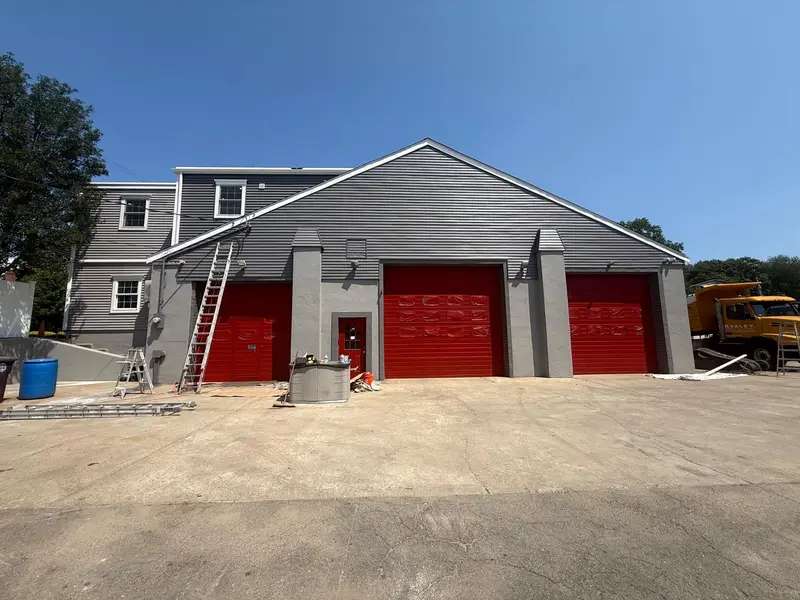
A garage building in Weymouth with white overhead doors and masonry pilasters whose paint was peeling. The doors and service doors were painted red and the pilasters refinished in gray.
See the photos →The Historic District Commission reviews exterior changes to properties in the town's local historic districts. Contact the commission through the town before work starts and ask which parts of your project need a certificate.
It's mildew or algae growing on a wall that stays shaded and damp, such as a wall shaded by pines or hemlocks. Washing it off with a mildewcide before painting, then using a mildew-resistant finish, keeps it from coming straight back. Trimming back branches to let in sun and air also helps the wall dry.
Yes, if lead is present. A 1960s house predates the 1978 ban, so the trim should be tested or treated as lead-containing. That means ground covers, hand scraping or HEPA-equipped sanding, and daily cleanup instead of dry power sanding.
It depends on the forecast, not the date. Most exterior paints list a minimum temperature, and the surface has to stay above it until the coat cures, with no dew landing on wet paint. Short fall days shrink the working window to midday.
Height and access, how much scraping and carpentry the siding needs, the amount of trim, and lead-safe requirements usually matter more than square footage. Massachusetts market ranges are in the exterior painting cost guide; a free visit gives you a written estimate.
Repainting itself generally isn't a building-permit item. The checks to make are historic district review if your property is in a local district, and the state lead rules if the house was built before 1978.
Licensed and insured, based in Ashland. Call AJ Painting at (508) 258-4325, Monday–Saturday 7AM–6PM, to book a free on-site visit and written estimate.
5.0 on Google · 35 verified reviews · Licensed & insured · Written quote in 48h