
Norwood, MA
Porch Floor, Steps & Railings in Norwood, MA
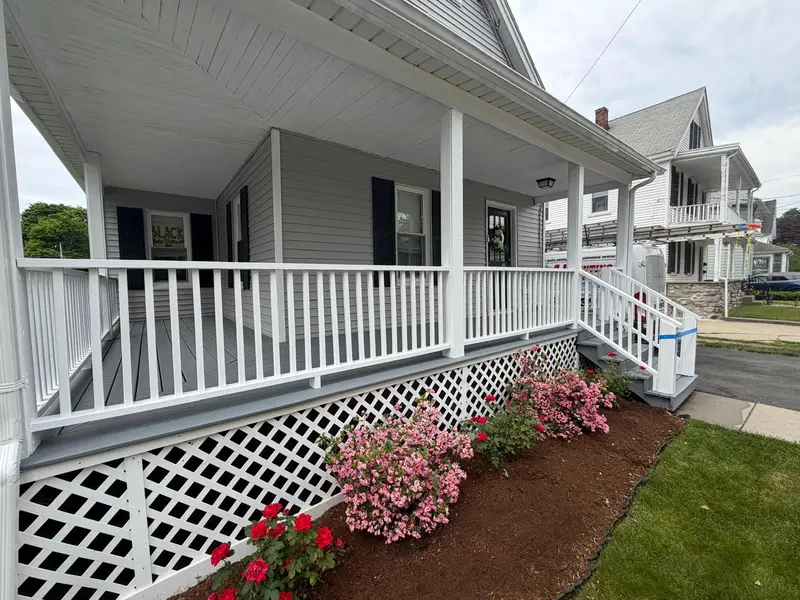
A Norwood home's front and back porches: floor boards and steps painted gray, with railings, balusters and lattice skirting in white.
See the photos →Washing, board repair and stain or paint for decks, porches, rails and steps, chosen for how much shade, debris and moisture the yard around the deck gets.
Census data shows 74.8% of the town's housing units are single-family detached homes, and another 8.0% are single-family attached. Where one of those homes has a deck, the finish wears according to the yard around it: how much sun it gets, what drops on it, and how fast it dries after rain.
Before picking a product, it helps to look at the deck on a damp morning. The boards that stay dark longest, the corners where debris collects, and the stair treads that get slick are where a finish will fail first.
The town's 2020 master plan describes local forests as mostly white pine and hemlock. Where they stand close to a deck, they shade it in every season and shed needles, pollen and sap onto it. Needles pack into the gaps between boards and hold water against the edges; sap leaves sticky spots that stain won't bond to.
For a deck in that setting, the maintenance between stain jobs matters as much as the stain itself:
Terrain here is rolling, higher in the western half of town, with elevations ranging from 250 feet to 715 feet at Mount Pisgah, according to the master plan. On a sloped lot, a deck is often elevated on one side, which leaves tall posts, long stair runs and the underside of the framing exposed to weather. Those vertical parts need finish too.
The plan names the Assabet River, running through the southeastern part of town, along with Little Chauncey Pond and Solomon Pond, as notable water resources. A deck that faces open water or sits low near wet ground can see more moisture than one on a dry upland lot, so let boards dry thoroughly before coating and favor penetrating finishes that allow the wood to breathe.
Pressure-treated pine is the usual framing and decking material for backyard decks. New boards come wet from treatment and should weather until a sprinkle of water soaks in rather than beading. Cedar resists rot naturally but turns silver within a season or two without a toned stain. Composite and PVC decking is cleaned, not stained.
A semi-transparent stain soaks into the wood and wears away gradually, so a recoat is a cleaning and a fresh coat. Solid stain and deck paint form a surface film that covers mismatched or weathered boards but can peel if water gets under it, and peeled film has to be stripped before switching back to a penetrating product. The paint vs. stain comparison walks through those trade-offs in more detail.
Census data puts 11.3% of local housing units in the 1939-or-earlier category, and a house of that age may have a covered porch with a painted tongue-and-groove floor rather than an open stained deck. Porch paint on a house built before 1978 may contain lead in its lower layers, so scraping and sanding it falls under Massachusetts lead-safe rules; see our lead-safe painting page. For the house walls and trim, go to exterior painting in Northborough, and deck stain in a New England winter explains how finishes wear over the cold months.
| Single-family detached homes | 74.8% of housing units (4,566 of 6,108) (U.S. Census ACS 2020–2024 5-year, table B25024) |
| Single-family attached homes | 8.0% of housing units (489, ±168) (U.S. Census ACS 2020–2024 5-year, table B25024) |
| Main forest types | White pine and hemlock (Town of Northborough Master Plan 2020, Chapter 3 (Vegetation)) |
| Elevation range | 250 ft to 715 ft (Mount Pisgah) (Town of Northborough Master Plan 2020, Chapter 3 (Landscape)) |
| Main water resources | Assabet River (southeast); Little Chauncey and Solomon ponds (Town of Northborough Master Plan 2020, Chapter 3 (Water Resources)) |
These jobs were in other towns, not in Northborough. Each card names the town where the work was done.
A Norwood home's front and back porches: floor boards and steps painted gray, with railings, balusters and lattice skirting in white.
See the photos →Needles themselves don't hurt stain, but trapped in the board gaps they hold moisture and feed mildew. Clearing them a few times a year, and especially before snow, keeps the edges of the boards dry and the finish lasting longer.
Stain won't bond well to sap. The spots need to be cleaned off with a solvent recommended by the stain maker, then the deck washed and dried before staining.
They should, at least the posts, stair stringers and rim boards you can see. Exposed framing on an elevated deck takes rain and sun just like the floor, and a matching finish there also makes the deck look finished from the yard.
When the wood is dry enough to absorb water instead of beading it. Depending on the lumber and the weather, that can take weeks to a few months. Staining too soon traps moisture and the stain won't soak in.
Railing and baluster count, stairs, board condition, and whether an old solid finish has to be stripped all weigh more than the floor area. The deck staining cost guide shows Massachusetts market ranges, and a free visit produces a written estimate.
Only after the paint is removed down to bare wood, since penetrating stain can't soak through a film. If stripping is more work than it's worth, a fresh coat of solid stain over well-prepped boards is the other route.
AJ Painting is licensed and insured and works out of Ashland. Call (508) 258-4325 Monday–Saturday, 7AM to 6PM, for a free on-site visit with a written estimate.
5.0 on Google · 35 verified reviews · Licensed & insured · Written quote in 48h