
Norwood, MA
Porch Floor, Steps & Railings in Norwood, MA
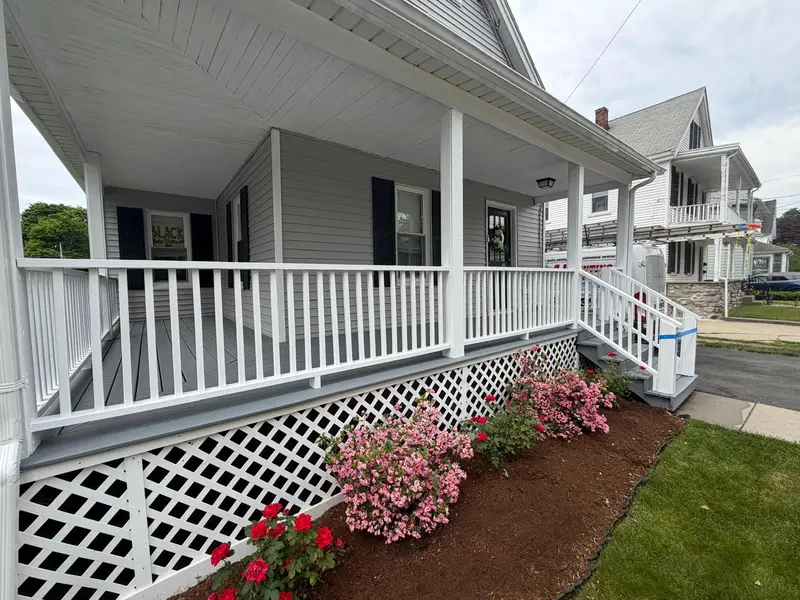
A Norwood home's front and back porches: floor boards and steps painted gray, with railings, balusters and lattice skirting in white.
See the photos →Prep, repair and repainting of siding, trim, doors and porches on Norfolk houses, from 1980s houses on estate lots to older homes near Rockwood Road.
The Census year-built table puts the town's median construction year at 1984, and its single biggest decade of building was the 1980s, with 824 of 3,557 housing units. The 1970s added another 612. A house from that era has stood through about four decades of New England weather, and every repaint it has had leaves another layer that the next coat has to bond to.
Nearly every house is a freestanding one: 90.8% of housing units are single-family detached. Each of its four sides faces different sun, wind and moisture.
After several repaints, the paint film on clapboard and trim gets thick and stiff. When it can no longer flex with the wood through a winter, it cracks along the board edges and lifts in sheets. A fresh coat over that kind of failure sticks only as well as the loosest layer underneath it.
Good prep on a house of this age means scraping to a sound edge, sanding the ridges so they don't telegraph through, priming bare wood, and caulking open joints at corner boards and window casings. Rotted sill and trim pieces get replaced or repaired with epoxy before primer, not painted over.
The Census counts 41.2% of the town's housing units as built before 1980. That Census cutoff falls two years after the 1978 federal ban on lead in residential paint, so the pre-1978 share is slightly smaller. On those houses the older layers under today's paint may contain lead, and dry scraping or power sanding them throws dust into the soil around the foundation, where children and pets play.
Federal EPA rules require lead-safe work practices when a contractor disturbs paint on a pre-1978 home: containment sheeting on the ground, misting, careful cleanup and proper disposal. Our lead-safe painting page explains what that looks like on a job.
The Charles, Stop and Mill rivers, along with Stony Brook and Cress Brook, run through town, and the town's draft master plan describes a long history of flooding tied to wetlands and other water features. A house that sits near one of those areas, or backs up to woods, can keep its north and shaded walls damp well into the day.
Damp siding is where mildew grows and where paint blisters when moisture pushes out from behind it. Before choosing a product, it helps to look at what is wetting the wall: gutters that overflow, sprinkler heads aimed at the clapboards, or shrubs touching the house. Fixing those keeps a new finish from failing early.
Norfolk has three National Register historic districts, including Rockwood Road and Sullivan's Corner at the junction of Main, Needham and Seekonk streets, plus 343 historic and cultural sites inventoried with the Massachusetts Historical Commission. The National Park Service states that Register listing alone places no restrictions on a private owner unless federal funding or permitting is involved, though state or local rules can still apply.
One local rule to know about is the town's demolition delay bylaw for buildings 75 years or older, which concerns tearing a structure down rather than repainting it. If you own one of the three properties in town that carry a preservation restriction, read that document before changing colors or materials.
Exterior paint needs dry surfaces and temperatures that stay above the product's minimum through the night it cures. Late spring through early fall gives the widest window, and fall work is possible on mild, dry stretches; see painting a house exterior in November for the limits. If the deck is due as well, deck staining in Norfolk can be scheduled around the same dry weather.
| Median year housing was built | 1984 (±3) (U.S. Census ACS 2020–2024 5-year, table B25035) |
| Housing units built before 1980 | 41.2% (1,467 of 3,557) (U.S. Census ACS 2020–2024 5-year, table B25034) |
| Single-family detached homes | 90.8% of housing units (U.S. Census ACS 2020–2024 5-year, table B25024) |
| National Register historic districts | 3 (Wrentham State School, Rockwood Road, Sullivan's Corner) (Norfolk Master Plan 2035, draft 5/13/24 (MAPC), p. 135) |
| Rivers and brooks crossing town | Charles, Stop and Mill rivers; Stony Brook and Cress Brook (Norfolk Master Plan 2035, draft 5/13/24 (MAPC), p. 115) |
These jobs were in other towns, not in Norfolk. Each card names the town where the work was done.
A Norwood home's front and back porches: floor boards and steps painted gray, with railings, balusters and lattice skirting in white.
See the photos →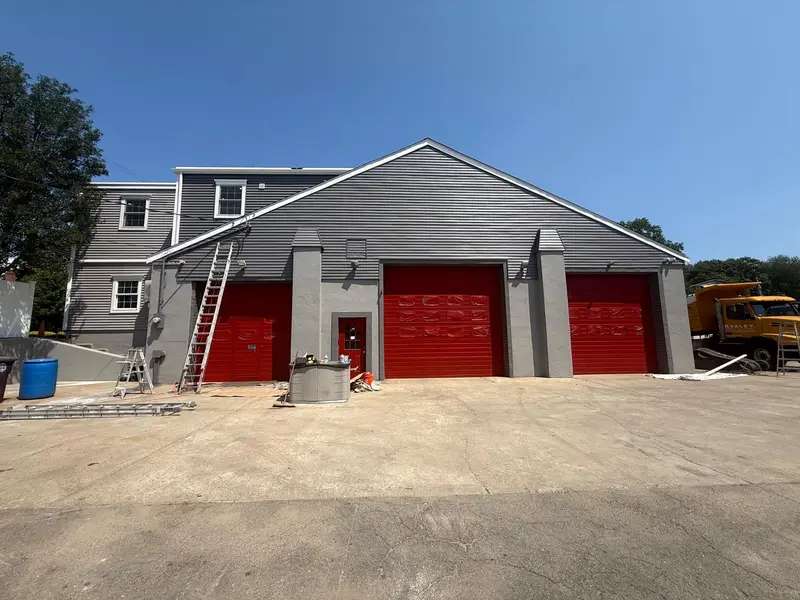
A garage building in Weymouth with white overhead doors and masonry pilasters whose paint was peeling. The doors and service doors were painted red and the pilasters refinished in gray.
See the photos →Register listing by itself doesn't. The National Park Service says listing places no restrictions on private owners unless the project uses federal money or permits. Separate state or local rules could still apply, so a quick question to the Norfolk Historical Commission before a big color change is worth it.
Long cracks that follow the board edges usually mean the paint film has become too thick and brittle after several coats. The fix is scraping and sanding those areas back to sound paint before priming. If the wood under the cracks is soft, that board needs repair first.
It helps, but the wall has to be cleaned of existing growth first or it comes back through the new coat. Cutting back plantings, fixing gutters and letting the wall dry faster will do as much as the paint does.
Older layers may contain lead, so the prep has to follow lead-safe practices: ground covers to catch chips, no dry power sanding, and a careful cleanup. It adds steps but keeps dust out of the yard. Our lead-safe page has the details.
Size matters, but so do the height of the walls, how much trim there is, how much failed paint has to come off, and whether lead-safe steps apply. The exterior painting cost guide summarizes Massachusetts market data, and the free visit ends with a written estimate for your house.
AJ Painting, based in Ashland, is licensed and insured. Call (508) 258-4325, Monday to Saturday, 7AM to 6PM, for a free on-site visit and written estimate.
5.0 on Google · 35 verified reviews · Licensed & insured · Written quote in 48h