
Norwood, MA
Porch Floor, Steps & Railings in Norwood, MA
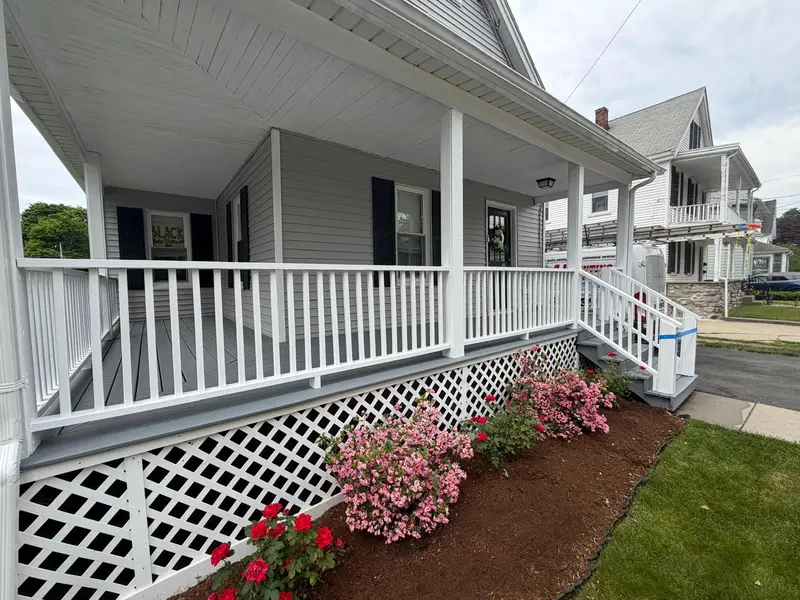
A Norwood home's front and back porches: floor boards and steps painted gray, with railings, balusters and lattice skirting in white.
See the photos →Siding, trim, doors and shutters scraped, repaired, primed and repainted, with the prep matched to the house's age and to how much shade and moisture it lives with.
Exterior paint in an inland town like this one fails from the same few causes: moisture getting behind the film, sun breaking down the side that faces south, and shade keeping the north side damp long enough to grow mildew. There is no salt air here; a state heritage report from 2006 even notes the town's lack of rivers and ponds. What the report does document is roadside tree cover, such as the arching canopy along Massachusetts Avenue (Route 111) between Middle Road and Hill Road that locals call the Cathedral of Trees.
A house under heavy canopy dries slowly after rain, collect pollen and leaf debris on sills and gutters, and tends to show green or black mildew first. Washing with a mildewcide before painting and checking that the gutters drain both address the moisture that shortens a coat's life.
Census figures show 24.1% of the town's housing went up in the 1970s and 29.1% in the 1990s. A house from the first wave has had roughly 50 years of repaints; layers can be thick, and where earlier coats were oil, newer latex sometimes lifts in sheets. That calls for scraping to a sound edge, feathering the transitions, and a bonding primer on bare and glossy spots.
A house from the second wave has been through fewer repaint cycles. Problems to look for at that age include primed trim that was never top-coated well, failed caulk at corner boards and window casings, and rot starting at the bottom of door jambs and garage trim where splashback hits. Rotted sections are cut out and replaced or epoxy-filled before priming.
Federal lead-paint rules apply to pre-1978 homes, and 45.8% of local housing predates 1980, the nearest Census bracket. Outside, the EPA's lead-safe requirements kick in once paid work disturbs more than 20 square feet of paint, a threshold a full scrape passes almost immediately. That means plastic sheeting on the ground, no open-flame burning, no power sanding without HEPA collection, and a cleanup of chips from soil and planting beds; misting the surface while scraping keeps dust down. Details are on the lead-safe painting page.
The Boxborough Old Town Center district along Hill Road was added to the National Register in 2006, with 52 contributing properties from the 1770s to the early 20th century in Colonial and Federal styles. National Register listing on its own places no federal restrictions on privately funded work, so repainting does not need a federal sign-off. Separately, the Historical Commission keeps a list of historically significant buildings subject to the town's Demolition Delay Bylaw; that bylaw concerns demolition applications, not color choices.
On those older houses the real questions are technical: old clapboard that has been painted many times, window sash with glazing putty that needs attention, and brick Federal houses where painted trim meets masonry. Whether to keep a traditional palette or change it is the owner's decision.
Twelve roads were covered by the Scenic Roads Bylaw as of 2006, including Hill, Sargent, Middle (between Hill and Depot) and Stow Roads. Removing trees or stone walls in the right-of-way on those roads requires a Planning Board public hearing. If a homeowner hopes to cut back a roadside tree to help a damp facade dry out, that process comes first; trees on the owner's side of the line are a separate matter.
Most exterior latex products need surface and air temperatures above roughly 35 to 50 degrees, depending on the product, and dry weather while they cure. That generally points to late spring through early fall, with October work scheduled around cool nights and morning dew. The post on painting an exterior in November covers the edge of the season.
| Units built in the 1970s | 567 units (24.1%) (U.S. Census ACS 2020–2024 5-year, table B25034) |
| Housing built before 1980 | 45.8% of units (U.S. Census ACS 2020–2024 5-year, table B25034) |
| Old Town Center Historic District | National Register, listed 2006; Colonial and Federal styles (National Park Service NPGallery, NRIS 06001122) |
| Scenic roads | 12 roads; tree or stone wall removal in the right-of-way needs a Planning Board hearing (as of 2006) (DCR / Freedom's Way, Boxborough Reconnaissance Report, 2006) |
| Exterior lead-safe threshold | More than 20 sq ft of paint disturbed, pre-1978 housing (U.S. EPA, Renovation, Repair and Painting Program: Contractors) |
These jobs were in other towns, not in Boxborough. Each card names the town where the work was done.
A Norwood home's front and back porches: floor boards and steps painted gray, with railings, balusters and lattice skirting in white.
See the photos →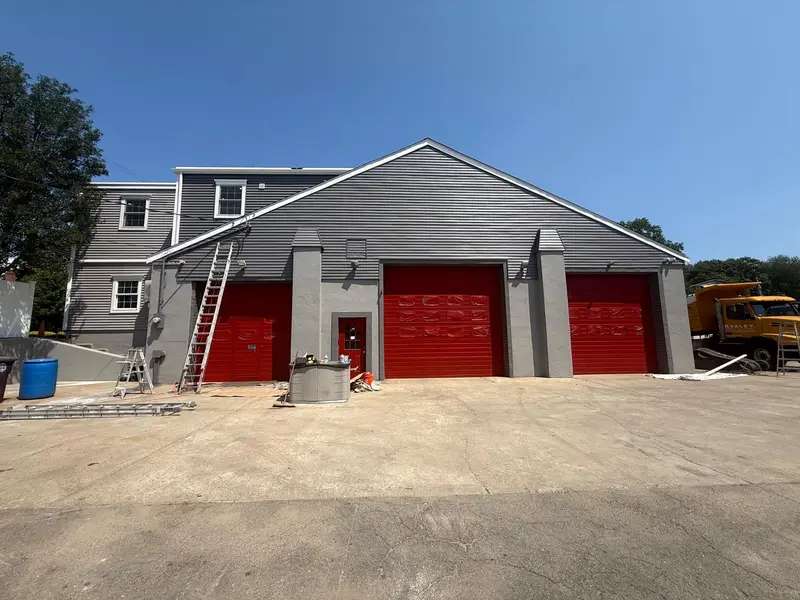
A garage building in Weymouth with white overhead doors and masonry pilasters whose paint was peeling. The doors and service doors were painted red and the pilasters refinished in gray.
See the photos →Not by itself. The growth is mildew or algae feeding on a surface that stays damp in shade. Washing it off with a mildewcide, letting the siding dry fully, and using a paint with a mildew-resistant additive slows its return; more sun and airflow on that wall slows it further.
We have not found a local historic district with design review over paint in Boxborough, and National Register listing alone does not restrict privately funded work. If you are unsure about your property, the Boxborough Historical Commission can confirm.
Usually not. The standard approach is to get loose paint scraped to a firm edge, the edges sanded smooth, bare wood primed, and two finish coats applied. Full stripping makes sense only where the layers have lost adhesion across whole walls. If the house predates 1978, the scraping is done under lead-safe rules.
Yes. Trim, doors and window casings often wear faster than the body color, and a trim-only job is a reasonable way to protect the wood. The siding gets inspected during the visit so you know how much time it has left.
If the tree stands in the road right-of-way, the Scenic Roads Bylaw requires a Planning Board public hearing before removal. The road list cited here dates from a 2006 state report, so confirm your road's status with the town's Planning Board office.
The exterior painting cost guide for Massachusetts lays out market ranges by house size. Carpentry repairs, lead-safe prep and the number of stories move the number, so AJ Painting writes a firm estimate after walking the house with you.
Licensed and insured. Call AJ Painting at (508) 258-4325 to book a free on-site visit and written exterior estimate, Mon–Sat 7AM–6PM.
5.0 on Google · 35 verified reviews · Licensed & insured · Written quote in 48h