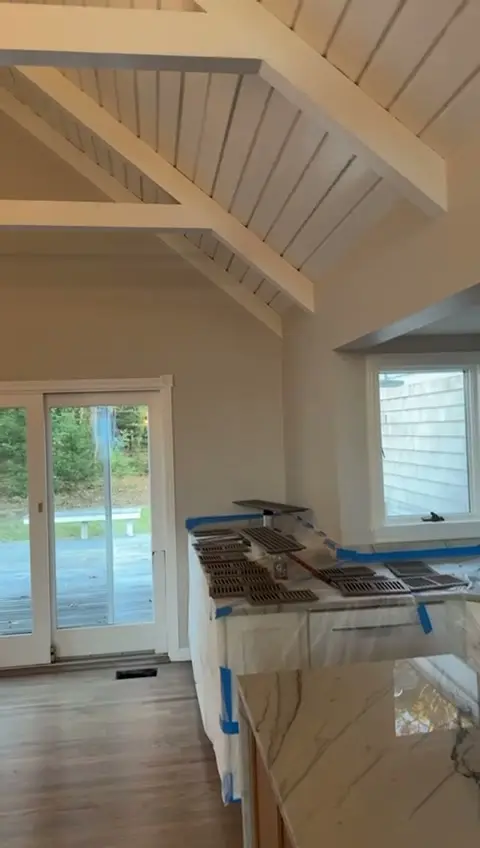
Interior painting, Boxborough MARepainting rooms in a town whose two biggest building decades were the 1970s and 1990s
The Census puts Boxborough's median year built at 1989, and the two biggest construction decades in its table are the 1990s (29.1% of units) and the 1970s (24.1%). Only 30 units, about 1.3%, date from 1939 or earlier. For interior work, that age profile shapes several decisions before any paint is opened: what the walls are made of, what coating is already on the trim, and whether lead rules come into play.
The town's own history explains the pattern. A 2006 state heritage report describes an agricultural town of dispersed farms that changed after I-495 was built through its western side in the mid-1960s, when farms were divided into house lots and residential growth climbed through the end of the century.
Rooms from the 1970s: lead questions and worn trim
Federal lead rules hinge on 1978. The ACS does not publish an exact pre-1978 count, but 45.8% of Boxborough's housing was built before 1980, the closest bracket available. In a house from that period, original door casings, window stools and baseboards may carry lead-based paint under later coats. Sanding or scraping that trim releases dust that settles on floors and sills.
When paid work disturbs more than six square feet of painted surface in a room of a pre-1978 home, the EPA Renovation, Repair and Painting rule requires a certified firm and lead-safe practices: plastic containment, no dry power sanding without HEPA collection, and a specific cleanup and verification step. The lead-safe painting page walks through what that looks like in an occupied house.
Rooms from the 1990s and later: drywall, open plans, tall walls
More than half the town's units (54.2%) were built in 1980 or later. Houses of that age are generally drywall over studs, so the common interior issues are nail pops, taped seams that show through flat paint, and corner bead cracks at stair openings rather than failing plaster. Those get set, reset or re-taped and spot-primed before color goes on, or the flaw telegraphs through the finish.
Where a house of this age has a two-story foyer or great room, that is the hardest space to paint. A 16- or 18-foot wall over a staircase needs planks or a stair-leveling ladder system, and cutting a clean line where that wall meets a sloped ceiling takes time. If the plan is to change color only on the lower floor, deciding where the color stops on an open stairwell is worth settling before the estimate.
- Ceilings: flat white hides roller marks and minor drywall seams best
- Walls: eggshell or matte for living spaces; satin where hands and pets rub
- Trim and doors: semi-gloss or satin enamel, with a bonding primer over old oil
- Bathrooms: a mildew-resistant finish, and the exhaust fan running during cure
The few older houses
The Old Town Center, a district centered on Hill Road, was listed on the National Register in 2006 with 52 contributing properties dating from the 1770s to the early 20th century. A house of that age is likely to have plaster on lath and many layers of earlier paint on its trim. Plaster cracks hold better when cut out and filled with setting compound than when covered with flexible caulk, and any disturbed painted surface should be treated as lead-bearing unless a test says otherwise. Choosing interior paint finishes matters more on wavy plaster, where higher sheen exaggerates every ripple.
Condo units in larger buildings
About a third of local housing units (34.3%) are in buildings with five or more units, most of them in buildings of 10 to 49 units. Painting inside a unit is normally the owner's call, but the association may set work hours, require a certificate of insurance before a contractor enters the building, and restrict use of hallways or elevators for materials. Getting those rules in writing first avoids a stalled start date.
Boxborough at a glance
| Median year housing built | 1989 (U.S. Census ACS 2020–2024 5-year, table B25035) |
| Housing built before 1980 | 45.8% (1,078 of 2,353 units) (U.S. Census ACS 2020–2024 5-year, table B25034) |
| Units built in the 1990s | 685 units (29.1%), the largest decade bracket (U.S. Census ACS 2020–2024 5-year, table B25034) |
| Units in buildings of 5+ units | 34.3% (807 of 2,353) (U.S. Census ACS 2020–2024 5-year, table B25024) |
| Interior lead-safe threshold | More than 6 sq ft of paint disturbed per room, pre-1978 housing (U.S. EPA, Renovation, Repair and Painting Program: Contractors) |