
Norwood, MA
Porch Floor, Steps & Railings in Norwood, MA
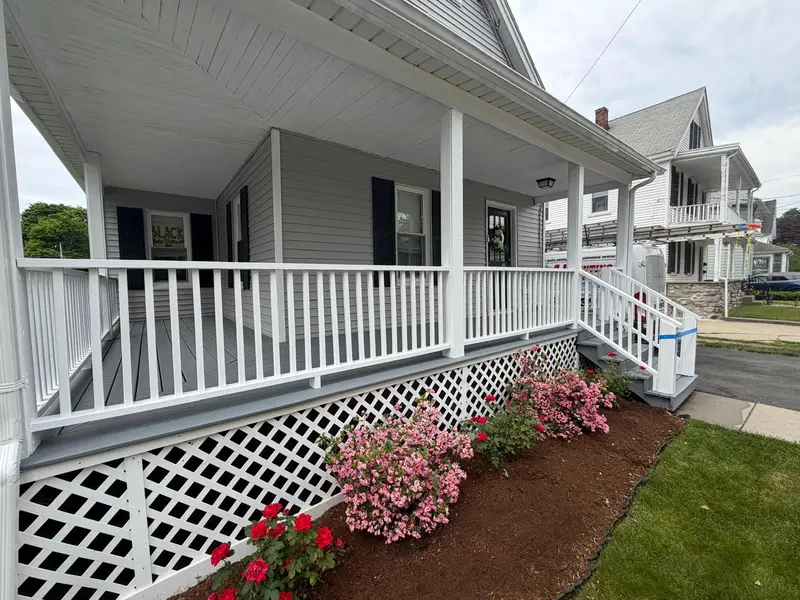
A Norwood home's front and back porches: floor boards and steps painted gray, with railings, balusters and lattice skirting in white.
See the photos →Siding, trim, windows and doors scraped, repaired, primed and painted, with prep planned around the age of the house and lead-safe methods on older paint.
Blackstone's houses come from very different periods, and their exteriors show it. Mill-era housing came first: the Blackstone Manufacturing Company opened its cotton spinning mill in 1809, and the worker housing it built was mostly wood-framed tenements of two to six units, originally sided in clapboard. Much later, the town's 2019 Housing Production Plan records rapid population growth in the 1980s, and Census estimates count about as many surviving homes from the 1960s as from the 1980s. Each period brings its own exterior painting problems.
Four National Register historic districts touch the town. The Blackstone Manufacturing Company district runs roughly along Main, County, Canal, Church and School Streets, and the National Park Service lists its styles as Greek Revival, Italianate and Queen Anne. The East Blackstone Village district along Elm Street holds fourteen residential buildings, mostly Greek Revival or Federal, with the oldest, the Seth Kelly House, dating to about 1760. Farnum's Gate and the multi-town Blackstone Canal district round out the list.
Wood clapboard of that age can carry many coats. Thick, old paint stacks crack across the grain and lift in sheets, and the wood underneath can be dry, split or soft at the bottom edges where water sits. Proper prep means scraping to a sound edge, feathering the transitions, replacing rotted boards with matching profiles, and priming bare wood the same day so it does not weather. Ornament on Italianate and Queen Anne houses, such as brackets and turned porch parts, takes the most hand work.
National Register listing on its own does not control what a private owner does. The National Park Service states that listing places no restrictions on what a non-federal owner may do with a property unless federal money is involved, and that it does not automatically create local historic district zoning. The town has a Historical Commission, which runs the historical museum at 23 Main Street. If you live in one of the listed districts and want to confirm whether any local rule applies to your project, the commission is the place to ask before choosing colors.
Units built in the 1960s and the 1980s each make up about 17% of local housing. Depending on the house and on any re-siding since, a home from either decade might have wood clapboard, wood shingles, or a manufactured product such as hardboard, and each one fails differently. Shingles weather and cup, hardboard swells where its edges get wet, and wood clapboard peels where moisture moves through from inside. A walkaround before the estimate identifies the siding type and the cause of any failure, because painting over a moisture problem shortens the life of the new coat.
Residential lots in the town's R1, R2 and R3 zones start at 35,000, 65,000 and 120,000 square feet. Where a wall faces woods or sits under branches, it stays damp longer and grows mildew. Those sides get a mildew wash and a thorough rinse before priming, and trimming back branches that touch the house helps the new paint dry and last.
About 62% of housing units here were built in 1979 or earlier, so many exteriors may carry lead in older layers. Scraping and sanding outside spreads chips into soil and garden beds unless the ground is covered and the debris is collected each day. Our lead-safe painting page outlines how that work is contained.
Most exterior paints need surface and air temperatures above a minimum, often around 35 to 50 degrees depending on the product, and dry conditions through curing. In central Massachusetts that confines exterior work to roughly spring through fall. Our post on painting a house exterior in November covers the late-season limits.
| Blackstone Manufacturing Company HD styles | Greek Revival, Italianate, Queen Anne (1800–1924) (National Park Service NPGallery, NRIS 95001038) |
| East Blackstone Village HD | 14 residential buildings; oldest c. 1760 (Wikipedia, citing the NRHP nomination and MACRIS) |
| What National Register listing restricts | Nothing for non-federal owners unless federal assistance is involved (National Park Service) |
| Housing units built 1979 or earlier | 62.1% (U.S. Census ACS 2020–2024 5-year, table B25034) |
| Minimum residential lot sizes (R1/R2/R3) | 35,000 / 65,000 / 120,000 sq ft (Town of Blackstone Housing Production Plan, 2019) |
These jobs were in other towns, not in Blackstone. Each card names the town where the work was done.
A Norwood home's front and back porches: floor boards and steps painted gray, with railings, balusters and lattice skirting in white.
See the photos →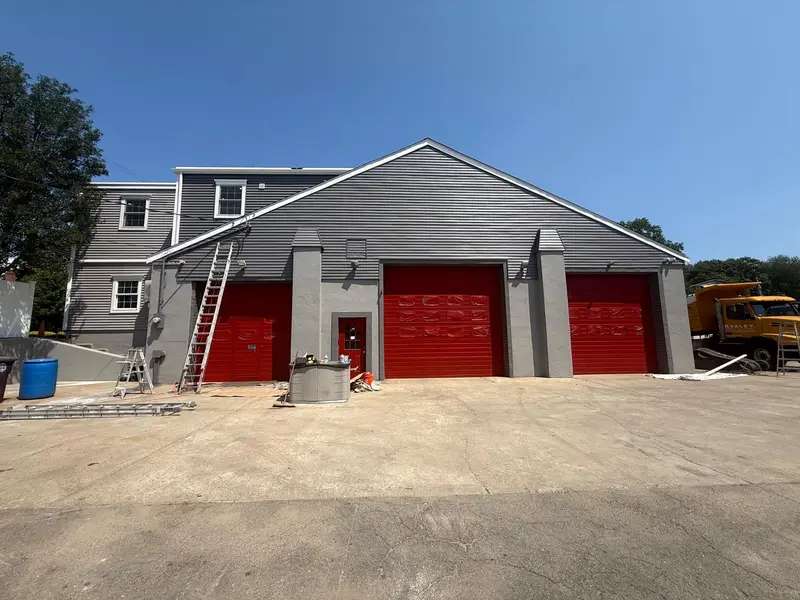
A garage building in Weymouth with white overhead doors and masonry pilasters whose paint was peeling. The doors and service doors were painted red and the pilasters refinished in gray.
See the photos →National Register listing alone does not require approval for a privately funded paint job, according to the National Park Service. Local rules are a separate question, so check with the town's Historical Commission before you commit to a color change.
Everything that is loose, peeling or cracked down to the wood. Paint that is still tightly bonded can stay, with its edges sanded smooth. Full stripping is only needed where layers are failing across a whole wall.
Repeated peeling in one area usually points to moisture: a shaded wall that never dries, a gutter overflow, a bathroom or kitchen behind the wall without venting, or bare ground splashing onto the bottom courses. The cause needs fixing before new paint will last.
It depends on the size and height of the house, how much scraping and carpentry the siding needs, and whether lead-safe containment applies. Our exterior painting cost page gathers Massachusetts market data, and a free on-site visit gives you a written figure for your house.
Yes. Soft sills, corner boards and lower clapboards are replaced or repaired with epoxy filler before priming, since paint over rotted wood fails quickly.
Exterior paint needs dry weather and temperatures above the product's minimum, so the practical window runs from spring into fall. Getting an estimate before the season starts gives the most scheduling options.
A free on-site visit covers siding condition, repairs and a written estimate. Licensed and insured. Call (508) 258-4325, Mon–Sat 7AM–6PM.
5.0 on Google · 35 verified reviews · Licensed & insured · Written quote in 48h