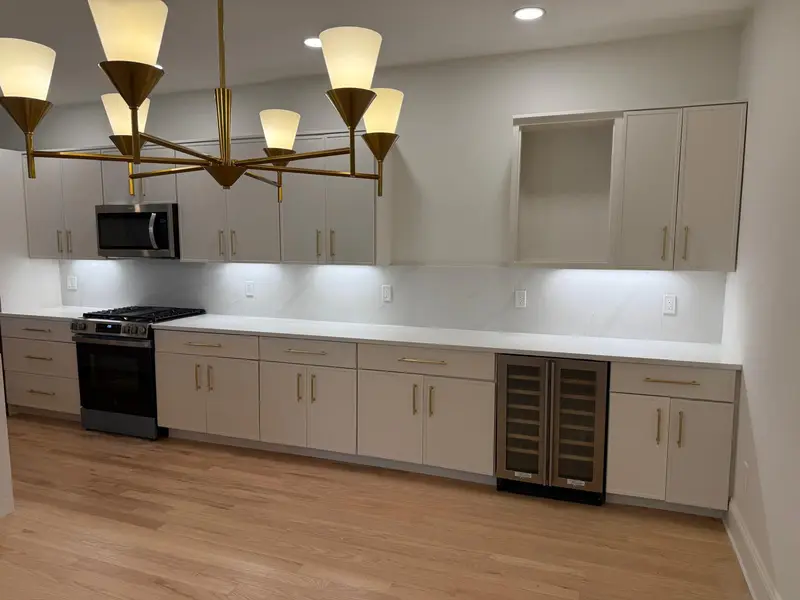
Cabinet painting, Blackstone MAPainting kitchen cabinets in a town where the median home was built in 1967
Half of the housing units in Blackstone were built before about 1967, the Census median, and roughly a third came in two decades alone: the 1960s and the 1980s each contributed about 17%. A kitchen in a house from either decade may have been remodeled since, so the cabinets may be original, a later replacement, or a mix. What matters for painting is what the cabinets are made of and what finish is already on them, and that varies from kitchen to kitchen.
Cabinet painting suits a kitchen where the layout works and the boxes are solid, but the color, the dated stain or the worn finish no longer does. It is not a fix for sagging shelves, delaminating particleboard or doors that no longer close.
Identifying the wood and the existing finish
A quick look inside a door edge or under the sink usually tells which of these you have. Factory finishes on wood cabinets are hard catalyzed lacquers or varnishes, and paint sticks to them only after thorough degreasing, scuff sanding and a bonding primer. Leaving out any of those steps invites chipping at door edges.
- Solid oak or oak veneer: open grain shows through paint unless it is filled; some owners like the texture, others want it smooth
- Maple, birch or cherry: closed grain, takes paint smoothly once the factory finish is scuffed and primed
- Painted wood from an earlier era: may carry several layers, sometimes oil-based, and in a pre-1978 house possibly lead
- Thermofoil or laminate: a plastic skin that standard primers do not grip well; often better replaced than painted
Older kitchens and lead
Census estimates put 62% of local housing units at 1979 or earlier. In a house built before 1978, cabinets that have been painted before, or the window trim and walls around them, should be presumed to possibly contain lead until tested. Sanding those surfaces without controls spreads fine dust through the kitchen, the room where food is prepared. Testing comes first, and if lead is present, sanding moves to contained, HEPA-vacuumed methods described on our lead-safe painting page. Stained wood cabinets with a clear factory finish are a different situation, since the finish is not paint.
How the work proceeds
Doors and drawer fronts come off and are labeled so each one returns to its own opening. Hinges and pulls are bagged. All surfaces are degreased, since kitchen grease near the range and handles is invisible but blocks adhesion. After scuff sanding and a bonding primer, doors are typically sprayed in a ventilated setting for a smooth, brush-free surface, while the boxes and face frames stay in place and are brushed and rolled or sprayed after masking.
The topcoat is a cabinet-grade enamel, such as a waterborne alkyd or a urethane-modified acrylic, which levels well and cures hard. These products feel dry within hours but take days to weeks to reach full hardness, so doors are rehung gently and heavy scrubbing waits. Our post on the kitchen cabinet painting process goes through each step in more detail.
Paint, refinish or replace?
Painting generally costs less than new cabinets and leaves countertops, plumbing and backsplash undisturbed. Replacement makes more sense when the boxes are water-damaged, the layout needs to change, or the material cannot hold paint. Our comparison of refinishing versus replacing kitchen cabinets walks through the trade-offs. In a two-family, the building type for about 15% of local units, the same decision applies to two kitchens, and each can be judged on its own condition.
Blackstone at a glance