
Norwood, MA
Porch Floor, Steps & Railings in Norwood, MA
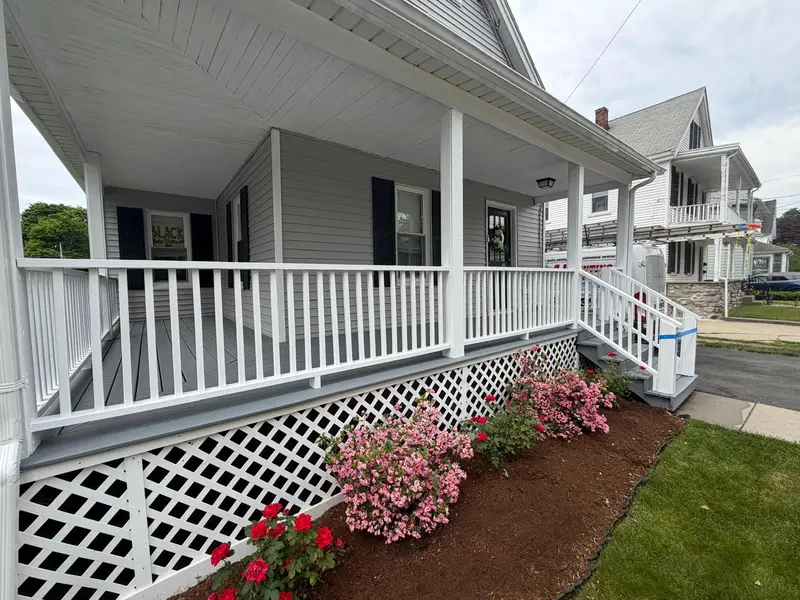
A Norwood home's front and back porches: floor boards and steps painted gray, with railings, balusters and lattice skirting in white.
See the photos →Siding, trim, porches and windows on Belmont houses, including homes inside the town's local historic districts where even a same-color repaint needs a certificate.
The town's 2014–2016 historic resources survey identified nine areas with a shared historic character, and their exteriors vary widely. Belmont Park's small lots were mostly built up between 1894 and 1899 with Queen Anne, Shingle and Colonial Revival houses. Clark Hill reflects a 1909 subdivision of English Revival and Craftsman designs. Belmont Hill mixes early Federal, Second Empire and Colonial houses with brick Georgian Revival mansions, and Snake Hill holds seven early-1940s houses by architect Carl Koch that the survey calls one of the earliest Modern house neighborhoods in the country.
Each of those styles puts paint on different things. A Queen Anne may have layered shingles, brackets and turned porch posts; a Georgian Revival brick house mostly needs its wood cornice, windows and doors; a Modern house of the 1940s has broad, plain surfaces where every flaw in prep shows.
The town's website describes three established local historic districts: Pleasant Street, which runs from Stella Road to Snake Hill Road and takes in the Town Hall complex; Common Street; and Richardson Farm, established in 2013. The Historic District Commission's rules reach paint directly. Keeping the same color still requires a Certificate of Non-Applicability, and changing color requires a Certificate of Appropriateness, because the commission reviews exterior changes visible from a public way, including color and materials.
The town recommends an informal meeting with the commission before filing a formal application. The commission reviews work using its written design guidelines for the districts, dated December 2009. Since the certificate has to come before the scraping, it belongs at the start of the schedule, not the end.
Census figures show 87.3% of the town's housing units were built before 1980. On any house built before the 1978 lead paint ban, the lower layers under today's paint may contain lead, and those are the layers that come loose during scraping. The EPA's Renovation, Repair and Painting rule requires anyone paid to disturb paint on a pre-1978 house to be certified.
Outside, that means ground covering to catch chips, limits on power sanding and open-flame removal, and a cleanup that leaves nothing in garden beds or the neighbor's yard. Our lead-safe painting page has more detail.
Two-unit buildings account for 29.7% of local housing, and another 8.7% sit in buildings of three or four units. A two-family exterior is one paint job shared by two households, and the scope may include porches and stair rails serving each unit. If the units are separately owned, both owners need to agree on the scope and the color before work starts.
Exterior coatings need surface and air temperatures inside the range printed on the can, plus enough dry hours for each coat to set before evening dew. Late fall narrows that window; our post on painting a house exterior in November explains the limits. An estimate done in the off-season leaves time for historic district certificates before spring.
For what tends to go wrong on older siding, read common exterior paint failures in Massachusetts. Area notes are on our Waverley and Cushing Square pages, and porches and decks are covered on deck staining and painting in Belmont.
| Same-color repaint in a local historic district | Certificate of Non-Applicability; a color change needs a Certificate of Appropriateness (Town of Belmont, Local Historic Districts) |
| Pleasant Street Historic District | Pleasant Street from Stella Road to Snake Hill Road; National Register listed 1979 (Town of Belmont, Local Historic Districts) |
| Snake Hill | Seven early-1940s houses by Carl Koch, among the earliest Modern house neighborhoods in the U.S. (Town of Belmont, Areas with a Distinctive Shared Historic Association and Character) |
| Housing units built before 1980 | 87.3% (9,495 of 10,881) (U.S. Census ACS 2020–2024 5-year, table B25034) |
| Units in buildings with 2–4 units | 38.3% (4,170 of 10,881) (U.S. Census ACS 2020–2024 5-year, table B25024) |
These jobs were in other towns, not in Belmont. Each card names the town where the work was done.
A Norwood home's front and back porches: floor boards and steps painted gray, with railings, balusters and lattice skirting in white.
See the photos →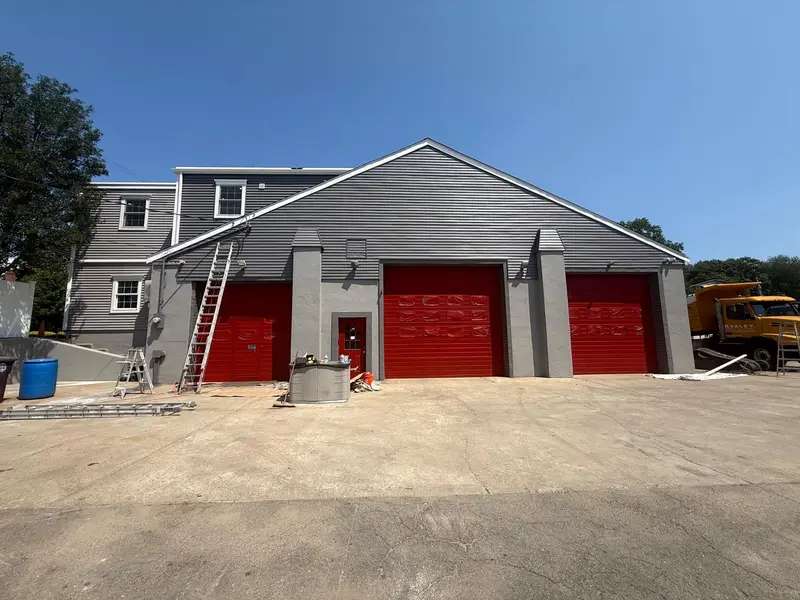
A garage building in Weymouth with white overhead doors and masonry pilasters whose paint was peeling. The doors and service doors were painted red and the pilasters refinished in gray.
See the photos →Yes. According to the town, a same-color repaint in a local historic district needs a Certificate of Non-Applicability from the Historic District Commission. That certificate confirms a full Certificate of Appropriateness is not required, and it should be in hand before scraping begins.
A color change visible from a public way needs a Certificate of Appropriateness. The town suggests meeting informally with the commission first, which is a good time to bring paint chips and ask how the 2009 design guidelines apply to your house's style.
The town's Local Historic Districts page lists the Pleasant Street, Common Street and Richardson Farm districts and describes their boundaries. Being in one of the nine areas named in the 2014–2016 survey, such as Payson Park or Waverley, does not by itself place a house in a local district, so check the district list or ask the commission.
It should be treated as one. A house built around 1900 is likely to carry coats applied before 1978, and sheeting paint means those layers are moving. Removing it is paint disturbance under the EPA rule, so it has to be done by a certified firm with ground protection and controlled cleanup.
It depends on the forecast and the product. Each paint lists a minimum temperature, and the surface also needs to stay dry long enough to cure before dew settles. If the window has closed, an on-site visit now lets the estimate, color choice and any district certificate be finished before spring.
Our exterior painting cost guide pulls together market data for the state. On older houses, the amount of scraping, carpentry and trim detail drives the price more than the wall area, which is why we give a written estimate after seeing the house in person.
Licensed and insured, based in Ashland. Call (508) 258-4325 to book a free on-site visit, Monday to Saturday.
5.0 on Google · 35 verified reviews · Licensed & insured · Written quote in 48h