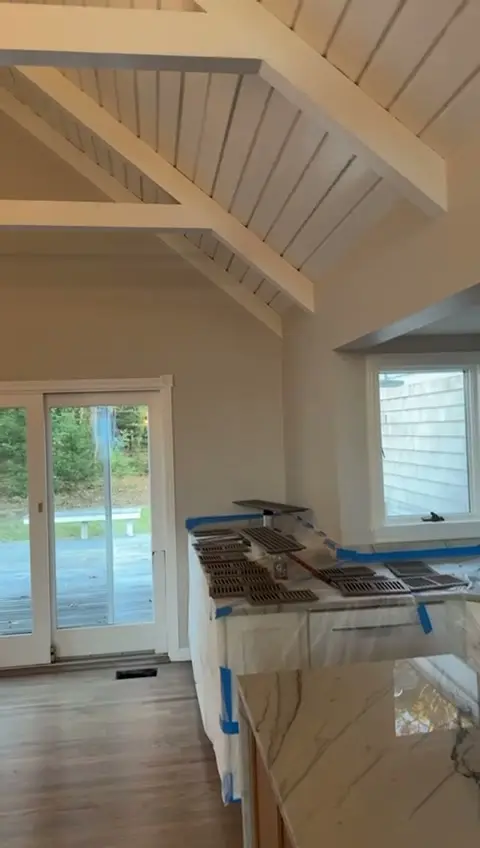
Interior painting, BelmontRepainting rooms in a town where the typical house dates to 1938
Census estimates put the median construction year of Belmont's housing at 1938, and 57.1% of its 10,881 housing units were built in 1939 or earlier. Inside, that age decides more about a paint job than the color does. A room finished before the Second World War may have plaster walls rather than drywall, and its trim, doors and window stools may carry many coats of paint applied over the decades since.
So an interior estimate here starts with the surfaces: what the walls are made of, how sound the ceilings are, and what is under the top layer on the woodwork. The color conversation comes after that.
Lead dust is the first planning question
By the same census table, 87.3% of the town's housing units were built before 1980 (the census groups construction years by decade, so it does not isolate 1978). In any house built before 1978, when lead-based paint was banned for residential use, the older coats on sashes, sills, baseboards and stair parts should be treated as possibly containing lead until a test says otherwise.
Federal rules follow from that. The EPA's Renovation, Repair and Painting rule applies to houses and apartments built before 1978, and anyone paid to disturb paint in them must be certified, including one-person businesses. Indoors, the dust from sanding a window stool or scraping a door casing is the main hazard, which is why the rule calls for containment, dust-minimizing methods and a careful cleanup before the room is used again. Our lead-safe painting page walks through what that looks like in an occupied home.
Woodwork from several building eras
The town's 2014–2016 historic resources survey shows how many periods sit side by side. Payson Park was mostly built out between 1886 and 1920 in Queen Anne, Colonial Revival, English Revival and Craftsman styles. Belmont Park filled in during the late 1890s. Clark Hill grew from a 1909 subdivision of architect-designed houses, while a 2017 town report describes post-World War II split levels and ranches around the ca. 1805 Thaddeus Frost House in the Winn Brook area, and Snake Hill holds a cluster of early-1940s Modern houses.
For interior work, the useful question in any of these is whether a given piece of woodwork has ever been painted. Original stained or varnished trim that has never been coated is a one-way decision: once it is primed and painted, getting back to clear wood means stripping. Trim that is already under many layers is a different job, where the work goes into scraping failed edges, filling and sanding smooth so the new coat does not telegraph old drips.
- Plaster cracks opened, taped or skim-coated before priming
- Loose ceiling paint scraped back to a sound edge
- Shellac or oil-based primer over stains and glossy old enamel
- Separate sheens for walls, ceilings and woodwork
Painting one side of a two-family
Two-unit buildings hold 29.7% of the housing stock, and 35.3% of occupied homes are rented. Interior work in those buildings can mean repainting one apartment while the owner lives in the other. The lead rule covers apartments just as it covers single-family houses, so a turnover between tenants is a practical window: rooms are empty, dust control is simpler and nobody has to move furniture twice.
Ceilings, timing and next steps
Old plaster ceilings deserve a closer look before any rolling starts, because a poorly bonded coat of paint can let go when a fresh coat adds weight and moisture. Testing a small area first shows whether the existing paint is bonded well enough to recoat. Indoor work can go ahead in the cold months as long as rooms get enough air and heat for the paint to dry; our note on winter interior painting covers ventilation and drying.
For outside work see exterior painting in Belmont, and for kitchens see cabinet painting. Area notes are on our Payson Park and Belmont Center pages.
Belmont at a glance
| Median year housing was built | 1938 (U.S. Census ACS 2020–2024 5-year, table B25035) |
| Housing units built 1939 or earlier | 57.1% (6,208 of 10,881) (U.S. Census ACS 2020–2024 5-year, table B25034) |
| Housing units built before 1980 | 87.3% (9,495 of 10,881) (U.S. Census ACS 2020–2024 5-year, table B25034) |
| Units in two-unit buildings | 29.7% (3,228 units) (U.S. Census ACS 2020–2024 5-year, table B25024) |
| Lead-safe certification | Required for anyone paid to disturb paint in pre-1978 houses and apartments (U.S. EPA, Renovation, Repair and Painting Program) |