

Norwood, MA
Porch Floor, Steps & Railings in Norwood, MA
A Norwood home's front and back porches: floor boards and steps painted gray, with railings, balusters and lattice skirting in white.
See the photos →Siding, trim, doors and porches on Auburn homes, prepared for the age of the house and the conditions on the lot, then painted within New England's outdoor season.
Auburn's housing spans close to three centuries. The town's 2019 master plan lists 242 entries in the state's historic inventory, MACRIS, and says most of them are houses from the 1700s and 1800s. Meanwhile, the Census counts about half of all units as built between 1940 and 1979, a span that includes the 1950s and 1960s, when interstate construction made the town the junction of I-90, I-290 and I-395.
Those two groups of houses ask different things of an exterior painter. Old wood clapboard has been scraped and recoated for generations; a 1960s ranch may have its original siding, a later replacement, or a mix. Seventy-three percent of the town's units are single-family detached homes; for those, the whole envelope, from the foundation line to the gable peak, is the owner's responsibility rather than an association's.
According to the master plan, Town Hall, the Congregational Church and many of the oldest houses in town, dating from 1729 to 1899, stand along Central and Church Streets. Town Hall itself, dedicated in 1896, is Queen Anne, and the 1911 former library building is Colonial Revival. Houses from that span can carry detailed cornices, corner boards and window casings that need hand scraping and careful priming rather than a quick wash and roll.
On wood that old, the lower layers of paint may include lead. Scraping and sanding them produces chips and dust that need to be contained on the ground and kept out of soil and gardens. Our lead-safe painting page explains the process. Elsewhere, the 2017 housing plan names Packachoag Hill among the town's historically significant areas; see our Pakachoag Hill page for that part of town.
As of the 2017 housing plan, Auburn had no National Register historic districts and no local historic districts. The Auburn Historic Commission's role, as the master plan describes it, is to inventory historic properties, prepare nominations, advise town officials and keep renovations from damaging areas worth preserving. Neither plan describes a permit or design review for repainting a house. If your home is an individually listed property, or if you are unsure, ask the town before changing colors or removing original trim.
In 1999, forest still covered 40% of the town's land, per the land-use table in the master plan, and the 2017 housing plan counts about 1,200 acres of 100-year flood zone and nearly 600 acres of wetlands. A wall that sits in shade or near wet ground dries slowly after rain and dew, which feeds mildew and pushes moisture into the wood from behind.
On those elevations, prep means washing off mildew with a cleaner that kills it, checking for soft sills and trim boards, and choosing a paint with mildew resistance. Trimming branches back from the siding helps the new coat dry between storms.
Exterior paint labels list a minimum surface and air temperature, often somewhere between 35 and 50°F, and the coat needs time above that before dew forms in the evening. In central Massachusetts that points to late spring through early fall, with late-season work possible on days that stay warm and dry. Our posts on painting in November and on how long exterior paint lasts here go further into both questions.
| Oldest houses in town | Many date from 1729–1899, along Central and Church Streets (Auburn 2019 Master Plan, Natural, Cultural & Historic Resources chapter) |
| Entries in the state historic inventory (MACRIS) | 242, including 218 buildings (as of 2019) (Auburn 2019 Master Plan, citing MACRIS) |
| National Register or local historic districts | None, as of 2017 (Town of Auburn Comprehensive Housing Plan (2017)) |
| Forest cover | 40% of land area (1999 land-use data) (Auburn 2019 Master Plan, Land Use chapter, Table 1) |
| Single-family detached homes | 73.3% of housing units (U.S. Census ACS 2020–2024 5-year, table B25024) |
These jobs were in other towns, not in Auburn. Each card names the town where the work was done.
A Norwood home's front and back porches: floor boards and steps painted gray, with railings, balusters and lattice skirting in white.
See the photos →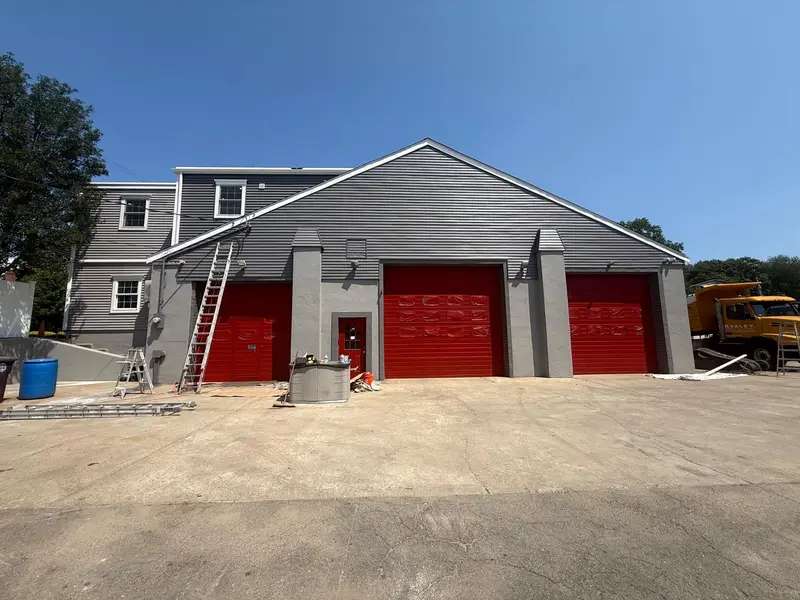
A garage building in Weymouth with white overhead doors and masonry pilasters whose paint was peeling. The doors and service doors were painted red and the pilasters refinished in gray.
See the photos →As of 2017 the town had no local historic districts, and neither the 2017 housing plan nor the 2019 master plan describes a painting permit. If your house is individually listed or you plan to remove original features, check with the town first.
Not by itself. The growth has to be killed and washed off before painting, and a mildew-resistant paint slows its return. More sun and air on that wall, from pruning nearby branches, makes the biggest long-term difference.
In a house built before 1978, assume it may, and test before any scraping. A certified inspector or EPA-recognized test kit can confirm it. If lead is present, the work needs ground covers, containment and careful cleanup.
Often, yes, with a paint rated for it. Vinyl needs a color no darker than the maker allows, or the panels can warp in the sun. Aluminum needs its chalky surface cleaned off first so the paint can bond.
Size, height, the amount of scraping and the number of colors drive the price. Our exterior painting cost guide pulls together statewide market figures, and our post on why painting quotes vary explains the spread you may see between bids.
Yes. Painted porch floors and railings can be included with the house; stained decks are covered on our deck staining page for Auburn.
We'll walk the house, note the prep each side needs and send a written estimate at no cost. Licensed and insured. Call (508) 258-4325.
5.0 on Google · 35 verified reviews · Licensed & insured · Written quote in 48h