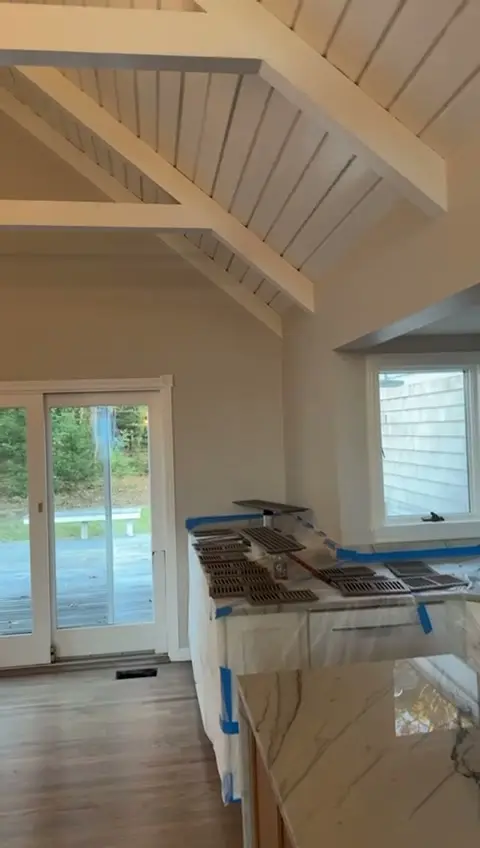
Interior painting, Saugus MAInterior painting for Saugus houses from three different building eras
Census estimates divide Saugus housing into three large eras: 29.4% of units were built in 1939 or earlier, 31.9% between 1940 and 1969, and 25.1% from 1970 through 1989. Only 5.0% date from 2010 or later. Each era tends to come with different wall materials, different trim and different paint history, so prep that suits one house can be wrong for the next one down the street.
Before a color is chosen, the first walk-through should answer three questions: what the walls are made of, what kind of paint is already on the trim, and whether any of it predates 1978.
Plaster in the oldest houses
The Massachusetts Historical Commission's 1985 survey of the town describes a building boom between 1870 and 1915, when plain 2½-story gable-front two-family houses were exceptionally numerous, followed by subdivisions of small, cottage-like houses between 1915 and 1940. Houses of those decades were finished before drywall took over, so walls and ceilings in them may be plaster on wood lath.
Old plaster fails in recognizable ways: hairline cracks over door corners, wider cracks along ceiling lath, and spots that sound hollow or move when pressed, which means the plaster has let go of the lath. Loose areas get reattached with plaster washers or adhesive, cracks are taped and skimmed, and patches are primed so they do not show through the finish coat as dull spots.
Mid-century walls and ceilings
Of today's local housing units, 3,025 date from 1950 through 1969. Rooms from that span can have plaster over gypsum lath, early drywall, or a mix after renovations. Drywall from that period shows its own wear: popped nails, visible tape seams and corner bead that has cracked loose. A textured ceiling of uncertain age should be tested before anyone scrapes it, since some older textured products contained asbestos.
Whatever the material, a flat ceiling paint hides minor waves in old plaster or drywall better than any sheen.
Lead dust and how rooms are protected
Out of 11,402 housing units, 8,202 were built in 1979 or earlier, a count that includes all of the town's pre-1978 homes. Windows, sills, doors and stair parts in those homes are common places to find old lead paint, and they are also the parts that get sanded and scraped.
EPA's renovation rule covers paid work in pre-1978 housing that disturbs more than six square feet of painted surface per room. It requires plastic containment, no open-flame burning or high-speed sanding without a shroud and HEPA vacuum, careful cleanup and a cleaning check before the room is reopened. The contractor must also hand the occupants EPA's Renovate Right pamphlet before work starts. More detail is on our lead-safe painting page.
Trim, doors and the right sheen
Trim in an older house may have decades of oil-based enamel under its newest coat. Waterborne paint applied straight over glossy oil can peel off in sheets, so a test patch and a bonding primer come first. Latex vs. oil-based paint explains why the two do not mix without one.
For walls, eggshell or matte wipes clean without highlighting every flaw; for trim, doors and stair rails, semi-gloss stands up to hands and vacuum bumps. Our paint finish comparison covers each option.
Occupied homes, rentals and timing
Renters occupy 28.5% of local households, and 882 units sit in two-unit buildings. If you own a two-family, a vacant unit between leases is the easiest time to paint it; in an occupied one, rooms can be done in sequence so the household keeps a working bedroom and kitchen. Interior work is not tied to the weather, which makes the colder months a practical window, as covered in winter interior painting. If the exterior is also due, the exterior painting page explains what the outside of these houses needs.
Saugus at a glance
| Housing built 1939 or earlier | 29.4% (3,349 of 11,402 units) (U.S. Census ACS 2020–2024 5-year, table B25034) |
| Housing built 1940–1969 | 31.9% (3,633 units) (U.S. Census ACS 2020–2024 5-year, table B25034) |
| Housing built 1970–1989 | 25.1% (2,865 units) (U.S. Census ACS 2020–2024 5-year, table B25034) |
| Renter-occupied households | 28.5% (3,122 of 10,958) (U.S. Census ACS 2020–2024 5-year, table B25003) |
| Two-family houses, 1870–1915 | Plain 2½-story gable-front two-families 'exceptionally numerous' (Massachusetts Historical Commission, Reconnaissance Survey Town Report: Saugus (1985)) |