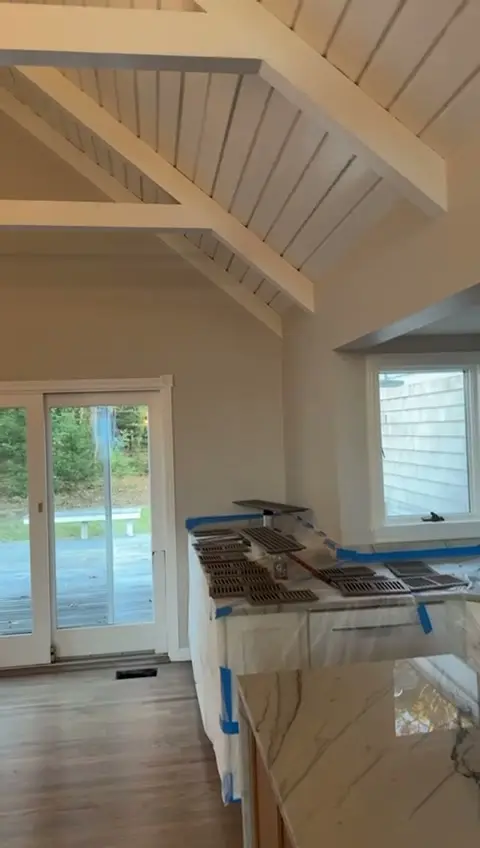
Interior paintingInterior painting for Rutland houses old and new
Census estimates show a split housing stock. About half of Rutland's 3,392 housing units, 1,718 of them, went up in 1990 or later, including 1,109 since 2000. Yet 1,498 units, about 44%, date from before 1980. The rooms inside those two groups ask for different prep before any color goes on the wall.
Owner-occupied households make up about 89% of occupied units in the estimate, and roughly 81% of all units are detached single-family houses. When people are living in the house during the work, the order of rooms and the protection of furniture and floors need to be planned before the first coat.
Drywall in the newer subdivisions
The Master Plan cites a wave of subdivision building from 1997 to 2007, and the town's housing stock grew another 21%, or 560 units, between 2010 and 2020. Houses from those decades are generally finished in drywall, and the defects that tend to show in drywall of that age are cosmetic: nail pops, settling cracks at corners and over doors, and scuffed flat paint that does not wash well.
Good results come from fixing those defects first. Popped fasteners get reset and spackled, cracked tape joints are re-taped instead of caulked, and patched areas are spot-primed so they do not flash through the finish. Switching hallways, stairways and kids' rooms from flat to an eggshell or matte enamel makes them far easier to wipe down.
Plaster and old woodwork
The Census counts 315 units built in 1939 or earlier, and the Master Plan notes that the town has a small number of historic buildings and that they are not concentrated in one location. A house of that age may still have plaster on wood or metal lath, along with original window and door casings that carry many coats of paint.
Plaster takes paint well when it is sound, but hairline cracks, bulges where keys have let go, and old water stains need attention first. Loose areas can be re-secured with plaster washers, cracks are taped and skimmed, and stains get a stain-blocking primer. Trim with heavy buildup is sanded or scraped smooth enough that doors close and sashes move.
- Repair cracks and loose plaster before priming
- Seal water stains with a stain-blocking primer
- Degloss and prime old oil-based trim before latex
- Caulk trim gaps, then two finish coats
Lead dust indoors
In a house built before 1978 (the Census places 44% of local units before 1980), treat older painted surfaces as possibly containing lead until testing says otherwise. Windows, door jambs and stair parts are the areas where friction and sanding make dust. The EPA's Renovation, Repair and Painting rule applies to paid work on pre-1978 homes: rooms are sealed with plastic, dust is controlled, and cleanup is verified before the space goes back into use. Details are on our lead-safe painting page.
Ceilings, stairwells and winter work
Ceilings are usually done before walls, with a flat finish that hides roller marks and minor surface flaws. A tall stairwell or open foyer needs staging or a plank setup rather than a single ladder, which is worth knowing when comparing quotes. Textured ceilings in older houses should be tested before anyone scrapes them.
Interior painting is not tied to the outdoor season. Low-odor waterborne paints let rooms be done in winter with the windows mostly closed; our post on painting with closed windows explains how ventilation is handled. If the kitchen is part of the plan, see cabinet painting in Rutland.
Rutland at a glance
| Built 1990 or later | 1,718 of 3,392 units, about 51% (U.S. Census ACS 2020–2024 5-year, table B25034) |
| Built 1939 or earlier | 315 units, about 9% (±130) (U.S. Census ACS 2020–2024 5-year, table B25034) |
| Owner-occupied households | 2,847 of 3,185 occupied units, about 89% (U.S. Census ACS 2020–2024 5-year, table B25003) |
| Housing growth 2010–2020 | +560 units, +21% (Town of Rutland Master Plan (2023), Population & Housing chapter) |