
Norwood, MA
Porch Floor, Steps & Railings in Norwood, MA
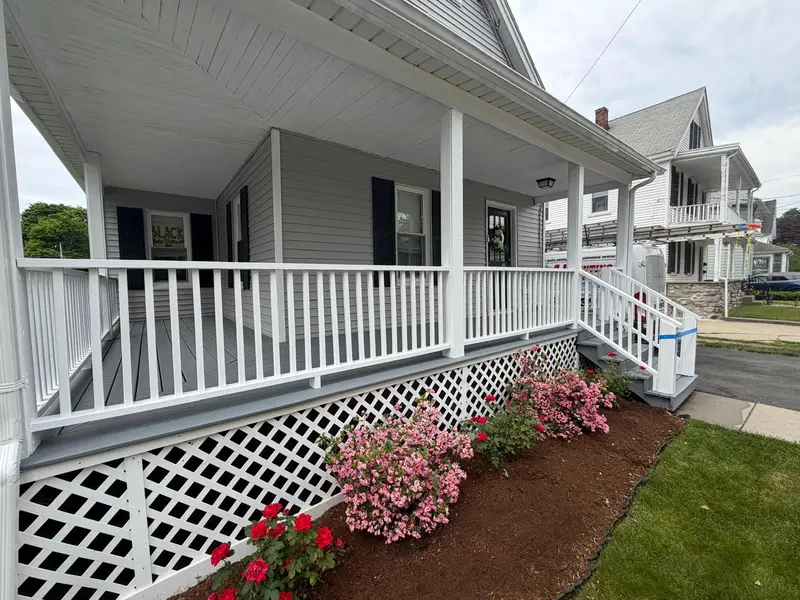
A Norwood home's front and back porches: floor boards and steps painted gray, with railings, balusters and lattice skirting in white.
See the photos →Decks, stairs and railings repaired, cleaned and coated with a stain or paint chosen for how much shade and moisture the boards see.
Land cover figures in Rutland's 2023 Master Plan show deciduous forest on 39.5% of the town, evergreen forest on 24.6% and forested wetland on another 10.2%. A deck that backs up to a stand of trees wears its finish faster than one in the open: falling leaves leave tannin marks, pine needles pack the gaps between boards, and shaded wood stays wet long after a rain.
The plan also describes much of the town as zoned for large lots with a 1.5-acre minimum. On a lot like that, a deck may face open lawn and full sun, or sit tucked against a tree line, and the right stain is different for each.
On a deck that rarely gets direct sun, gray-green film and black specks are usually mildew or algae, not dirt. Painting or staining over them traps the growth under the new coat. The fix is a mildew-killing deck cleaner, a low-pressure rinse, then an oxalic-acid brightener to lift leaf tannins and restore the wood color. The boards then need to dry until water soaks in instead of sitting on the surface.
Keeping the gaps between boards open matters as much as the coating. A deck that drains and gets air underneath dries faster and holds its stain longer. Stains with a mildewcide additive help on the shady side of the house.
The Master Plan reports that households on the Town water system draw from Muschopauge Pond, and a Watershed Protection District covers land around the reservoir. Forested wetlands are a tenth of the town. With that much water and wet ground around, it makes sense to choose biodegradable cleaners where they will do the job, avoid washing strippers into a yard that drains toward a brook or wetland, and collect paint chips and sanding dust instead of rinsing them off the deck.
Census data counts 609 housing units built in the 1990s and 584 in the 2000s, and the Master Plan cites a subdivision surge from 1997 to 2007. A deck original to a house from those years has been through two to three decades of freeze and thaw, so loose railings, cupped boards and soft stair treads are worth checking before any finish goes on.
The EPA notes that manufacturers stopped making CCA-treated wood for homeowner uses in December 2003. Pressure-treated deck boards installed before then may be CCA lumber, so sanding should be limited and the dust captured. Where boards are badly worn, replacing them is often better than sanding them down.
Semi-transparent and penetrating stains soak in and wear away gradually, so recoating is mostly cleaning and reapplying. Solid stain and deck paint cover color differences between old and new boards, but they form a film that can peel on stair treads and walking paths, and peeled film has to be stripped before a fresh coat will bond. One option is penetrating stain on the floor and solid color on railings and skirting, which see far less foot traffic.
Staining needs dry wood and a few dry days, so late spring to early fall is the practical window. Our post on deck stain and New England winters covers why finishing before cold weather pays off. For the siding and trim behind the deck, see exterior painting in Rutland.
| Forest cover | Deciduous 39.5%, evergreen 24.6%, forested wetland 10.2% of town land (Town of Rutland Master Plan (2023), Land Use chapter, Table 2 (MassGIS 2016)) |
| Minimum residential lot size | 1.5 acres across much of the town (Town of Rutland Master Plan (2023), Land Use chapter) |
| Town water source | Muschopauge Pond, with a Watershed Protection District (Town of Rutland Master Plan (2023), Population & Housing and Land Use chapters) |
| CCA lumber for home use | Discontinued December 2003 (U.S. EPA, Chromated Arsenicals (CCA)) |
These jobs were in other towns, not in Rutland. Each card names the town where the work was done.
A Norwood home's front and back porches: floor boards and steps painted gray, with railings, balusters and lattice skirting in white.
See the photos →Clean it with a mildew-killing deck wash and rinse at low pressure, then let it dry. A stain with mildewcide slows regrowth, and trimming branches over the deck and clearing the board gaps lets it dry faster after rain.
It can be if harsh strippers or a lot of paint chips wash off the deck. Biodegradable cleaners, tarps under the work area and collecting chips and dust reduce the risk. If your lot is in a protected area, the town can tell you about any limits.
If the deck is original, the boards may be CCA-treated, since manufacturers made it for homeowner uses until December 2003. Light sanding with dust collection is reasonable; heavy sanding is not. Replacing worn boards with new lumber is often the better route.
Common causes are moisture in the wood when it was applied, coats that were too thick, or a film laid over an old finish that was already failing. Horizontal boards with foot traffic take the worst of it. Going back to a penetrating stain means stripping the film first.
Composite boards are designed not to need stain, and most are cleaned rather than coated. Wood railings, posts or stairs attached to a composite deck can still be stained or painted.
Square footage, the number of stairs and the length of railing, repair work, and whether an old film finish must be removed all move the number. The deck staining cost guide walks through these with Massachusetts market data, and a free visit gets you a written estimate.
Boards, railings and the old finish inspected before we recommend a stain. Call (508) 258-4325, Monday to Saturday, 7 AM to 6 PM.
5.0 on Google · 35 verified reviews · Licensed & insured · Written quote in 48h