

Mashpee, MA (Cape Cod)
Whole-Home Interior in Mashpee, MA
A home in Mashpee on Cape Cod with light gray walls, white trim and doors, and a vaulted plank ceiling with exposed beams finished in white.
See the video →Walls, ceilings, trim and doors in Needham houses of every era, from Federal-era houses at McIntosh Corner to 1950s homes and the replacement houses built on lots where older ones were demolished.
The Census puts the median year built for local housing at 1965, but that middle number hides three very different groups of rooms. About 18% of units date from 1939 or earlier. The 1950s alone account for nearly 20%, the largest single decade in the stock. And roughly 15% were built in 2010 or later; the Planning Board deduces that about 89% of new single- and two-family permits between mid-2013 and mid-2023 were for homes replacing a demolished house.
Each group brings its own surfaces. Prewar rooms often have plaster walls, thick casings and several generations of paint on the woodwork. Postwar rooms are usually simpler, with narrower trim and walls that may be plaster or an early gypsum product. New construction means smooth drywall, tall ceilings and long sightlines where every roller mark shows. Prep, primer and sheen should follow the walls you actually have, not a one-size routine.
Of the town's 11,929 housing units, 7,621 (63.9%) were built in 1979 or earlier. That Census bucket is the closest available match to the 1978 federal ban on lead-based house paint, so close to two-thirds of local homes are old enough that lead could sit in some layer of paint on windows, doors, stair parts or baseboards.
Under the EPA's Renovation, Repair and Painting Rule, paid work in a pre-1978 home that disturbs more than six square feet of painted surface in a room must follow lead-safe practices: containment, dust control and a specific cleanup and verification. Sanding a set of window sashes or scraping a stair stringer can pass that threshold. Our lead-safe painting page explains what the setup looks like.
Old plaster rarely fails all at once. It shows hairline cracks along ceiling seams, loose keys over doorways and bulges near windows where water once got in. Painting over those spots without repair just outlines them in fresh color. Sound plaster gets crack repair with a setting compound and mesh where needed; loose areas get reattached before anything else happens.
Ceilings deserve their own line on the estimate. Flat white over an old ceiling hides small waves; a flat, low-reflectance finish is kinder to plaster than eggshell. In a new house with nine- or ten-foot ceilings, the challenge is the opposite: perfectly flat drywall under strong window light, where a uniform roller pattern and a full second coat matter more than patching.
The town's published inventory of historic houses lists about 140 properties with dates from the early 1700s to the 1950s, many on Great Plain Avenue, Central Avenue, Nehoiden Street, Maple Street and South Street. Interiors in the oldest of those houses can have raised-panel doors and beaded casings. That woodwork is usually best treated by careful scraping of loose paint, a bonding primer and a brushed enamel, not by stripping it bare.
Postwar trim may be clamshell or plain colonial casing, and if it was last painted in an oil enamel, new latex will not grip it without proper sanding and a primer made for glossy surfaces. In newer homes, trim is often factory-primed MDF that needs caulked joints and two finish coats to look crisp.
When the family stays in the house during the work, a practical plan sequences rooms so bedrooms are back in use by evening and the kitchen is never out of service for long. Furniture moves to the center of each room under cover; switch plates come off; floors are protected edge to edge.
Interior work also does not depend on the weather, which makes the colder months a reasonable window. Our post on winter interior painting in Massachusetts covers ventilation and drying times, and the guide to preparing your home for an interior paint job lists what to clear before day one. Planning a kitchen too? The cabinet painting page for this town goes into that separately.
| Homes built 1979 or earlier | 63.9% of housing units (7,621 of 11,929) (U.S. Census ACS 2020–2024 5-year, table B25034) |
| Homes built 1939 or earlier | 18.0% of housing units (U.S. Census ACS 2020–2024 5-year, table B25034) |
| Largest construction decade | 1950–1959, 19.8% of units (U.S. Census ACS 2020–2024 5-year, table B25034) |
| Median year built | 1965 (U.S. Census ACS 2020–2024 5-year, table B25035) |
| Lead-safe threshold, interior | More than 6 sq ft of painted surface disturbed per room (pre-1978 homes) (U.S. EPA, RRP Program for Contractors) |
These jobs were in other towns, not in Needham. Each card names the town where the work was done.
A home in Mashpee on Cape Cod with light gray walls, white trim and doors, and a vaulted plank ceiling with exposed beams finished in white.
See the video →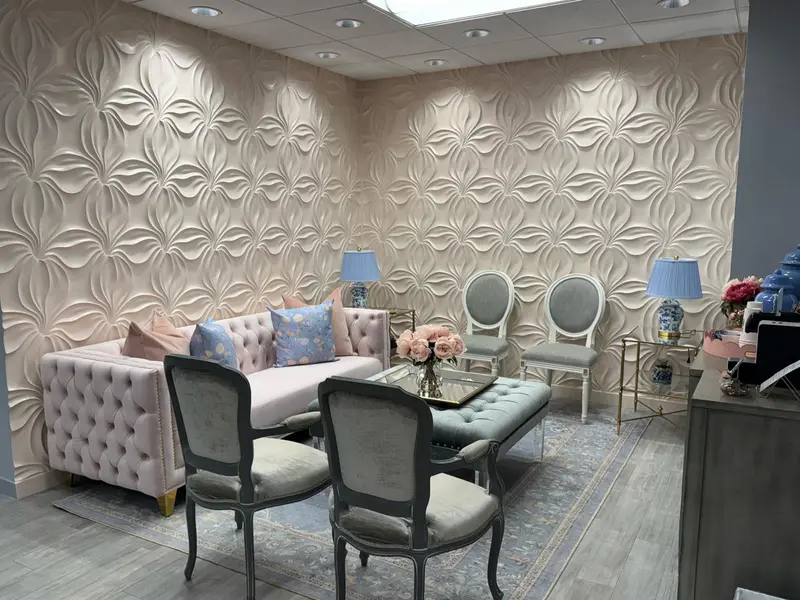
A dental practice's waiting room and reception area, finished in soft gray with applied panel molding, next to a sculpted floral feature wall.
See the photos →It may be plaster over gypsum or metal lath rather than drywall. Plaster takes paint well but cracks differently, so repairs use setting compound rather than lightweight spackle. A quick look during the estimate visit usually settles which material you have.
Only testing tells you for sure. If the house was built before 1978 and the work will disturb more than six square feet per room, the job is handled under lead-safe rules unless a certified inspector or a recognized test kit shows the paint is lead-free. The lead-safe page has more detail.
If the walls received only one finish coat over primer, touch-ups and roller laps show under strong light. A full repaint with a washable finish and two coats usually fixes it; nail pops and settling cracks from the first year get filled first.
Yes. Rooms are done in a planned order with furniture covered and floors protected, and low-odor waterborne paints keep the house livable. In pre-1978 homes, the containment needed for lead-safe work also keeps dust out of the rest of the house.
Ceiling height, plaster repair, the amount of trim and doors, and whether old oil enamel needs converting have more effect than square footage alone. The interior painting cost guide summarizes Massachusetts market data, and AJ Painting gives a free written estimate after seeing the rooms.
We did not find a town rule covering interior paint. The Historical Commission's published role is reviewing demolitions under the demolition delay by-law, which is a different matter. If you are planning structural changes alongside painting, check with the town's building department.
AJ Painting offers a free on-site visit and a written estimate that covers prep, repairs and lead-safe steps where they apply. Call (508) 258-4325, Monday to Saturday, 7AM to 6PM.
5.0 on Google · 35 verified reviews · Licensed & insured · Written quote in 48h