
Norwood, MA
Porch Floor, Steps & Railings in Norwood, MA
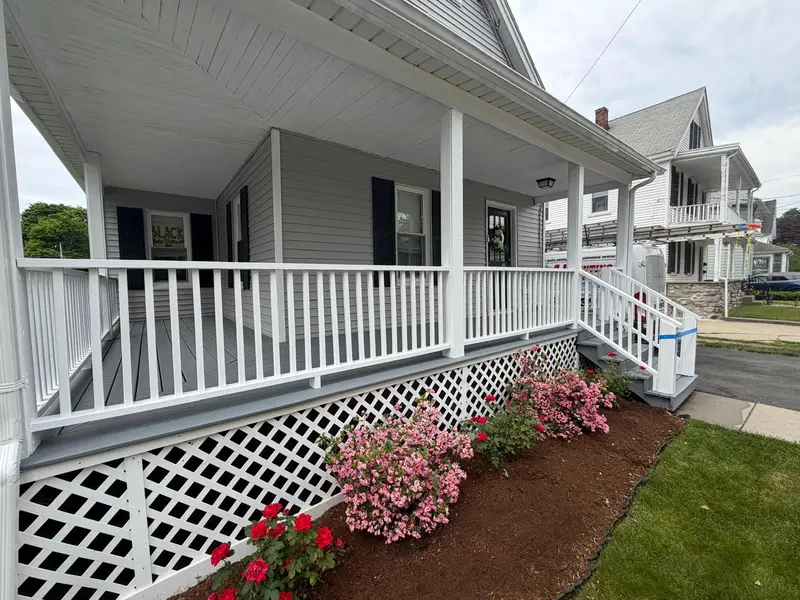
A Norwood home's front and back porches: floor boards and steps painted gray, with railings, balusters and lattice skirting in white.
See the photos →Cleaning, repair checks and stain or paint for decks, porch floors, stairs and railings at Needham homes, matched to the wood species and the coating already on the boards.
Census figures count 74.3% of housing units here as single-family detached houses, where a deck or porch serves one household and one owner decides how it is finished. The wood under your feet, how much sun it gets, and what was put on it last time decide the finish far more than any brand name.
Age matters too. On a house from the 1950s, the decade with the most surviving homes in town, a backyard deck may be a later addition with its own age and history of coatings. One on a newer replacement home may still be on its first finish, or may be composite that needs cleaning rather than coating.
Pressure-treated pine is widely used for decking. It often arrives wet with preservative and should not be coated until water soaks in instead of beading. Western red cedar is lighter, more stable and naturally tannin-rich, so an oil-based penetrating stain suits it. Tropical hardwoods such as ipe are so dense that ordinary stains sit on top; they take a specific hardwood oil or are left to weather.
If the boards already carry a solid stain or paint, the choice narrows: stay with a film finish, or strip completely before going back to a semi-transparent. Mixing the two is a reliable way to get blotchy color and early peeling. Our paint vs. stain comparison lays out the trade-offs.
Deck floors take weather head-on. Sun breaks down stain on the south and west sides; shade under trees keeps boards damp and invites mildew and algae. Snow left sitting on a deck through a thaw-and-freeze cycle drives water into end grain and fastener holes. That is why decks usually need recoating more often than siding on the same house, a point our post on deck stain and New England winters explains.
Sweeping debris out of the board gaps, washing the surface each spring and recoating before bare gray wood appears all slow that cycle down.
About 18% of homes here date from 1939 or earlier, and on a house that old the outdoor floor may be a painted front porch rather than a stained deck. Tongue-and-groove porch boards, turned balusters and lattice skirts take porch-and-floor enamel over primer, not deck stain, which cannot penetrate wood already sealed with paint.
Old porch paint can contain lead. Federal RRP rules apply to paid exterior work on a pre-1978 house that disturbs more than 20 square feet of painted surface, and a full porch floor plus its railings covers more area than that. Ground covers, wet scraping and careful cleanup keep chips out of the yard; the lead-safe painting page covers the details.
The town also has 317 units in two-unit buildings, where a back porch or stair may be shared. In that case both households need to agree on color and timing, and the upper level is finished before the lower one.
A deck job starts with a walk-over for soft boards, popped fasteners, loose rail posts and failing stair treads, with any carpentry flagged before coating. Cleaning comes next, then stripping if a failed film is present and a brightener to restore the wood's pH. Rails, balusters and stringers are coated before the floor, and floor boards are finished in full lengths so lap marks do not form.
If the house siding is due as well, the exterior painting page for this town covers that work. The Needham Heights and Needham Junction pages describe housing in those parts of town.
| Single-family detached homes | 74.3% of housing units (8,869) (U.S. Census ACS 2020–2024 5-year, table B25024) |
| Units in two-unit buildings | 317 (U.S. Census ACS 2020–2024 5-year, table B25024) |
| Homes built 1939 or earlier | 18.0% of housing units (U.S. Census ACS 2020–2024 5-year, table B25034) |
| Lead-safe threshold, exterior | More than 20 sq ft of painted surface disturbed (pre-1978 homes) (U.S. EPA, RRP Program for Contractors) |
These jobs were in other towns, not in Needham. Each card names the town where the work was done.
A Norwood home's front and back porches: floor boards and steps painted gray, with railings, balusters and lattice skirting in white.
See the photos →Once the boards absorb water instead of beading it. Depending on how wet the lumber was and how much sun it gets, that can take several weeks to a few months. Staining too early traps moisture and the stain will not soak in.
Not successfully. Peeling means a film-forming stain has lost its bond, and new coats will fail along with the old. The loose finish has to be stripped or scraped back to sound material first, and then you can choose to recoat solid or switch to a penetrating stain on fully stripped wood.
Semi-transparent wears away gradually and is easy to refresh without stripping. Solid stain covers mismatched or weathered boards but behaves like paint and eventually peels on walking surfaces. One reasonable split is semi-transparent on the floor and solid on the rails.
Yes, in two ways. It needs porch-and-floor enamel rather than deck stain, and if the house is pre-1978 the scraping must follow lead-safe rules unless testing shows the paint is lead-free.
Square footage is only part of it. Railing length, balusters, stairs, and whether an old finish must be stripped all add labor. The deck staining cost guide uses Massachusetts market data, and AJ Painting gives a written estimate after a free on-site look.
Late spring through early fall, on a run of dry days with mild temperatures and no rain forecast for at least a day after coating. Fall work is possible, but leaves and cool nights shorten the window.
AJ Painting checks the wood and the current finish, then puts the recommended stain or paint system in a written estimate. Call (508) 258-4325, Monday to Saturday.
5.0 on Google · 35 verified reviews · Licensed & insured · Written quote in 48h