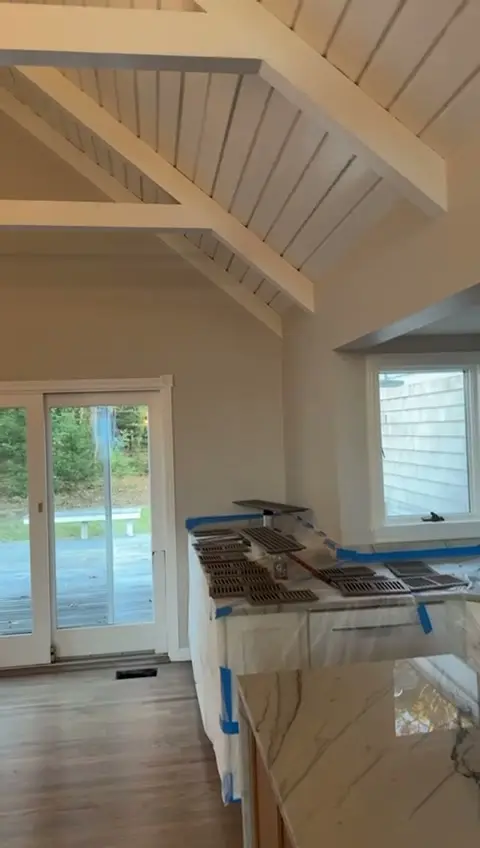
Interior painting, Milford MAWhat the age of a Milford house means for painting its rooms
Inside work starts with one question: when was the house built? The Census puts the median construction year of local housing at 1971, but that midpoint hides a wide spread. About 22.6% of housing units in town date from 1939 or earlier, while 36.2% were built in 1980 or later. Those two groups have different walls, different trim and different paint history underneath, and the prep plan should follow the building, not a one-size routine.
Whether you need one bedroom freshened or a full first floor redone, the sections below explain what changes from one era to the next and what to ask before work starts.
Plaster rooms in the older housing stock
A house from before the 1940s predates gypsum drywall becoming the standard wall material, so its walls and ceilings are likely plaster over wood lath. Plaster takes paint well when it is sound, but it shows its age in specific ways: hairline cracks that follow the lath, bulges where the keys behind it have let go, and old water stains near chimneys or under bathrooms.
Good prep here means cutting out and filling cracks with a setting compound rather than lightweight spackle, re-securing loose sections before they get skimmed, and spot-priming every patch so it does not flash through the finish coat. Ceilings deserve the closest look, because gravity works on loose plaster overhead.
The early-1900s duplexes and rowhouses of the Prospect Heights district, built by the Draper Corporation as company housing, fall into this period too; see our Prospect Heights page for more on that neighborhood.
Lead paint is a real factor, not a footnote
Of the roughly 11,600 housing units counted in town, 63.8% were built before 1980. The Census bracket ends at 1979, so it does not line up exactly with the 1978 federal cutoff for residential lead paint, but it gives a fair sense of how many homes may carry lead in older layers on trim, windows, doors and stair parts.
Under the EPA's Renovation, Repair and Painting rule, paid work that disturbs more than six square feet of paint per room in a pre-1978 home has to follow lead-safe practices: containment, controlled sanding or scraping, and specialized cleanup. Window replacement is covered regardless of size. Our lead-safe painting page explains what that looks like in an occupied house, which matters if young children or a pregnant family member live there.
Repainting 1960s, 1970s and 1980s homes
Census estimates put about 4,800 local units in the 1960s through the 1980s combined, three of the largest single-decade counts in the table. Rooms from that period are generally drywall rather than plaster, and after several decades they can show nail pops, mismatched touch-ups and flat paint that marks easily.
The common job here is a reset: setting popped fasteners, skim-coating rough patches, sanding glossy trim so new paint bonds, and choosing finishes that suit each room. Our interior paint finish comparison walks through flat, eggshell, satin and semi-gloss for walls and trim.
- Bedrooms and living rooms: a washable matte or eggshell hides drywall seams better than shinier finishes
- Kitchens and baths: satin or a moisture-resistant product where steam and splashes are routine
- Trim and doors: semi-gloss or satin, with oil-to-latex adhesion checked on older woodwork
- Ceilings: flat white or a tinted ceiling paint to reduce visible roller marks
Planning the work around your household
Interior painting happens in a lived-in space, so the plan should cover which rooms are emptied first, where furniture goes, and how long each room stays out of use. Indoor work does not depend on the weather, so it can be scheduled through fall and winter; our article on winter interior painting covers ventilation and drying when windows stay shut. If kitchen cabinets are part of the project, the cabinet painting page covers that separately.
Milford at a glance
| Median year built | 1971 (±2 years) (U.S. Census ACS 2020–2024 5-year, table B25035) |
| Built 1939 or earlier | 22.6% of housing units (2,623 of 11,627) (U.S. Census ACS 2020–2024 5-year, table B25034) |
| Built before 1980 | 63.8% of housing units (7,416 of 11,627) (U.S. Census ACS 2020–2024 5-year, table B25034) |
| Interior lead-safe threshold | More than 6 sq ft of paint disturbed per room, pre-1978 housing (U.S. EPA, Renovation, Repair and Painting Program) |