
Norwood, MA
Porch Floor, Steps & Railings in Norwood, MA
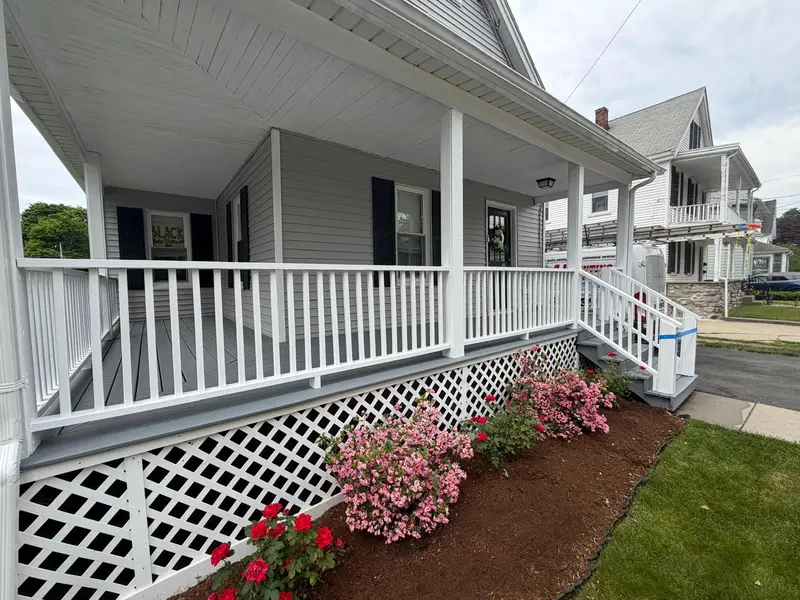
A Norwood home's front and back porches: floor boards and steps painted gray, with railings, balusters and lattice skirting in white.
See the photos →Washing, repairing and staining or painting decks, stairs, railings and porch floors, with the product picked for your wood and how much sun the yard gets.
Decks sit on yards, so the starting point is the lot. Single-family detached houses account for 55.5% of housing units in town, with another 8.6% in attached, townhouse-style buildings, 64.1% of units combined. Whether yours was built with the house or added later, the wood, the exposure and whatever coating is on it now decide what goes on next.
There is no single best deck stain for the town. There is a best choice for a sunny pressure-treated platform and a different one for a cedar deck under oaks, and they should not be treated the same way.
The Charles River runs into the center of town and is dammed to form Milford Pond, with Louisa Lake draining into it from the northwest. A 2020 restoration plan by the town and the Charles River Watershed Association measured the 1.5-square-mile Milford Pond subwatershed, which takes in the town center along Main Street, as 46% residential and 30% forested. That is one subwatershed, not the whole town, but it shows woods and house lots sharing the same ground even near the center.
Shade and moisture shape how a deck coating wears. Boards that stay damp under a canopy grow mildew and algae, and film-forming coatings on them tend to peel. Boards in full sun lose pigment and dry out at the surface. The same plan notes that the town has named both flooding and drought as challenges. That finding is about water management, not decks, but an outdoor wood coating does have to cope with both wet spells and dry ones.
What is already on the boards narrows the options. A penetrating stain cannot soak through an old solid stain or paint, so switching from a solid to a transparent look means stripping first. Our paint vs. stain comparison compares durability and upkeep.
With 63.8% of local housing units built before 1980, porches on older houses may carry decades of paint on floors, railings and columns. On a pre-1978 house, scraping more than 20 square feet of that paint outdoors brings in the EPA's lead-safe rules: ground sheeting, wet methods and careful collection of chips. See our lead-safe painting page.
Some porches have already been changed. The 1990 National Register nomination for the Prospect Heights district recorded cement steps with iron railings replacing original wood ones and some front porches enclosed. A tongue-and-groove porch floor is usually painted with a porch and floor enamel rather than stained, and every board end gets sealed so water does not wick in.
Stain lasts as long as the surface under it allows. Soft boards near the house, under planters and at stair treads should be replaced first. Then comes cleaning, a brightener on cedar or pressure-treated wood, sanding of raised fibers, and full drying. Application needs dry wood, mild temperatures and a clear forecast through the cure time, which in practice means late spring to early fall. For how winter affects each coating, read deck stain in a New England winter. If the siding needs paint as well, the exterior painting page explains that side.
| Single-family detached homes | 55.5% of housing units (6,454 of 11,627) (U.S. Census ACS 2020–2024 5-year, table B25024) |
| Milford Pond subwatershed land cover | 30% forested, 46% residential (subwatershed only) (Town of Milford and Charles River Watershed Association, Subwatershed Restoration Plan (2020)) |
| Climate challenges named by the town | Flooding and drought (Town of Milford and Charles River Watershed Association, Subwatershed Restoration Plan (2020)) |
| Exterior lead-safe threshold | More than 20 sq ft disturbed, pre-1978 housing (U.S. EPA, Renovation, Repair and Painting Program) |
These jobs were in other towns, not in Milford. Each card names the town where the work was done.
A Norwood home's front and back porches: floor boards and steps painted gray, with railings, balusters and lattice skirting in white.
See the photos →Clean off the growth with a deck cleaner, let the wood dry completely, and use a penetrating stain that contains a mildewcide instead of a thick solid stain. Trimming branches to let in light and air also helps the boards dry between rains.
It depends on the product and the exposure. Transparent stains on sunny boards may need renewing every year or two; solid stains last longer on vertical parts but can peel on walking surfaces. Railings usually outlast the floor.
Only by stripping the old solid stain and sanding, which is labor-heavy. If the boards are in good shape underneath, it can be done; otherwise recoating with a solid color is the practical choice.
Not without removing the paint, and on a house built before 1978 that removal falls under lead-safe rules. Repainting with a porch and floor enamel is usually the simpler route.
Square footage, stairs and railings, stripping and board replacement set the cost. Our Massachusetts deck staining cost guide lists market ranges, and AJ Painting gives a written price after a free visit to measure the deck.
Licensed and insured painter AJ Painting offers a free on-site visit and a written estimate. Reach us at (508) 258-4325, Monday–Saturday from 7AM to 6PM.
5.0 on Google · 35 verified reviews · Licensed & insured · Written quote in 48h