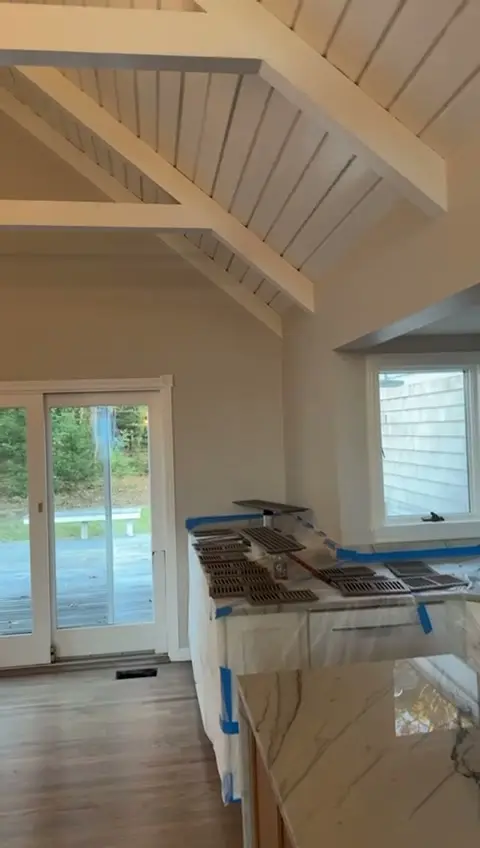
Interior painting, LynnRepainting rooms in a city where the typical house dates to 1946
Census estimates put the median construction year of Lynn's housing at 1946, and 17,360 of the city's 37,960 housing units (45.7%) were built in 1939 or earlier. Only 7.8% went up in 2000 or later. Indoors, that age can mean surfaces carrying many decades of coatings: trim painted over shellac or oil enamel, ceilings with hairline cracks, and walls that may be original plaster rather than drywall.
None of that rules out a clean, modern finish. It changes the order of work. Before any color goes on, each room needs an answer to three questions: does the old paint contain lead, is the wall surface sound, and will the new coat bond to what is already there.
Lead dust comes before color
By the same census tables, 78.1% of the city's housing units were built before 1980. The census groups construction years by decade, so that is the closest available stand-in for the pre-1978 cutoff that matters for lead paint. In any home built before 1978, the EPA's Renovation, Repair and Painting rule requires contractors whose work disturbs painted surfaces to be lead-safe certified and to contain and clean up the dust.
A 2019 Daily Item report counted 105 cases of Lynn children with elevated blood lead levels between 2012 and 2017, with only Boston, Brockton, New Bedford and Springfield reporting more in the state. That same year the city received $9.3 million from HUD, administered by Lynn Housing Authority and Neighborhood Development (LHAND), to delead more than 400 homes. Window stools, door edges and stair parts that rub or get sanded are common sources of that dust. Our lead-safe painting page covers containment, cleanup and testing in detail.
Plaster walls and old ceilings
Plaster damage tends to show up along ceiling cracks where the lath flexes, around door frames that get slammed, and under windows where moisture has crept in. Hairline cracks can be cut out, taped and filled. Plaster that has separated from the lath needs to be reattached before it is patched, or the patch will crack again within a season.
Ceilings deserve their own plan. Old calcimine or distemper coatings can make new latex peel off in sheets, so a flaking ceiling may need scraping and a sealing primer before any finish coat. A scratch test at a corner shows whether many old layers are still holding.
- Crack repair and skim coating on plaster walls
- Sealing primer over chalky or flaking ceilings
- Bonding primer over old oil and shellac trim
- Caulking gaps where trim has pulled away from the wall
What the house's era says about its trim
The Massachusetts Historical Commission's survey of the city describes several building waves: workers' side-hall houses on the streets between Western Avenue and Essex Street, with well-preserved examples in the Highlands and on the fringes of West Lynn; and, between 1915 and the mid-century, Craftsman bungalows and two-families around the Flax and Sluice Pond shores near Wyoma. Each era used different finishes.
Woodwork in an older house may carry oil enamel under the latex that came later, and latex applied straight over glossy oil tends to peel. Rubbing a hidden spot with denatured alcohol shows whether a finish is latex, which softens, or oil, which does not. In a bungalow, interior woodwork may have been stained originally; whether to paint it is the owner's call, but once paint is in the grain, getting back to bare wood is slow work.
Painting inside two-families and three-deckers
A third of the city's homes (32.5%) sit in buildings of two to four units, and renters occupy 51.9% of occupied homes. In those buildings, a unit may be painted while neighbors live above or below, or an apartment may be turned over between tenants. Shared front halls and back stairs can be scheduled separately so the apartments stay accessible.
If the building is an association, see our condo painting page; for kitchens, cabinet painting is quoted as its own scope.
Lynn at a glance