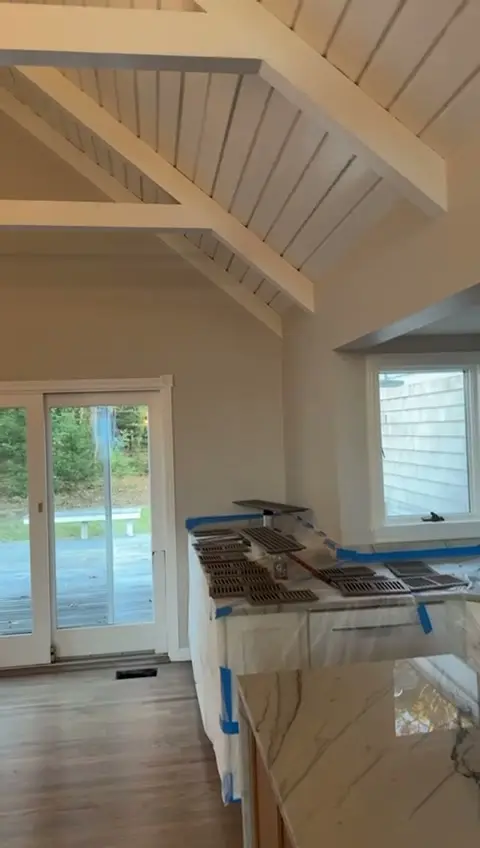
Interior painting, HolbrookPainting inside a Holbrook house: what the building's age tells you before the first coat
Census estimates put the median construction year of Holbrook's housing at 1957. The 1950s alone produced 1,571 of the town's 4,398 housing units, or 35.7%, more than any other decade in the table. Another 843 units (19.2%) date to 1939 or earlier, while only 218 (about 5%) were built in 1990 or later. For an interior job, that age profile decides what the walls are made of, what sits under the current paint, and how much repair comes before any color goes on.
The housing stock leans heavily toward detached, owner-occupied homes: 84.1% of units are single-family detached houses, and owners live in 84.0% of occupied units. The median unit has 6.2 rooms, a useful baseline when you list which spaces to include and in what order.
Plaster, drywall, or a mix of both
Houses from the middle of the last century can have plaster walls, gypsum board, or both, especially where a kitchen, bath or addition was redone later. A knuckle tap is a quick test: plaster sounds hard and solid, while drywall sounds hollow between the studs.
The two fail differently. Plaster tends to crack along lath lines and out from the corners of doors and windows, and sections that have let go of the lath need re-anchoring before any skim coat. Hairline cracks come back unless they are taped or bridged with a flexible filler. Drywall shows popped nails, lifted tape seams and dents, which get reset, filled and sanded. Every patch then needs primer, or the joint compound absorbs the finish differently and shows through as dull spots.
Lead dust is the indoor risk to plan around
According to the same Census table, 3,495 units, or 79.5%, were built before 1980. The decade bins cannot isolate 1978, the cutoff the federal lead rules use, but the number shows how many houses fall in or near that range. In a pre-1978 home, earlier coats under today's paint may contain lead, and sanding, scraping or cutting through them makes fine dust that settles on floors and sills.
Window sashes and sills, door edges and stair parts are where old paint gets rubbed and chipped by daily use, and they are also the surfaces prep work disturbs most. Under the EPA's Renovation, Repair and Painting rule, paid work that disturbs lead paint in a pre-1978 home must be done by a certified firm using certified renovators, with the room sealed off and cleaned and checked afterward. Our lead-safe painting page walks through that process.
Painting over lead paint manages it; it does not remove it. Owners who want it removed can look at the town's Get the Lead Out program, run by Holbrook Community Development, which offers low-cost loans toward deleading. The Holbrook Housing Rehabilitation Program adds 0% deferred-payment loans for income-eligible owners of Holbrook and Randolph properties with no more than two units.
Ceilings and trim
A flat ceiling paint hides the waves and trowel marks of old plaster better than any sheen. Brown rings from a past roof or plumbing leak bleed through ordinary latex, so they get a stain-blocking primer first; see our note on ceiling stains after ice-dam leaks.
Trim and doors in an older house may still carry oil-based enamel under later coats. Latex brushed straight over glossy oil can peel off in sheets, so the trim is cleaned, dulled with sandpaper and primed with a bonding primer. A cotton swab with denatured alcohol tells the two apart: latex softens and transfers, oil does not. Our latex vs. oil comparison covers the topcoat choice.
Planning the rooms
Furniture moves to the middle of each room under covers, outlet plates and hardware come off, and floors are protected before patching starts. Interior work runs year-round; in cold months, low-odor paints and short bursts of ventilation keep the house comfortable, as explained in our winter interior painting guide.
If the kitchen cabinets are part of the plan, the Holbrook cabinet painting page covers that separately, and siding and trim outside are on the exterior painting page. Either way, the first step is a free on-site visit and a written estimate.
Holbrook at a glance