
Norwood, MA
Porch Floor, Steps & Railings in Norwood, MA
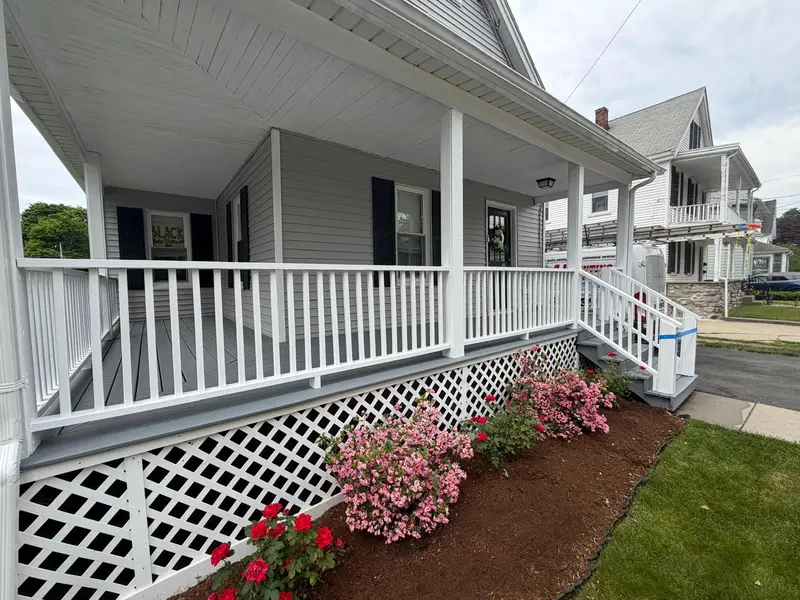
A Norwood home's front and back porches: floor boards and steps painted gray, with railings, balusters and lattice skirting in white.
See the photos →Decks, porches, railings and steps cleaned, repaired where needed and stained or painted on Holbrook properties.
Of the 4,398 housing units the Census counts in Holbrook, 3,699, or 84.1%, are detached single-family houses, and on a detached house any deck, porch or set of wooden steps is the owner's alone to maintain. Horizontal wood takes the hardest beating of anything on the property. Rain pools on it, snow sits on it, leaves rot on it, and boots wear the finish off the busiest paths first.
Staining a deck is mostly preparation. The coat itself goes on quickly; what decides whether it lasts is how clean, dry and sound the boards are underneath.
The Holbrook Town Forest covers about 115 acres of woodlands and forested wetlands, with oak, beech, maple, sassafras, hemlock and pine, and Hemlock Brook, a tributary of Cranberry Brook, flows through it. A deck sitting under similar trees deals with three things an open deck does not.
Oak leaves release tannins that leave dark blotches on wet wood. Pine needles and seed pods pack into the gaps between boards, hold water against the edges and feed rot. Shade keeps the surface damp longer after every rain, which lets mildew and green algae spread across the boards and railings.
The fix starts with clearing debris from the gaps, then a deck cleaner to kill and lift the growth, and an oxalic-acid brightener that removes tannin and gray weathering and brings the wood back toward its natural color. A pressure washer helps only on a low, wide setting; held close, it tears soft pine fibers and leaves a fuzzy surface that stains blotchy.
Pressure-treated pine is wet from the treatment when it is installed and has to dry before stain will soak in. Cedar is naturally rot-resistant and looks best with a translucent or semi-transparent stain that keeps its grain in view. Composite and PVC boards are cleaned, not stained; only their wood posts, rails or skirting take a coating.
A simple drop test tells you whether wood is ready: splash a little water on a few boards. If it sits on top in beads, stain will sit there too. If the wood soaks it up and darkens within a minute or so, it is ready for stain.
Penetrating stains, from clear through semi-transparent, soak into the wood and wear away gradually, so a later recoat needs cleaning but not scraping. Solid stain and porch paint form a surface film that hides mismatched or patched boards, yet that film eventually wears through on stairs and traffic lanes and then peels, and it has to be scraped and sanded before recoating. Once a deck carries a film, going back to a natural look takes stripping. Our deck paint vs. stain comparison goes through both.
Census figures show 843 housing units in town built in 1939 or earlier, and the federal government did not ban the sale of lead-based paint for home use until 1978. Painted porch floors, stair treads and railings on older houses may have lead in their lower coats, and those are exactly the surfaces worn by feet and weather.
Scraping them for pay falls under the EPA's lead renovation rule, which requires a certified firm, ground cover and careful chip cleanup. Our lead-safe painting page describes the process, and the house walls and trim beside the porch are covered on the Holbrook exterior painting page.
Stain needs dry boards, air and surface temperatures within the label's range, and a dry forecast long enough for it to soak in and set. As nights cool in the fall, that window narrows. Our post on deck stain and New England winters explains what cold does to a fresh coat, and why a deck cleaned in fall may be best stained in spring.
| Detached single-family homes | 3,699 of 4,398 units (84.1%) (U.S. Census ACS 2020–2024 5-year, table B25024) |
| Holbrook Town Forest | About 115 acres; oak, beech, maple, sassafras, hemlock, pine (Neponset River Watershed Association) |
| Hemlock Brook | Crosses the Town Forest; tributary of Cranberry Brook (Neponset River Watershed Association) |
| Units built 1939 or earlier | 843 (19.2% of units) (U.S. Census ACS 2020–2024 5-year, table B25034) |
These jobs were in other towns, not in Holbrook. Each card names the town where the work was done.
A Norwood home's front and back porches: floor boards and steps painted gray, with railings, balusters and lattice skirting in white.
See the photos →It could be mildew, tannin staining from wet leaves, or both. Mildew usually looks fuzzy or speckled and spreads in damp shade; tannin shows as dark blotches where leaves lay. A deck cleaner handles the growth and an oxalic-acid brightener lifts the tannin before staining.
Only once the boards pass the water-drop test. Freshly treated lumber is often too wet to absorb stain right away, and the drying time varies with sun, shade and weather, so testing beats counting weeks.
The loose film has to be scraped and sanded off those areas, the wood cleaned, and the deck recoated with the same type of product. If you would rather have a natural wood look, the whole film needs stripping first.
It depends on the product, the sun and the traffic, so there is no fixed schedule. Check every spring: when water stops beading and the high-traffic paths look worn, it is time for a cleaning and a fresh coat.
Composite and PVC decking is meant to be cleaned, not stained; follow the board maker's care guide. Wood rails, posts or lattice around it can still be stained or painted.
Deck size, railings and balusters, stairs, board repairs and whether old film must be stripped all shape the price. Our deck staining cost guide has Massachusetts market data, and a free visit ends with a written estimate for your deck.
A licensed, insured painter will check the boards, rails and stairs at no cost and give you a written estimate. Call (508) 258-4325, Monday–Saturday 7AM–6PM.
5.0 on Google · 35 verified reviews · Licensed & insured · Written quote in 48h