
Norwood, MA
Porch Floor, Steps & Railings in Norwood, MA
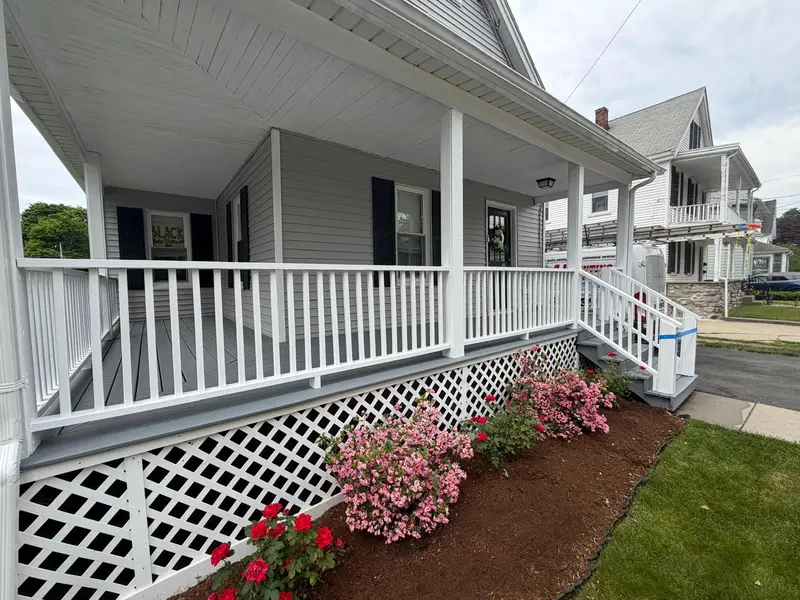
A Norwood home's front and back porches: floor boards and steps painted gray, with railings, balusters and lattice skirting in white.
See the photos →Siding, trim, porches and doors on Reading's wood-frame houses scraped, primed and repainted, with lead-safe prep on older homes and attention to historic district rules.
The National Register nomination for the town's historic resources puts it plainly: Reading "has traditionally built in wood, except for a few, usually public buildings." First Period houses are heavy timber frames sheathed in clapboards; some Greek Revival houses used flushboard siding; mansard-roofed Second Empire cottages date from the 1870s; Queen Anne and Colonial Revival houses followed in the late 1800s, then, less often, Craftsman and bungalow designs around 1910 to 1920.
On a house that still wears its original wood, the job is mostly about painted wood. Clapboards, corner boards, window casings, porch columns and shingled gables all expand, contract and take on moisture, and paint that can't keep up cracks and peels. The prep below is what keeps a new coat bonded.
With 26.9% of the town's housing units built in 1939 or earlier, many exteriors carry a long paint history. Our post on common exterior paint failures shows what blistering, alligatoring and cross-grain cracking say about the layers underneath.
The town has a local historic district under Chapter 40C, centered on West Street, where the first settlement stood and the militia mustered on April 19, 1775. Its design guidelines, updated in February 2024, say most exterior construction visible from a public way needs Historic District Commission review, but paint color and ordinary maintenance and repair are exempt.
The catch is in the definition: ordinary maintenance does not include replacing materials or changing design or size. Even swapping rotted clapboards in kind is replacement under that wording, so it is worth a call to the commission first; switching a wall to a different material clearly needs review. The guidelines discourage aluminum, vinyl and other synthetic siding and ask that deteriorated historic features be repaired rather than replaced.
The two National Register districts, around the Common and along Woburn Street, are a separate matter. The National Park Service says that listing places no federal restrictions or requirements on a private owner unless a project involves federal funding or permits, so the listing does not by itself regulate your paint job; state or local rules may still apply.
Three in four of the town's housing units (74.7%) were built before 1980, the closest census figure to the 1978 lead cutoff. On the outside of a pre-1978 house, the EPA's rule applies when paid work disturbs more than 20 square feet of paint. Ground sheeting, wet scraping, no open-flame burning and daily cleanup of chips keep that paint out of the soil and the garden. Details are on our lead-safe page.
The town has been a Tree City USA since 1985. Any wall under a heavy canopy dries slowly after rain and is where mildew and green algae show up first, so those elevations need a mildewcide wash and extra drying time before priming.
Paint needs dry wood and air and surface temperatures within the label's range, which in eastern Massachusetts usually rules out midwinter. Our posts on the best time of year to paint and painting in November go into the limits. For porches and decks, see deck staining and painting in Reading; for houses near the Common, see our downtown Reading page.
| Building tradition | "Has traditionally built in wood" (styles from the 1690s to the 1920s) (NPS, Reading Multiple Resource Area National Register nomination) |
| Local historic district (West Street) | Paint color and ordinary maintenance exempt from HDC review; synthetic siding discouraged (Town of Reading HDC Design Guidelines (updated Feb 22, 2024)) |
| Woburn Street Historic District | 16 late-19th-century houses, mostly Colonial Revival or Queen Anne; National Register 1985 (Wikipedia, citing the NRHP nomination and NPS NRIS) |
| Housing units built 1939 or earlier | 26.9% (2,679 of 9,951) (U.S. Census ACS 2020–2024 5-year, table B25034) |
| Tree City USA | Since 1985 (The Reading Post, April 16, 2025) |
These jobs were in other towns, not in Reading. Each card names the town where the work was done.
A Norwood home's front and back porches: floor boards and steps painted gray, with railings, balusters and lattice skirting in white.
See the photos →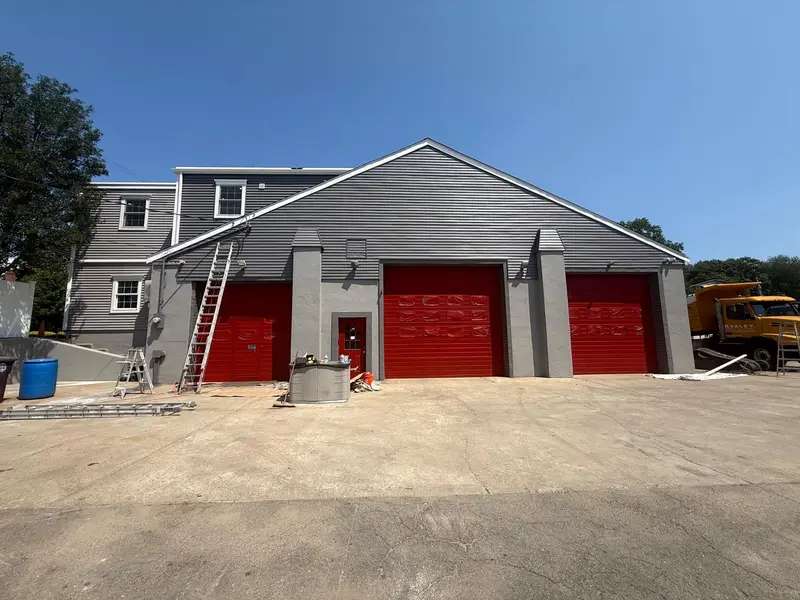
A garage building in Weymouth with white overhead doors and masonry pilasters whose paint was peeling. The doors and service doors were painted red and the pilasters refinished in gray.
See the photos →Not under the current guidelines, which exempt paint color from Historic District Commission review. Approval does come into play if the job grows into replacing trim, siding or porch parts with something of a different material or design, so raise any of that with the commission before work begins.
On its own, no. The National Park Service says listing places no restrictions on a private owner unless federal funding or permits are involved. The local district with review power is the one centered on West Street, so check which one your address falls in.
Outside the local district, that is your decision. Inside it, the guidelines discourage synthetic siding and prefer repair of historic features, and a change of material is not ordinary maintenance. Replacing only the failed boards with matching wood is the smaller change, though inside the district even that is worth confirming with the commission.
By the hours of prep and access as much as by wall area: how much paint has failed, how much rot needs repair, how many stories and how much trim detail the house has, and whether lead-safe setup is required. Our exterior painting cost guide reports Massachusetts market ranges; your written estimate comes from the free visit.
Green growth on a shaded wall is typically mildew or algae sitting on the surface, not a failure of the paint film. A wash with a mildewcide cleaner removes it, and a top coat with mildew-resistant additives slows its return. Peeling on that same side, though, points to moisture in the wall and is worth a closer look.
It depends on prep, product and exposure more than on a set number of years. Our post on how long exterior paint lasts in Massachusetts walks through what shortens and extends it.
AJ Painting is licensed and insured. Call (508) 258-4325, Monday to Saturday, 7AM–6PM, to book a free on-site visit and written estimate.
5.0 on Google · 35 verified reviews · Licensed & insured · Written quote in 48h