
Norwood, MA
Porch Floor, Steps & Railings in Norwood, MA
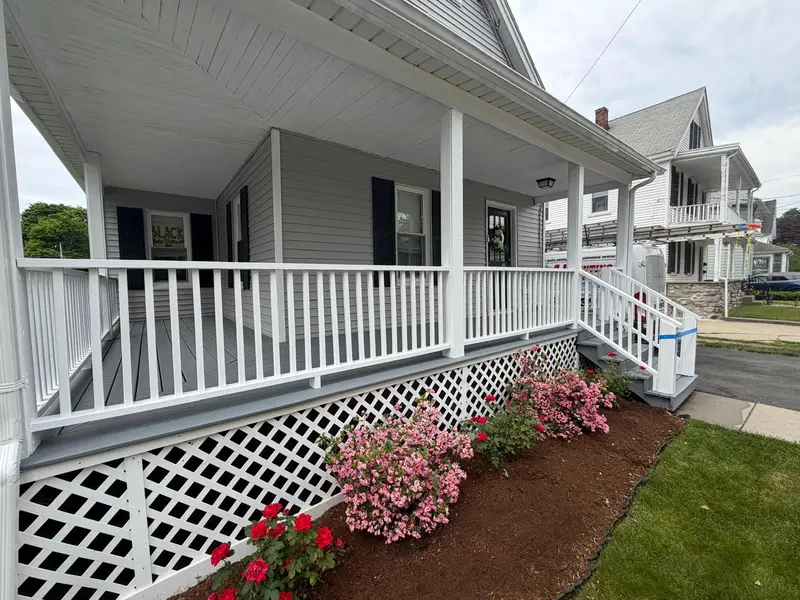
A Norwood home's front and back porches: floor boards and steps painted gray, with railings, balusters and lattice skirting in white.
See the photos →Decks, porches, railings and steps in Reading cleaned, sanded and stained or painted, with the product chosen for the wood and how much sun the deck actually gets.
Census figures count 71.2% of the town's 9,951 housing units as single-family detached houses, the kind of property where a backyard deck or a front porch is part of the house. Flat boards and rails take harder weather than siding does: standing water on flat boards, snow sitting for weeks, foot traffic and sun on the railings. A finish that suits a wall rarely lasts on a deck floor.
The right product depends on three things you can check yourself: what the boards are made of, how much direct sun they get, and how wet the ground under the deck stays.
The town has been a Tree City USA for 40 years, since 1985. Under a full canopy, a deck stays damp longer after rain, collects leaves and pollen in the board gaps, and grows mildew and algae. Those decks need a thorough clean with an oxygen-bleach or mildew-removing wash before any coating, and they do better with a penetrating stain than with a thick film that traps moisture.
The town's geography adds to that. The Ipswich River forms its northern boundary, and the National Register nomination for its historic resources notes extensive cedar swamps across much of the northern half of town. If your deck sits low over damp soil, ground moisture rises into the joists and the underside of the boards, and a coating on top alone can blister. Good airflow underneath and a breathable finish help.
A simple test tells you whether wood is ready: sprinkle water on a board. If it beads, the surface is not absorbing yet, either because the lumber is still wet or because an old sealer is still there. Transparent stains need recoating soonest; solid stains last longer on the boards but can peel, and once a solid stain peels, sanding back is the only clean way forward. Our paint vs. stain comparison goes further.
Census estimates date 74.7% of local housing units to before 1980, and a porch with painted floors, columns and balustrades on a house that old may carry decades of coatings. In a pre-1978 house, old porch paint may contain lead, and porch floors and steps wear it down into dust and chips. Paid scraping there follows the EPA's lead-safe rules for exteriors, with ground covering and careful cleanup. See our lead-safe painting page.
Inside the West Street local historic district, the guidelines exempt paint color and ordinary maintenance from review, so restaining or repainting an existing porch or deck is not a review item. New construction visible from a public way, or replacing wood parts with a different material, is a different question for the Historic District Commission.
Stain needs a dry deck, no rain for the drying window, and temperatures in the product's range, which limits work to the warmer months. The post on deck stain and New England winters explains what a winter does to a finish. If the house siding is due too, see exterior painting in Reading.
| Single-family detached homes | 71.2% of housing units (7,085 of 9,951) (U.S. Census ACS 2020–2024 5-year, table B25024) |
| Tree City USA | Since 1985 (40 consecutive years in 2025) (The Reading Post, April 16, 2025) |
| Water and wetlands | Ipswich River on the northern boundary; extensive cedar swamps in the northern half of town (NPS, Reading Multiple Resource Area National Register nomination) |
| Local historic district review | Paint color and ordinary maintenance exempt (Town of Reading HDC Design Guidelines (updated Feb 22, 2024)) |
These jobs were in other towns, not in Reading. Each card names the town where the work was done.
A Norwood home's front and back porches: floor boards and steps painted gray, with railings, balusters and lattice skirting in white.
See the photos →Until the boards absorb water instead of beading it, which for standard pressure-treated lumber can take weeks to a few months depending on the weather; boards labeled kiln-dried after treatment are ready sooner. Staining too early leaves the finish sitting on the surface, where it peels. The stain maker's label usually gives its own guidance.
A penetrating semi-transparent stain with a mildewcide, applied after a deep clean, usually copes better in shade than a solid stain or paint. Clearing leaves out of the board gaps and trimming back branches for some sun help as much as the product does.
Not over loose material; the new coat would peel with it. Failed areas are scraped and sanded to sound wood, and the whole floor is cleaned before recoating. If peeling is widespread, stripping back fully and switching to a penetrating stain is worth considering.
It turns on deck size, railings and stairs, the condition of the old finish and how much sanding or stripping it needs. The deck staining cost guide gives Massachusetts market ranges, and the free visit produces a written estimate for your deck.
Only after the paint is fully removed, which on an old porch means lead-safe stripping. In most cases, repainting with a porch-and-floor enamel is the practical choice, because a painted floor that has been scraped and primed will take a new coat without stripping.
Some composite products can take a coating made for them, but it changes the maintenance from washing to periodic recoating. Check the manufacturer's guidance first, since coating can affect a product warranty.
AJ Painting is licensed and insured. Call (508) 258-4325, Monday to Saturday, 7AM–6PM, for a free on-site visit and written estimate.
5.0 on Google · 35 verified reviews · Licensed & insured · Written quote in 48h