
Norwood, MA
Porch Floor, Steps & Railings in Norwood, MA
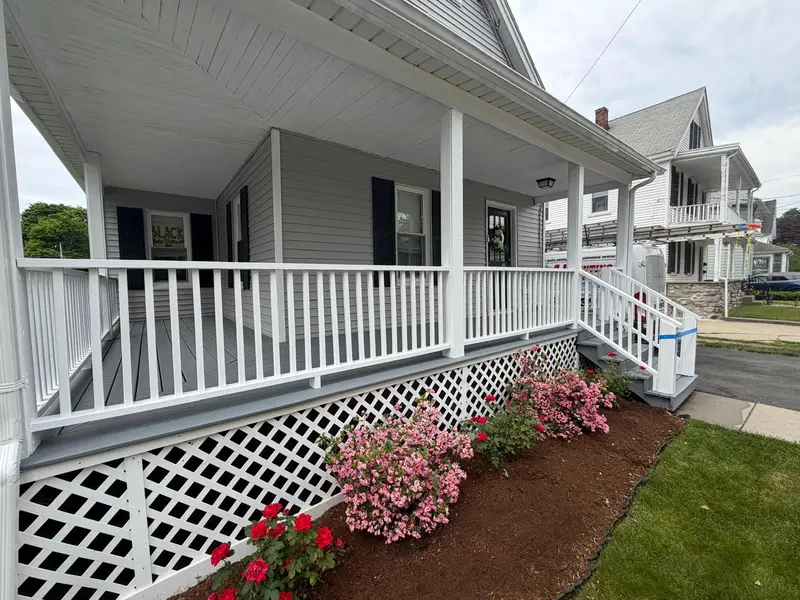
A Norwood home's front and back porches: floor boards and steps painted gray, with railings, balusters and lattice skirting in white.
See the photos →Siding, trim, windows, doors and outbuildings scraped, repaired, primed and painted for houses that range from 18th-century farmhouses to recent builds.
North Reading was settled as a farming community in 1651 and incorporated in 1853, according to the town's 2020–2030 Master Plan. Today it is mostly single-family homes: Census estimates count 73.7% of housing units as detached single-family houses.
The exterior job on a house depends on three things: the siding and trim it has, how much sun and moisture each wall gets, and how many layers of old paint are already on it.
The Massachusetts Historical Commission's 1981 survey of the town describes center-chimney houses from the mid-1700s, Federal houses around the town center, Harmony Vale and Park and Elm streets, and Greek Revival side-hall cottages from 1830 to 1875 that survive in good numbers. A house that old may carry many coats, and a thick paint buildup tends to crack and lift in sheets once it loses flexibility.
On those walls, preparation decides how long the next coat lasts: scraping to a sound edge, sanding feathered transitions, replacing split clapboards or rotted sills, priming bare wood the same day, and caulking only the joints that should be sealed. Painting over failing layers just adds weight to a film that is already letting go.
Census data shows 56.7% of the town's housing units were built before 1980. Exterior trim, porch columns and old clapboard on those houses can carry lead-based paint under newer coats. Scraping it outdoors still creates chips and dust that land in garden beds and lawns, so work on pre-1978 houses follows EPA's Renovation, Repair and Painting rule, with ground covering, wet scraping and daily cleanup. Our lead-safe painting page explains the requirements in Massachusetts.
The Master Plan notes that much of the town's undeveloped land is forested, that its wetlands are mostly red maple swamps, and that the entire town sits within the Ipswich River watershed, with Martins, Swan and Eisenhaure's ponds as the largest bodies of water. A house next to woods or wet ground can have walls that stay damp long after rain, especially on the north side.
Those walls are where mildew grows, paint blisters, and the bottom courses of siding rot first. Washing with a mildew cleaner, letting the siding dry fully, cutting back shrubs that touch the house, and choosing a paint with mildewcide address the cause. For a broader look at what goes wrong, see common exterior paint failures in Massachusetts.
The Master Plan places the Rev. Daniel Putnam House, the 1817 David Damon Tavern on Bow Street and the 1917 Batchelder School in what it calls the Center Village Historic District, near the Town Common at Park and Haverhill streets. The Putnam House on Bow Street and the John Bickford House on Elm Street are individually listed on the National Register.
National Register listing by itself does not restrict a private owner's paint colors. If your house is in or near the town center and you're planning a change in color or materials, ask the town's planning or historical commission office whether any review applies before work is scheduled.
Exterior paint needs dry wood and air and surface temperatures above the label minimum, both during application and overnight. In this part of Massachusetts that usually means late spring through early fall. Our post on the best time of year to paint explains the trade-offs, and painting exteriors in November covers late-season limits. For the deck or porch floor, see deck staining in North Reading.
| Single-family detached homes | 73.7% of housing units (4,371 of 5,933) (U.S. Census ACS 2020–2024 5-year, table B25024) |
| Built before 1980 | 56.7% of housing units (U.S. Census ACS 2020–2024 5-year, table B25034) |
| National Register houses | Rev. Daniel Putnam House (Bow St.); John Bickford House (Elm St.) (National Park Service NPGallery, NRIS 90000176 and 90000177) |
| Watershed | Entire town within the Ipswich River watershed (North Reading Master Plan 2020–2030 (MAPC, January 2020)) |
These jobs were in other towns, not in North Reading. Each card names the town where the work was done.
A Norwood home's front and back porches: floor boards and steps painted gray, with railings, balusters and lattice skirting in white.
See the photos →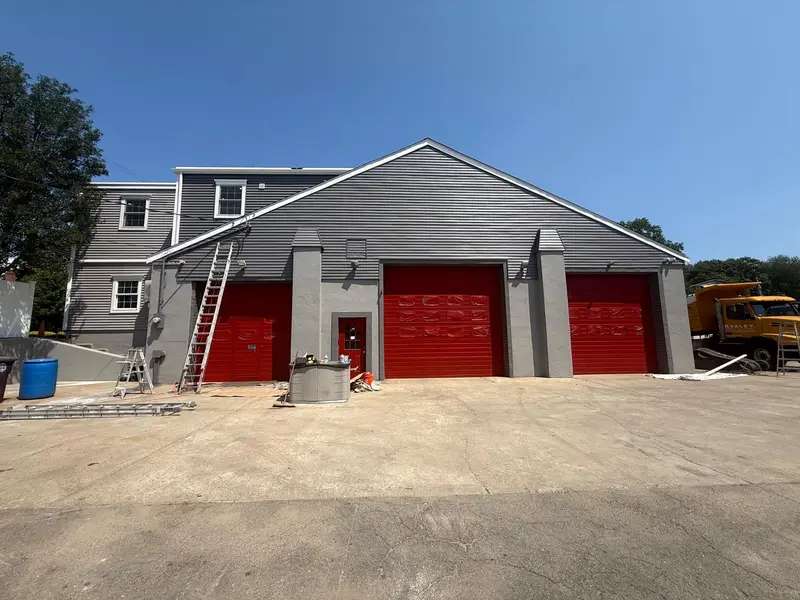
A garage building in Weymouth with white overhead doors and masonry pilasters whose paint was peeling. The doors and service doors were painted red and the pilasters refinished in gray.
See the photos →We couldn't confirm that the Center Village Historic District named in the town's Master Plan carries design review for paint. Before changing colors or materials on a house in that area, ask the town's planning department or historical commission whether any review applies.
That wall gets little sun, so it stays damp longer, and moisture behind or under the paint pushes it off. Check for gutters that overflow, shrubs against the siding, and missing or failed caulk at trim. Fixing the moisture source and letting the wood dry before repainting matters more than the brand of paint.
Full stripping is rarely needed. Removing loose and failing paint to a firm edge, then priming and repainting, is the usual approach. Where the layers have cracked across a whole wall, more aggressive removal may be justified. On a pre-1978 house, any of that work is done with lead-safe methods.
Yes. When the state surveyed the town in 1981, it found that a large number of small shoe shops from the 1800s and early 1900s still stood, some of them surprisingly intact. A weathered outbuilding like that may need wood repairs and primer on bare boards before paint, so it helps to have it listed as its own line on the written estimate.
The condition of the existing paint, the amount of trim and windows, access on steep or wooded lots, and carpentry repairs weigh more than the house's square footage. Our exterior painting cost guide explains Massachusetts market figures, and we give a written estimate after a free on-site look.
It depends on prep, product and exposure. A sunny south wall wears differently than a shaded one by the woods. Our post on how long exterior paint lasts in Massachusetts gives realistic ranges.
Licensed and insured, AJ Painting is based in Ashland. Reach us at (508) 258-4325, Monday through Saturday, 7AM–6PM, for a free on-site visit and written estimate.
5.0 on Google · 35 verified reviews · Licensed & insured · Written quote in 48h